 | Passage: Genesis 1-3
On Wednesday, February 23, 2011, Unmi wrote,
Having just read the 1st 3 chapters of Genesis, it just confirmed for me why we need to read the Bible (over and over again, year after year).
When the Serpent was deceiving Eve, he asked "Did God really say..."
When we face such questions in our lives, how are we to answer if we do not know what God said,
how are we to know, if we do not read His Word on a regular basis.
In order to fight deception and temptations in our own lives, we MUST know The truth that is revealed in God's words.
The entire conversation is very interesting;
God said “You are free to eat from any tree in the garden; but you must not eat from the tree of the knowledge of good and evil, for when you eat from it you will certainly die"
First the serpent wrongly quotes God by saying “Did God really say, ‘You must not eat from any tree in the garden’?”
Isn't that quite clever, he says God said something that He didn't, the question itself is a trick question.
In response, Eve actually adds to what God said by saying ‘You must not eat fruit from the tree that is in the middle of the garden, and you must not touch it, or you will die.’” Why did Eve add to what God said? We need to be careful in what we "add" to God's words. Many of the so called "Christian" cults either take away truth that is clearly revealed in the Bible (such as the Jehovah's witnesses) or add to it (such as the Morman's). Many of the heresys of the past as well as those to come in the future are based on deletions and additions to the TRUTH that God has already revealed.
So many Christians are looking for more than what God has already shown us. It comes under many different terms such as "a new annointing" or "new revelation." Many are not satisfied or content with what God has sufficiently revealed to us.
My prayer for our Church is that through this year's reading of the Bible, God will reveal Himself anew to each and every one of us, that as we learn with our "minds" the plan for redemption that God had for us from the very beginning of creation, that his knowledge will transform our "hearts" into the likeness of Jesus Christ.
Matt 22: 37-38
37 Jesus replied: “‘Love the Lord your God with all your heart and with all your soul and with all your mind.’ 38 This is the first and greatest commandment.
| |
|
| Passage: Genesis 4-7
On Wednesday, February 23, 2011, Unmi wrote,
The length of our life on earth is NOT a measure of God's blessing or of how righteously we lived on this earth.
Enoch who "walked with God" lived the shortest life among those recorded in the geneology before Noah.
Many times when we face the premature death of a person, we question WHY? "He was such a good man, why did God take him away?"
When a faithful follower of Jesus Christ leaves us, shouldn't we rejoice for the one who has gone to be with the Lord?
Did Enoch miss out on some of God's blessings because he lived a "short" life? I don't think so..He was BLESSED when God took him away!
As a believer, often I find my life here on this earth a difficult journey and I ask God, how much longer before you take me from this place?
Is it that I am not worthy to enter through His gates yet? Is there more that I need to do to prepare myself?
When these doubts about myself arise, I rest assured knowing that Christ died for my transgressions already, there isn't anything more that I need to do to enter His gates...Christ has done it all. We are saved through GRACE ONLY, not by works....
Perhaps we are still here because God is using us to fulfill His purposes in the lives of those around us. So we press on to live the life Christ has called us to live, to be the salt and light of this world as witnesses to the unending mercy and grace He gives us.
In the account of Noah, God says he was "a righteous man..."
What was it about Noah that made him "righteous" before God?
I think the answer is revealed in Noah's response to God's instructions;
"Noah did everything just as God commanded him."
It is obedience that God wants from us!!!
| |
|
| Passage: Genesis 8-11
On Wednesday, February 23, 2011, Unmi wrote,
My thoughts on Noah and his sons:
Noah's behavoir (his druckeness and nudity) caused his youngest son, Ham, to sin.
So I think to myself... Have my actions, what I say or do, caused someone else to fall into sin?
Lord, help me NOT to be a stumbling block for someone else, esp for my children!!!
With or without stumbling blocks, we are all individually accountable for our own actions.
The American mentality today is to blame someone else. This goes back to Adam with his reply to God. “The woman you put here with me—she gave me some fruit from the tree, and I ate it.” In his response, he not only blamed "the woman" but also blames God himself for putting the women there is the first place. We now live in a society full of victims; personal responsibility is nonexistent, but the Bible clearly teaches that we are each held individually responsible for our actions and even our thoughts.
Lord, help us see ourselves with your eyes and change our ways to conform to the likeness of Jesus Christ.
| |
|
| Passage: Genesis 12-15
On Friday, January 13, 2012, Unmi wrote,
Abraham thought that his wife was beautiful to the point that he feared for his life... However, as I read this again, I just realized that Sarai was a 65 year old woman. The Egyptians saw a 65 year old woman and thought that she was beautiful. WOW!!! How do we know that she was 65? Genesis 12:4 says that Abram was 75 years old when he departed from Haran. Genesis 17:17 shows us that Sarah was 10 years younger than Abraham.
However, even though the Egyptians only saw Sarah's outer beauty, God gives credit to Sarah for her inner beauty:
1 Wives, in the same way submit yourselves to your own husbands so that, if any of them do not believe the word, they may be won over without words by the behavior of their wives, 2 when they see the purity and reverence of your lives. 3 Your beauty should not come from outward adornment, such as elaborate hairstyles and the wearing of gold jewelry or fine clothes. 4 Rather, it should be that of your inner self, the unfading beauty of a gentle and quiet spirit, which is of great worth in God’s sight. 5 For this is the way the holy women of the past who put their hope in God used to adorn themselves. They submitted themselves to their own husbands, 6 like Sarah, who obeyed Abraham and called him her lord. You are her daughters if you do what is right and do not give way to fear. (1 Peter 3:1-6)
Peter says we (women) are to follow Sarah's example, submitting to our husbands, doing what is right, not giving way to fear, putting our hope in God...in this we will be found worthy and beautiful in the sight of God. | |
|
| Passage: Genesis 12-15
On Wednesday, February 23, 2011, Unmi wrote,
Perhaps the most important doctrine of our Christian faith comes from this section of Scripture:
Gen 15:6 "Abram believed the LORD, and he credited it to him as righteousness."
Some Biblical scholars even call this verse "The most important verse in the entire Bible".
This is the 1st mention in the Bible of faith being credited to someone as righteousness.
The doctrine of "Justification by Faith" is not New Testament theology that was developed by Paul.
Paul talks of Abraham's faith extensively in Romans Chapter 4.
Abram was declared righteous before he was cicumcisized, before the law was given to Moses, solely based on his faith in God.
Romans 4:22-25:
This is why “it was credited to him as righteousness.” The words “it was credited to him” were written not for him alone, but also for us, to whom God will credit righteousness—for us who believe in him who raised Jesus our Lord from the dead. He was delivered over to death for our sins and was raised to life for our justification.
In Galatians, Paul counters the Judaizers (Jews who claimed to be Christian who were trying to get new Gentile believers to submit to the Laws of Moses). Paul says through Galatians 3:11 Clearly no one who relies on the law is justified before God, because “the righteous will live by faith.”
In the above Galatians verse, Paul was quoting from Habakkuk 2:4
“See, the enemy is puffed up;
his desires are not upright—
but the righteous person will live by his faithfulness
God said this to Habakkuk when Habakkuk was complaining of all the injustice and wickedness of his time. God tells Habakkuk that "in his time" he will bring justice...in the meanwhile, we are to live by faith.
Habakkuk 3:17-18 is one on my favorite verses in the Bible. Although oppressed by injustice and wickedness, Habakkuk says:
Though the fig tree does not bud
and there are no grapes on the vines,
though the olive crop fails
and the fields produce no food,
though there are no sheep in the pen
and no cattle in the stalls,
yet I will rejoice in the LORD,
I will be joyful in God my Savior.
Whether we live in times of prosperity and material blessings or through times of injustice and personal loss, God wants us to remain faithful to him and wait upon the Lord because in his time, he will answer the cries of his people. How many years did Abraham wait before God finally blessed him with the promised heir... 25 years!!!
BOTH for the Jews and the Gentiles justification comes by faith. The God of the Old Testament and the New Testament is the same God, unchanging and everlasting. It is because of this, we are able to trust him. | |
|
| Passage: Genesis 16-18
On Wednesday, February 23, 2011 (Last Updated on 1/14/2012), Unmi wrote,
My thoughts on the three visitors and pending judgement on Sodom:
At the end of our reading today, judgement on Sodom is pending and the inhabitants of the city are not even aware. Only Abraham knows what is about to happen....what does Abraham do? He intercedes for them.
Isn't the same situation occuring right now. We live in a wicked and ungodly world. Many are not aware that judgement is coming (or at least they choose not to believe). But we have the word of God and we know that the time of judgment WILL come for all inhabitants of this earth. Just as Abraham, we also need to intercede for the lost, we need to pray for God's mercy and patience.
Yujin adds... One caveat to this is that Abraham likely prayed for Sodom because his nephew Lot was there. This is also why he kept challenging God with the notion of God's destroying the righteous with the wicked. When he keeps asking about how many righteous people would need to be there before God would preserve the city, he was likely trying to guess how many righteous people were in Lot's group. We later discover that God preserves Lot and his immediate family for the sake of Abraham (Genesis 19:29). | |
|
| Passage: Genesis 19-21
On Wednesday, February 23, 2011 (Last Updated on 1/15/2013), Unmi wrote,
The story of Lot is another intriguing account. In Lot we see an example of a "carnal" believer. A man who knows God, but wants to live "in the world." Lot and his family lived in the city where not even 10 righteous people were found, so they surrounded themselves with unrighteous people and essentially had no fellowship with those followed their God. We see how both Lot and his daughter's morality have been compromised by influences from the society they were living in. The biggest problem with Sodom was sexual immorality.
For Lot, he offers his daughters to the Sodomites for sex in order to protect his house guests...
For his daughters, they get their father drunk and have sexual relations with him to have children "as is the custom all over the earth." Were the loose sexual inclinations of Lot and his daughters influenced by the society they lived in?
Does where we live, who we "hang out" with, influence our thinking, our behavoirs?....YES it does.
Even as a believer, if we keep exposing ourselves to the morality of this world, it will corrupt us.
When I see "Christians" embrace homosexuality as a norm, embrace "choice" over "life,"
I see those who have allowed "the world" to corrupt their morality. They are allowing "the world" to tell them what is right and wrong instead of using God's standard.
The importance of Christian fellowship can not be overstated. It's not just about "eating and playing" together, but about encouraging each other to remain faithful, praying for each other esp during times of trial, and even rebuking each other (in love) when one of us falls astray...
Yujin comments... These are excellent applications. But just so that we might not mischaracterize Lot, Abraham's nephew, as "carnal" just because he lived in a wicked city, let us consider the testimony of the apostle Peter regarding him and his time there:
if he condemned the cities of Sodom and Gomorrah by burning them to ashes, and made them an example of what is going to happen to the ungodly; and if he rescued Lot, a righteous man, who was distressed by the depraved conduct of the lawless (for that righteous man, living among them day after day, was tormented in his righteous soul by the lawless deeds he saw and heard)— if this is so, then the Lord knows how to rescue the godly from trials and to hold the unrighteous for punishment on the day of judgment (2 Peter 2:6-9).
So Peter calls Lot righteous and indicates that he was ceaselessly tormented in his soul by all the unrighteousness around him. He likely regretted his decision to choose this fertile land for his group rather than the less fertile ones, which may not have been filled with such evil people. What is more, it is likely that God rescued Lot not simply because he was Abraham's nephew but because he was among the less than ten righteous in the city.
Even so, the point that society and culture influences our morals and behavior is certainly true. This is one of the reasons why God told the people of Israel to completely destroy the idolatrous Canaanites from the Promised Land. Otherwise, they would influence them to forget God and worship their idols. | |
|
| Passage: Genesis 22-24
On Wednesday, February 23, 2011, Unmi wrote,
The story of Abraham's test is difficult to comprehend from a human perspective. As good parents, would be shocked if God asked us to sacrifice any of our children. We would even question the very Goodness of God. How could a good god ask us to do such a thing? Why? For what purpose?
For Abraham, Isaac was the fulfillment of God's promise. Is God going back on His word? It totally doesn't make sense. As I was thinking about this, I realized my thinking was narrow. I ask these questions because I limit what God can do, I limit his abilities. Abraham had a much broader understanding of the omnipotence of God. In early chapters in Genesis, God tells Abraham that it is through Isaac that he will establish an everlasting covenant.
Genesis 17:19
Then God said, “Yes, but your wife Sarah will bear you a son, and you will call him Isaac. I will establish my covenant with him as an everlasting covenant for his descendants after him.
Genesis 21:12
But God said to him, “Do not be so distressed about the boy and your slave woman. Listen to whatever Sarah tells you, because it is through Isaac that your offspring will be reckoned.
After making these promises, God now asks Abraham to sacrifice Isaac. There is only two ways to go from here, either God will NOT keep His covenant and Isaac will die or God WILL keep his covenant even after Abraham sacrifices Isaac. How will God keep His covenant? God would have to be able to raise Isaac from the dead....
Heb 11:17-19
By faith Abraham, when God tested him, offered Isaac as a sacrifice. He who had embraced the promises was about to sacrifice his one and only son, even though God had said to him, “It is through Isaac that your offspring will be reckoned." Abraham reasoned that God could even raise the dead, and so in a manner of speaking he did receive Isaac back from death.
Even though I have read Genesis and Hebrews separately numerous times, this is the 1st time I saw this connection. It never made sense to me (1) why God would ask Abraham to sacrifice Isaac and (2) why Abraham obeys God's instructions without question.
God asked Abraham to do this as a test of his faith. Abraham obeys because he trust that God is not only WILLING but ABLE to keep his promises. Abraham didn't ask the "WHY?" question because he believed God would keep his promises even if Isaac was sacrificed! That is why Abraham is the Father of Faith.
Do we trust that God is not only willing but able when it concerns our own lives?...The truth is that there are times when I doubt His WILL and at times when I doubt His ABILITY to overcome difficult situations...
Lord, help us to have the faith of Abraham!!!
| |
|
| Passage: Genesis 25-26
On Monday, January 17, 2011, Unmi wrote,
One thing stood out for me in this section of reading.
Gen 25:21: Isaac prayed to the LORD on behalf of his wife...
That is so beautiful! I have personally known many couples who struggled with infertility issues and know how devastating it can be. There is no account of how Rebekah felt, but we can just imagine how distraught she may have felt. One thing I find interesting is that Isaac did not go outside of his marriage to have children, instead Isaac prays for his wife. How blessed Rebekah was that she has a faithful praying husband who could intercede for her. It is so beautiful that it brought tears to my eyes today as I was reading....
I too am thankful for my husband and count myself truly blessed by the Lord because I know he prays for me regularly. A husband who prays for his wife shows where his heart is and this is more valuable to a wife than his physical attributes, his mental prowess or his financial status.
I encourage all of you husbands to pray and intercede for your wives...it is a beautiful sight before the Lord!!!
| |
|
| Passage: Genesis 25-26
On Monday, January 21, 2013, Unmi wrote,
Did Isaac and Rebekah have the "perfect" marriage?
Everything started off beautifully in this God ordained marriage. Both Isaac and Rebekah were obedient in marrying the spouse that God had chosen for them. In the early part of their marriage, they loved each other, prayed for each other...but then what goes wrong in this perfect marriage?
Just as we have all experienced in our own marriage, sin enters the picture. As the story of Jacob's deception unfolds, each is out for their own interest. We see the picture of what we would now call a dysfunctional family. There is no thought about the "other" person, let alone any consideration for God's will.
Instead of thinking that our marriage would have been better if we had just married the right person, perhaps we should concentrate on how we can transform our marriage by the renewing of our minds by not conforming to the expectations of this world (Romans 12:2), but by patterning our lives after God's standard that is revealed to us through prayer and meditation on His Word.
| |
|
| Passage: Genesis 27-29
On Wednesday, February 23, 2011 (Last Updated on 1/18/2013), Unmi wrote,
Gen 29:20 So Jacob served seven years to get Rachel, but they seemed like only a few days to him because of his love for her.
It is a beautiful picture of first love...When we first fall in love, everything is easy to do, whether it is the falling in love with a person or falling in love with God. When I first became a believer in college; praying, reading the bible, going to church, bible studies...everything was easy and exciting. There was no hard work in it. I couldn't get enough to fill my thirst to know God more and more! Then what happens, as time passes, the things we used to do for our loved one becomes more and more difficult and even sometimes burdensome.
What about God? Does His love for us also grow dim with time?
Lamentations 3:22 says "The steadfast love of the Lord never ceases, His mercies never come to an end"
Isn't it reassuring to know that the love of God is NOT like ours, its doesn't wax and wane, it doesn't change with the cicumstances, it is not even dependant on us at all. Not only is God's love steadfast, nothing can separate us from his love.
Romans 8:38-39 For I am convinced that neither death nor life, neither angels nor demons,neither the present nor the future, nor any powers, neither height nor depth, nor anything else in all creation, will be able to separate us from the love of God that is in Christ Jesus our Lord.
As he is steadfast, let us remain steadfast and persistent in loving the Lord. | |
|
| Passage: Genesis 30-31
On Wednesday, February 23, 2011, Unmi wrote,
Isn't it always greener on the other side.
Leah had many sons, but didn't have the love of her husband;
Rachel had the love of her husband, but didn't have children....
So what does Rachel do to try to remedy this situation:
(1) she demands Jacob to give her children, he tells her "Am I..God?"
(2) she gives Jacob her maidservant to give her children which works, but still doesn't satisfy her desire to have her own...
(3) she allows Leah to sleep with Jacob in exchange for Reuban's mandrakes. (This sound similiar to Esau giving his birthright to Jacob in exchange for a bowl of soup) What is the significance of mandrakes? In ancient times, it was used as a fertility aid. This of course was a failure as well, because it was Leah who conceived that night....
But what I find amazing, is that "some time later...God remembered Rachel; he listened to her and enabled her to conceive." This happens just before Jacob flees from Laban. While leaving, Rachel steals her father's household gods. God already knew that Rachel would do this but still blessed her with a son, not any ordinary son, but Joseph who would one day be as powerful as Pharoah and the son who would have the love of his father, Jacob.
Despite our inpatience and transgressions, God hears the cry of His people, and is still willing to bless.
What a mighty, forgiving and gracious God we have! | |
|
| Passage: Genesis 32-34
On Wednesday, February 23, 2011, Unmi wrote,
It seems that throughout Jacob's life he is wrestling with someone. It begins in the womb as he fights with Esau and even grabs onto Esau's ankle during childbirth, his battle with Esau regarding birthright and blessing, his struggles with Laban for his wives and against unfair wages...
Now he wrestles with a unnamed man in the middle of the night, as dawn approaches neither is willing to give up on the struggle, so the man touches Jacob's hip to cause him to become cripple. Experiencing this supernatural touch, Jacob comes to realize that he is not wrestling with no ordinary man but God himself, Jacob declares "I saw God face to face, and yet my life was spared."
This is remarkable event, Jacob says it was God that he was wrestling with. Was this a spritual fight in his dreams or a physical fight? Jacob walks away with a limp showing this indeed was physical in nature. In any case, whether spiritual or physical, Jacob's wrestling with God doesn't end here. Throughout the history of the nation of Isreal, their struggle with God continues...
What I find interesting is that the struggle could have ended at anytime in the night with a simple touch, however, God allowed it to continue throughout the night...Why? Many times we ourselves struggle with God as we ask for answers to tough questions (the Why questions), when God doesn't seem to be listening or answering our prayers...Is God allowing us to continue in this struggle as a means of building perseverance and character in us?
Whether our life is easy or a continuous struggle from begining to end...
...we know that in all things God works for the good of those who love him, who have been called according to his purpose. (Romans 8:28)
Blessed be the name of the Lord who knows what is good for us and helps us to persevere in our struggles.
| |
|
| Passage: Genesis 35-37
On Friday, January 21, 2011, Unmi wrote,
As I read today's section of Eat the Word, Reuben caught my attention. We see two different sides of Reuban's character...
In Chapter 35, After Rachel's death, Reuben sleeps with Rachel's maidservant, Bilhah and defiles his father bed. It says that Jacob heard about it, but the Scripture doesn't say he did or said anything about it. So I am thinking...how could Reuban do such a thing, what a treacherous son! But then, in Chapter 37, It is Reuben who tried to save Joseph from the brothers who wanted to kill him. "Reuben said this to rescue him from them and take him back to his father." From what is written, it appears he was trying to save Joseph for his father's sake. Reuben was thinking about his father's well being? What a good son!! Why this turn around? Was Reuben remorseful about what he had done earlier? Perhaps his father's silence regarding the matter may him feel more and more guilty? In any case, there is no further recordings of any further wrongdoing on Reuben's part for the rest of the book of Genesis. At the end, however, in Chapter 49, no matter how good he tried to be, because of what he did with Bilhah, Reuben does lose the rights of the firstborn when Jacob gives out his blessings to his children.
Like Reuben, none of us have or will live a perfectly righteous life. No matter how "good" we are, there is always at least one thing that separates us from the Holy One...for all have sinned and fall short of the glory of God (Romans 3:23) But we have this hope...our final judgement, is NOT based on what we did, but based on the righteousness of Jesus Christ and what HE DID.
Matthew 26:27-28 Then he took a cup, and when he had given thanks, he gave it to them, saying, “Drink from it, all of you. This is my blood of the covenant, which is poured out for many for the forgiveness of sins.
Thank you Jesus because you poured out your blood so that I may receive forgiveness for my sins, so that I may be called a child of God and receive the blessing of eternal life. Amen
| |
|
| Passage: Genesis 38-40
On Wednesday, February 23, 2011, Unmi wrote,
What I like about the story of Joseph and Potipher's wife is what Joseph said to her:
Gen 39:9 “How then could I do such a wicked thing and sin against God?”
A lot of times, we think about how we wronged someone else, or how they wronged us...we forget that ultimately, the sin was against GOD himself. Joseph had the right perspective and I think it is this perspective that can help us when we face temptations.
Such as in the case of adultery, if a husband or wife only thinks about their spouse, it can be easy to justify their actions (my husband doesn't love me anyway, my wife doesn't respect me, my marriage is dead already....), however, if we think about God and how what we do and say can be sinful before God's sight, I think we would think twice...
Hebrews 12:1Therefore, since we have so great a cloud of witnesses surrounding us, let us also lay aside every encumbrance and the sin which so easily entangles us, and let us run with endurance the race that is set before us, 2fixing our eyes on Jesus, the author and perfecter of faith, who for the joy set before Him endured the cross, despising the shame, and has sat down at the right hand of the throne of God.
Thank you Lord Jesus because You will perfect my faith as I keep my eyes upon You! Amen.
| |
|
| Passage: Genesis 41-42
On Wednesday, February 23, 2011, Unmi wrote,
The sovereignty of God is a controversial topic even among Christians. However, when I read this section, it is the first thing I think of...Even before Abraham had his promised son, God told him:
Gen 15:13-14
Then the LORD said to him, “Know for certain that for four hundred years your descendants will be strangers in a country not their own and that they will be enslaved and mistreated there. But I will punish the nation they serve as slaves, and afterward they will come out with great possessions.
So the beginning of the fullfillment of this starts with Joseph in Egypt.
Every step of Joseph's life: the preferential treatment by his father, the envy of his brothers, the Ishmaelites traveling to Egypt, the imprisonment because of Potiphar's wife, the cupbearer/baker's dreams, Pharoah's dream, the famine that eventually brings all of Isreal's sons to Egpyt are all a series of events that were ordained by God to bring about the fullfillment of his plans. Even nature itself with the 7 years of plenty and 7 years of famine all submit to the will of God.
Does God simply have foreknowledge of what man will do or does he intervene in the affairs of mankind to bring about His predetermined plans? I do not believe that God is a bystander just watching what man does, I believe He is an active player, but if we proclaim that God is an active player, (and not just an active player, but the main player) in the affairs of mankind, many cry out "It's not fair!" Why does He choose one and not another? Why does God bless one and condenm another?
Romans 9: 11-21
Yet, before the twins were born or had done anything good or bad—in order that God’s purpose in election might stand: not by works but by him who calls—she was told, “The older will serve the younger.” Just as it is written: “Jacob I loved, but Esau I hated." What then shall we say? Is God unjust? Not at all! For he says to Moses,
“I will have mercy on whom I have mercy,
and I will have compassion on whom I have compassion.”
It does not, therefore, depend on human desire or effort, but on God’s mercy. For Scripture says to Pharaoh: “I raised you up for this very purpose, that I might display my power in you and that my name might be proclaimed in all the earth." Therefore God has mercy on whom he wants to have mercy, and he hardens whom he wants to harden.
One of you will say to me: “Then why does God still blame us? For who is able to resist his will?” But who are you, a human being, to talk back to God? “Shall what is formed say to the one who formed it, ‘Why did you make me like this?’" Does not the potter have the right to make out of the same lump of clay some pottery for special purposes and some for common use?
As I was dead in my transgressions and sins, I thank the Lord for intervening, for having mercy and compassion and giving me new life in Christ.
| |
|
| Passage: Genesis 41-42
On Wednesday, February 23, 2011 (Last Updated on 1/17/2013), Unmi wrote,
Gen 41: 15-16
Pharaoh said to Joseph, “I had a dream, and no one can interpret it. But I have heard it said of you that when you hear a dream you can interpret it.” “I cannot do it,” Joseph replied to Pharaoh, “but God will give Pharaoh the answer he desires.”
It is so easy for us to take pride in our individual gifts and talents. We like to take credit for our achievements, and we quickly forget God... However, in this passage we see that Joseph has the right perspective. He knew that his gift was from the Lord and gives credit to God...Let us follow in Joseph's footsteps and ackowledge the Lord in the gifts and talents he gives us...
We not only need to acknowledge that our gifts and talents come from the Lord, we also need to understand for what purpose they were given...Was it only for our own benefit? Are we being selfish in how we use our abilities?..or maybe the opposite, Are we hiding our gifts? and burying in the ground like the 3rd servant in the Parable of the Talents (Matthew 25). Will the Lord call us "wicked and lazy" as the master said to the 3rd servant?
This past HC meeting, we were asked "how do you want to serve your church this year?". Let us take this question seriously.
Romans 12:6-8
We have different gifts, according to the grace given to each of us. If your gift is prophesying, then prophesy in accordance with your faith; if it is serving, then serve; if it is teaching, then teach; if it is to encourage, then give encouragement; if it is giving, then give generously; if it is to lead, do it diligently; if it is to show mercy, do it cheerfully.
Let us use our God-given talents and abilities to serve Him, to serve His church, to serve one-another, to serve those who do not know Him yet...for what purpose? so that every tongue will confess that Jesus Christ is Lord. Let us bring glory and honor to His name. | |
|
| Passage: Genesis 46-47
On Wednesday, February 23, 2011, Unmi wrote,
Whenever I previously thought of Egpyt, I always had toughts about God destroying an ungodly nation. The only image I had of Egpyt was the plagues that God brought upon the Egyptians as the Isrealites left. But I forgot that it was God that brought this nation to its height as well. The Lord made Pharoah prosper through the revelation that God himself gave Pharoah. At the end of this section, Pharoah owned EVERYTHING in the entire land. And so it is... the rise and fall of all nations, whether godly or ungodly, is under the Sovereign direction of the Lord.
As President Obama gives his State of the Union address tonight, we have to be mindful that he is NOT the one in control of the course of this nation. He as well as every leader of this nation answers to God whether they like it or not. Because we know that the Lord is in control, we do need to pray for our nation and its leaders.
This does NOT mean that we stay out of the political process, the Lord has been gracious to us in allowing us to live in a country where its citizens can help shape the course this nation. When I think about the many who live without any political rights in oppressive countries, it seems sinful for Americans not to vote...
Let's shake off this apathy and actively take part in the political process through voting, but always keeping in mind that our true "citizenship is in the heaven" (Philippians 3:20) | |
|
| Passage: Genesis 48-50
On Wednesday, February 23, 2011, Unmi wrote,
When I see Jacob passing on his prophetic blessings to his children, I thought WOW, isn't that great, but then some of the "blessings" are not so favorable...Even though we don't have a prophetic gift, I think we also pass our "blessings" to our children, both good and bad. Children so easily pick up both the good and bad habits of their parents. They see what we DO as well as what we SAY. We all want our children to grow up and become faithful followers of Jesus Christ, my biggest fear in raising my children is that I personally may be a hindrance to their faith. I pray as they grow up and mature even further that their faith is NOT based on what I do or say, but based on what Christ did and said.
Do our children see us as their provider?
Do our children come to us for comfort?
Do our children fear us when they do something bad?
This is all good and appropriate when they are young children, but as they mature, Let us help our children to look to Jesus as their provider, as their comforter, as their God and Savior!
When I pass on from this life, I want my children to remember my God more than they remember me. | |
|
| Passage: Exodus 1-3
On Wednesday, February 23, 2011, Unmi wrote,
Being in the medical profession, the story of the midwives stuck out for me. "The midwives, however, feared God and did not do what the king of Egypt had told them to do; they let the boys live."
A personal (long) testimony:
While attending medical school, I decided that I wanted to be become an OB-GYN (obstetrics-gynecology). Since I was thinking of medical missions work, I thought OB-GYN would be a great field, to provide women's health care for the underserved as well as help in the delivery of babies...Great, right? I thought so too, but God had other plans for me...
During my 4th year of medical school, I went to Korea for 2 months and interned at an Ob-GYN office, I was shocked by what I learned. For every 1 baby delivered, 4-5 were being aborted by Korean women and these weren't promiscuous teenagers or rape victims, they are married Korean women who were using abortion as a form of birth control or for sex preferences of the child. My naive thinking that this profession was about delivering babies came to an abrupt halt....Most American women are not having abortions as a form of birth control or for sex preferences, however, there is still a lot of abortions being performed in the USA. American Christians tend to focus on "elective abortions" such as those performed by Planned Parenthood, but many of these abortions are consider "therapeutic" abortions because of birth defects detected during prenatal testing. Not only abortions, there are a lot of other moral and ethical issues...I remember seeing an 11 year old girl who was pregnant...quite disturbing!
Even with these personal experiences in mind, I still decided to pursue my career decision. I reasoned to myself that I would be a "Christian" Ob-Gyn, that I won't performed morally objectionable procedures, and went about applying for residency programs. I had excellent grades in medical school and great recommendations and was confident (a "bit" arrogant) that I would get into any program that I wanted. Since my husband was going to attend dental school in Maryland, I applied to EVERY residency position in the area....BUT I didn't get into ANY program, even the ones that I was "overqualified" for...WHAT!!!! I was so upset. How could God let this happen to me? I was doing this for God, wasn't I.. maybe?
When I look back now, I THANK God that He closed the doors for me. I think God knew me better than I knew myself..if I went into this field, I would have made compromises, I woud have used excuses to justify my work...In my current field I see a lot of people dealing with end of life issues and am able to provide not only medical advice but also spiritual counseling which is the part that makes my work the most rewarding. I don't have to compromise my personal beliefs in the performance of my duties which in itself is a true blessing. This experience helped me realize that God shuts doors for a reason, sometimes we don't know why and may never know why, but we do need to trust Him when it does occur.
When I was pregnant with my three children, I refused to have the "triple screen" which is a blood test that screens for common birth defects such as down syndrome. My OB thought I was crazy especially since I was already in the medical field. It's only a blood test, "there's no harm in it", however, I disagreed. If the test comes back negative, that's good, but what about if it were to come back positive? Would I have a "therapeutic" abortion? I told my OB that I would not abort my child in ANY case and therefore testing would not be necessary and a positive test would only cause me undue anxiety during the pregnancy. I would accept whatever child the Lord gives me with or without birth defects.
We recently saw the Nick Vujicic video at church about the man with no arms or legs, he hard an unbelievably difficult childhood, but NOW God is using him in a mightly way to proclaim the gospel throughout the world..I can't help think that if sonography was available to his parents during pregnancy, whether he would be here today. Most definately the doctors would have recommended "terminating the pregnancy" and 99.99% of parents would have accepted this recommendation.
I also think about when I was pregnant with my third child, the ultrasound showed that it was a "girl". I can't help to think about how many babies are being terminated in Korea and China because they only wanted a boy. Stephen and I were shocked to have another son when our baby "girl" was delivered.
The Hebrew midwives had it right, doing what is right before the Lord comes before everything else. Sometimes doing the right thing comes at a tremendous cost, these costs are not always monetary as in the case of a child with a birth defect and we each have to ask ourselves how much are we willing to "pay."
I have to admit that I have not always made the "right" decision. Many times I do what is "right" in my eyes instead of what is right before God. If we take the example of the midwives, it appears that if we do the right thing that we will be rewarded. Yes, we will be rewarded but it is not always earthly rewards, and so at times our decisions result in personal sacrifice or suffering and persecution..so isn't that the dilemma that we all face. It seems that we fear more the "present time" than the eternal judgement that is to come.
Lord, help me to be bold and courageous, to do what is right before Your eyes! | |
|
| Passage: Exodus 4-6
On Tuesday, February 22, 2011 (Last Updated on 1/28/2012), Unmi wrote,
"Please send someone else”
Isn't that what we are all silently saying to God...Moses had a miraculous encounter with God, God spoke audibly to him and if that wasn't enough, he even performed miraculous signs right before his eyes, but what did Moses say... "please send someone else." Many of us say that if God gave us a direct personal revelation to go into ministry, then we would do it. If God told us to go off to the mission field, then we would go. If God told us to sell our possessions to do whatever, then we would..so here we are waiting to "hear" directly from God. If we really did hear from God, would we really go? or would we be like Moses "please send someone else." Perhaps God is not talking to us directly because He already knows what our response would be...I think we should really think about where our heart is before we accuse God of not clearly communicating His will for our lives.
In any case, I believe that God has already spoken directly to us through the Scriptures, I do not believe a personal or special revelation from God is even necessary. My prayer for each of us this year as we read through His Word is that we would each individually come to understand what is God's will for us (which I think we will learn as we continue to read...)
Romans 12:2 Do not conform any longer to the pattern of this world, but be transformed by the renewing of your mind. Then you will be able to test and approve what God’s will is—his good, pleasing and perfect will. | |
|
| Passage: Exodus 7-9
On Tuesday, February 22, 2011, Unmi wrote,
Egyptian magicians also did the same things by their secret arts...
When I see the Egyptian magicians doing the same thing as Moses, I see where discernment becomes an essential part of Christian living.
There are many people out there who are performing miraculous signs, who are prophesizing, who are healing, and even those who claim that they have raised people from the dead, but are ALL these from the Lord? Many of them claim that the Lord gave them these "gifts" but to be honest I question whether that is true...As we approach the End Times, I fear that there will be more and more "false prophets.". I am concerned that many Christians won't be able to discern the difference when wolves come in sheep's clothing.
Matthew 7: 15-23
15 “Watch out for false prophets. They come to you in sheep’s clothing, but inwardly they are ferocious wolves. 16 By their fruit you will recognize them. Do people pick grapes from thornbushes, or figs from thistles? 17 Likewise, every good tree bears good fruit, but a bad tree bears bad fruit. 18 A good tree cannot bear bad fruit, and a bad tree cannot bear good fruit. 19 Every tree that does not bear good fruit is cut down and thrown into the fire. 20 Thus, by their fruit you will recognize them.
21 “Not everyone who says to me, ‘Lord, Lord,’ will enter the kingdom of heaven, but only the one who does the will of my Father who is in heaven. 22 Many will say to me on that day, ‘Lord, Lord, did we not prophesy in your name and in your name drive out demons and in your name perform many miracles?’ 23 Then I will tell them plainly, ‘I never knew you. Away from me, you evildoers!’
It is not the one who performs miraculous signs, but the one who does the will of God (whether they perform miraculous signs or not) that are true children of God. The Egyptian magicians were able to perform miraculous signs, but it was Moses who was doing the will of God.
We are all familiar with "To obey is better than sacrifice" similiarly
Lord, help us to OBEY you more than chase after miraculous signs and wonders.
| |
|
| Passage: Exodus 10-12
On Tuesday, February 22, 2011 (Last Updated on 1/30/2012), Unmi wrote,
600,000 thousand men, that's a lot of people! Assuming an equal amount of women, then that's 1.2 million men and women. If we add children and the elderly, then likely over 2 million total polulation. I just can't imagine seeing 2 million people walking out of Egypt, it's an incomprehensible amount.
Genesis 46, says 70 not counting their wives entered Egpyt 430 years prior to their exodus.
The current world population growth rate is approx 1.2% per year. At a rate of 1.2%, the population would have only been 17,000 after 430 years, but they had over 2 million [Yujin comments: Annual pop. growth rate of about 2.42% would achieve this; so 2x current rate], what tremendous growth they had during the time they spent in Egypt.
I am amazed how God keeps the promise to make Abraham's decendents as numerous as the stars in the sky. Imagine the Egyptians seeing all these Isrealites leaving their land, even without the miraculous signs, just seeing this alone would have made me think What a mighty God they have! and So, What a mighty God we have! What do we have to fear! Is anything out of the control of our God? Absolutely nothing! | |
|
| Passage: Exodus 13-15
On Tuesday, February 22, 2011 (Last Updated on 1/17/2013), Unmi wrote,
Genesis 8:1: God remembered Noah
genesis 19:29: he remembered Abraham
Genesis 30:22: Then God remembered Rachel
Exodus 2:24:God heard their groaning and he remembered
Exodus 6:5: I have remembered my covenant
Now in this section of Scripture what does God ask the Isrealites to do?
To remember what God has done for them and teach the future generations about the mighty hand of God.
What I think is interesting when Moses wrote the 1st five books to the generation that was about to enter the Promise Land, he did not only record the good things but even the bad/evil things that were done by the Patriarchs. Why did he record even the bad? The purpose of this recorded history was to give GOD the GLORY, not man!!! | |
|
| Passage: Exodus 16-18
On Tuesday, February 22, 2011, Unmi wrote,
In this section we see the Israelites interact with distant relatives. The Amalekites were a descendent of Esau.The Midianites were a descendent of Abraham. By now, both the Amalekites as well as the Midianites probably heard about the mighty hand of God that delivered the Isrealites from bondage, but they react completely differently.
The Amalekites came and attacked the Israelites
Jethro was delighted to hear about all the good things the LORD had done for Israel
(now Jethro doesn't necessarily represent the Midianites as a whole, but it is an interesting comparison.)
Similarly, when "friends" tell us about the good things that God has done for them, how do we react?
Are we jealous and envious, just waiting for them to fall or
Are we truly delighted to hear the good things the Lord has done for them?
My prayer for our church is that we would be the kind of brothers and sisters that truly delight when we hear good things that the Lord has done for another. Let us share our joys in the Lord with each other so that we can praise the Lord together!!! | |
|
| Passage: Exodus 19-21
On Tuesday, February 22, 2011, Unmi wrote,
Throughout Galatians and Romans, Paul talks extensively about the Abrahamic covenant as well as the the Law (the Mosaic covenant).
The Abrahamic covenant was an unconditional covenant of land, descendents and blessing. The blessing in this covenant did not apply to Abraham alone, but God says that through Abraham He will bless all the peoples of the earth (that includes us). God promises to bless Abraham and this promise is not dependent on Abraham to perform some kind of duty, the only thing Abraham was to do is believe, and so it says that Abraham was credited with righteousness because of his belief, and because of this, he is known as the father of faith...
Genesis 12:1-3 The LORD had said to Abram, “Go from your country, your people and your father’s household to the land I will show you.
“I will make you into a great nation,
and I will bless you;
I will make your name great,
and you will be a blessing.
I will bless those who bless you,
and whoever curses you I will curse;
and all peoples on earth
will be blessed through you."
Genesis 12:7 The LORD appeared to Abram and said, “To your offspring {seed}I will give this land.”
Genesis 15:6 Abram believed the LORD, and he credited it to him as righteousness.
Up until now, the Isrealites were living waiting for God to fullfill his Promises to Abraham. Now in this section, a new covenant is established. The Mosaic covenant is different than the Abrahamic covenant because it is conditional, there is an If..Then...This covenant requires the Isrealites to fully obey the Law that is about to be given. The blessing to follow was dependent on whether they are able to fully obey the Law or not....
Exodus 19:5-6 “ Now if you obey me fully and keep my covenant, then out of all nations you will be my treasured possession. Although the whole earth is mine, you will be for me a kingdom of priests and a holy nation."
So the questions is:
Does the new Mosaic covenant make the Abrahamic covenant obsolete?
Is the Abrahamic covenent no longer valid since a new covenant is now being established?
What if the Isrealites are unable to keep the Law that God requires, do they lose out on everything including the promises made to Abraham?
Why did God give such a covenant when He knew the Isrealites wouldn't be able to keep their part of the deal?
Paul tells us in Galatians:
Galatians 3:15-19
Brothers and sisters, let me take an example from everyday life. Just as no one can set aside or add to a human covenant that has been duly established, so it is in this case. The promises were spoken to Abraham and to his seed. Scripture does not say “and to seeds,” meaning many people, but “and to your seed," meaning one person, who is Christ. What I mean is this: The law, introduced 430 years later, does not set aside the covenant previously established by God and thus do away with the promise. For if the inheritance depends on the law, then it no longer depends on the promise; but God in his grace gave it to Abraham through a promise. Why, then, was the law given at all? It was added because of transgressions until the Seed to whom the promise referred had come...
In other words, the covenant God made with Abraham is an everlasting covenant and the "seed" promised to Abraham is Jesus Christ himself. It is through Abraham's seed, Jesus, that all the nations of the earth will be blessed. From the beginning, it was always JESUS through whom all blessings flow.
So then why establish the law? It was because of transgressions (sin), so that we may be conscious of our sinful nature,
Romans 3:20 Therefore no one will be declared righteous in God’s sight by the works of the law; rather, through the law we become conscious of our sin.
When we come to know how unrighteous we are, we come to truly appreciate who Christ is and what Christ did for us.
Romans 8:1-4
Therefore, there is now no condemnation for those who are in Christ Jesus, because through Christ Jesus the law of the Spirit who gives life has set you free from the law of sin and death. For what the law was powerless to do because it was weakened by the flesh, God did by sending his own Son in the likeness of sinful flesh to be a sin offering. And so he condemned sin in the flesh, in order that the righteous requirement of the law might be fully met in us, who do not live according to the flesh but according to the Spirit.
I truly believe that we must know what it is that we profess to believe. How can we defend our faith if we do not understand. When we read the Old testament, it seems like it has nothing to do with us today, however, it has everything to do with us. It was through Abraham, who lived 2000 years before Christ, that God promised to bless all the people of the earth. God's plan for our redemption was already in place even before Christ was born. Isn't that amazing!!!
| |
|
| Passage: Exodus 22-24
On Tuesday, February 22, 2011, Unmi wrote,
Moses then wrote down everything the LORD had said.
It is amazing that God had planned all this from the beginning. The Isrealites were all under slavery in Egypt, how many of them could read or write? God picked baby Moses of all the Isrealites and had him live under Pharaoh where he was undoubtably educated, instructed on reading and writing, for this very purpose to write down the words of God for future generations!!!
This reminds me of the famous line in Ester "For such a time as this"
Mordecai is trying to persuade Ester, a Jewish woman who was one of King Xerses' queens, to beg and plead for mercy for the Jews who were about to be annihilated. Ester uses excuses for why she can't, and Mordecai tells her that even if you don't do this, the deliverance of Jews will come about another way for this is God's will, but could it be that you are in your current position precisely for THIS very reason.
Ester 4:12-14
When Esther’s words were reported to Mordecai, he sent back this answer: “Do not think that because you are in the king’s house you alone of all the Jews will escape. For if you remain silent at this time, relief and deliverance for the Jews will arise from another place, but you and your father’s family will perish. And who knows but that you have come to your royal position for such a time as this?”
Even for us, our upbringing, our education, our profession, our living in a free country, all of this is not by a random sequence of events. God has place each of us exactly where he wants us, so now we each need to ask ourselves: for what purpose? and are we willing to be obedient?
| |
|
| Passage: Exodus 25-27
On Tuesday, February 22, 2011, Unmi wrote,
The Ark housed 3 items:
1) the tablets of the covenant law (the ten commandments)
Exodus 25:21...put in the ark the tablets of the covenant law that I will give you.
2) a pot containing an omer of manna
Exodus 16: 34: As the LORD commanded Moses, Aaron put the manna with the
tablets of the covenant law, so that it might be preserved.
3) Aaron's rod that budded, blossomed and produced almonds
Numbers 17:10: The LORD said to Moses, “Put back Aaron’s staff in front of the ark of the covenant law,
to be kept as a sign to the rebellious...
The Ark is mentioned later:
1. when the Isrealites cross the Jordan River, the river stops flowing as soon as the feet of the priests carrying the Ark touches the water's edge, therefore allowing the Isrealites to cross over the Jordan River.
2. during the battle of Jericho, they carried the Ark around the city for 7 days blowing trumpets
3. it was captured by the Phillistines, but caused tumors and death to the people, so they gave it back...
4. David tried to move it to Jerusalem, this is when Uzzah was killed on the spot because he touched the Ark to prevent it from falling off the cart.
5. once Soloman's temple was built, it was finally placed in the Holy of Holies, where the high priest came before it only once a year (Yom Kippur) to offer blood sacrifice as an atonement for the nation's sin. (at that time, only the tablets of the covenant law were inbox)
6. it is unknown what happened to the Ark when the Babylonians destoyed the temple...it has become the famous "Lost Ark" of the Indiana Jones movie.
The Ark was the most sacred religious object to the Jews. It represented God's throne on earth, it was where God's presence was manifested, it was the center of worship, and it was the place where the Jews went to seek forgiveness of sins.
What does this have to do with us as Christians today? The Ark is no longer necessary. We now have the indwelling of the Holy Spirit within us, our body is the temple of the Holy Spirit. We no longer have to go to a specific place to communicate with the Lord, and with regards to the atonement of sins, we no longer have to make animal sacrifices as Christ himself was the sacrificial Lamb whose blood atoned for all our sins once and for all.
| |
|
| Passage: Exodus 28-29
On Tuesday, February 22, 2011, Unmi wrote,
I had long wondered, what is an Ephod? It is easier for me to think of it as an apron that goes over the priests robes....Something of interest is that there is a Jewish organization called the Temple Institute that is advocating for the rebuilding of the 3rd Temple.
The 1st temple was built by Solomon, destroyed by the Babylonians, the 2nd temple was build during Nehemiah's time after returning from their exile and destroyed in 70 AD, there has been no Jewish temple since 70 AD. (Many orthodox Jews believe that the actual Third Temple will be built by the coming Messiah who will reinstate the sacrificial system of worship) Apparently this organization has already spent over 27 million dollars rebuilding many of the sacred ojects that are needed for the Temple, including the garments for the high priest and the breastplate made of precious stones which have the names of the 12 tribes of Israel engraved on them. It is interesting to think what all this will lead to in the "End Times"......of note, they have NOT rebuilt of Ark of the Covenant, they apparently believe it is still hidden under the original Temple Mount.
| |
|
| Passage: Exodus 30-32
On Tuesday, February 22, 2011, Unmi wrote,
As I read this section, I find the actions of Aaron quite disturbing. Since Moses is up on the mountain, Aaron is the leader of the people, the man who is to be their high priest, however, I see him giving in too quickly to the demands of the people for an idol. What I find interesting is that after he makes the golden calf, he says "These are your gods, Israel, who brought you up out of Egypt.” He doesn't say they are the same gods as the Egyptians or the Canaanites; he tries to associate the golden image to the "LORD" himself. So in effect, he compromises the true worship of God with a man-made version, a version that is pleasing to the people. As I see this happening, I can't help to think about the many Christian leaders out there that are compromising the true faith with a watered down version, a perverted version or versions that please people, instead of staying true to a faith that pleases GOD!! I can't help to think of the popularity of the "prosperity gospel" where God is essentially a magic genie that gives you what you want. WHAT happened to the "fire and brimstone" sermons that stressed the importance of REPENTENCE?! These are, of course, NOT very popular.
When I think about what we are to believe about God, who He is, how He works, what He does, when He will fulfill his promises, I come from a standpoint that we should believe what GOD has said, what he has revealed to us in the Bible…whether it makes sense or not, whether it is popular or not, whether it is fair or not, whether it is convenient or not…Our tendency to water down our faith has made America a “laughingstock” to the rest of the world. "Moses saw that the people were running wild and that Aaron had let them get out of control and so become a laughingstock to their enemies." We in America are known to the rest of the world as a Christian nation, but isn’t it sad what foreigners think about America. What is America associated with? Immortality, materialism, selfishness disguised as “individuality,” indifference disguised as “tolerance.”
As Moses intercedes for Aaron, God does relent in his anger and Aaron does go on to became the 1st high priest of Isreal. When I see how quickly Aaron sinned in this section, I question how effective he would be as the high priest who intercedes for the sin's of his people...But how marvelous that we have a faithful, sinless high priest that intercedes for us!
Therefore, since we have a great high priest who has ascended into heaven,Jesus the Son of God, let us hold firmly to the faith we profess. For we do not have a high priest who is unable to empathize with our weaknesses, but we have one who has been tempted in every way, just as we are—yet he did not sin. Let us then approach God’s throne of grace with confidence, so that we may receive mercy and find grace to help us in our time of need. --Hebrews 4:14
Who then is the one who condemns? No one. Christ Jesus who died—more than that, who was raised to life—is at the right hand of God and is also interceding for us. --Romans 8:34
| |
|
| Passage: Exodus 33-35
On Tuesday, February 22, 2011, Unmi wrote,
I thought the following was sort of amusing as I read:
Then the LORD said to Moses, “Go down, because your people, whom you brought up out of Egypt (Exodus 32:7)
But Moses sought the favor of the LORD his God. “LORD,” he said, “why should your anger burn against your people, whom you brought out of Egypt with great power and a mighty hand? (Exodus 32:11)
Then the LORD said to Moses, “Leave this place, you and the people you brought up out of Egypt (Exodus 33:1)
Moses said to the LORD...Remember that this nation is your people (Exodus 33:12-13)
Then the LORD said: “I am making a covenant with you. Before all your people I will do wonders never before done in any nation in all the world (Exodus 34:10)
God and Moses keep going back and forward saying "your" people that "you" brought out of Egypt, seemingly neither one of them wanted to take ownership of the Isrealites....It is not until Leviticus 11 that God says:
I am the LORD, who brought you up out of Egypt to be your God; therefore be holy, because I am holy (Leviticus 11:45)
and what does God say about us, are we his people?
But you are a chosen people, a royal priesthood, a holy nation, God’s special possession, that you may declare the praises of him who called you out of darkness into his wonderful light. Once you were not a people, but now you are the people of God; once you had not received mercy, but now you have received mercy. (1 Peter 2:9-10)
As he says in Hosea: “I will call them ‘my people’ who are not my people; and I will call her ‘my loved one’ who is not my loved one," and, “In the very place where it was said to them, ‘You are not my people,’ there they will be called ‘children of the living God.’” (Romans 9:25-26)
Thank you Lord that you have chosen us and call us "my people," "my loved one." | |
|
| Passage: Exodus 36-38
On Tuesday, February 22, 2011, Unmi wrote,
Exodus 36:3-7: And the people continued to bring freewill offerings morning after morning...and said to Moses, “The people are bringing more than enough for doing the work the LORD commanded to be done.” Then Moses gave an order and they sent this word throughout the camp: “No man or woman is to make anything else as an offering for the sanctuary.” And so the people were restrained from bringing more, because what they already had was more than enough to do all the work.
Exodus 38: 24 The total amount of the gold from the wave offering used for all the work on the sanctuary was 29 talents and 730 shekels, according to the sanctuary shekel. (that is equivalent to 1 ton of gold, which would be worth approx $43,000,000, gold price today is $1350/ounce). 25 The silver obtained from those of the community who were counted in the census was 100 talents and 1,775 shekels,according to the sanctuary shekel— (that is equivalent to 3.4 tons and 44 pounds of silver which would be worth $3,100,000, silver price today is $29/ounce)
WOW!!! The golden calf that they made earlier was only the tip of the iceberg...Where did all this gold and silver come from? Exodus 12:35 The Israelites did as Moses instructed and asked the Egyptians for articles of silver and gold and for clothing. 36 The LORD had made the Egyptians favorably disposed toward the people, and they gave them what they asked for; so they plundered the Egyptians. ("plundered" seems to be an understatement)
The shear amount that the Isrealites had is amazing, however, what is more amazing is that they were willing to offer that and more to the work of building a santuary for the LORD. Their offering wasn't just their material possessions, it also included their skills: Exodus 36:2...every skilled person to whom the LORD had given ability and who was willing to come and do the work. This "willingness" to use our abilities as well as our material resources is a test of where our heart is, for the LORD looks at the heart of those who serve and give.
1 Corinthians 9:7 Each of you should give what you have decided in your heart to give, not reluctantly or under compulsion, for God loves a cheerful giver.
What a witness we would have to the rest of the world if everyone in our church was giving and serving to the point that the church leadership had to "restrain" us...Is it really that impossible?...It is nice to think about (and hope for), however, if we preseverate on it, it can lead down a dangerous road of accusing others of NOT doing what they should...if we look at what others are NOT doing, that itself can be a stumble block for us individually. Yes, we should encourage each other to do good, but must remember that we each individually stand before the throne of God on the day of judgement. Let's examine our own hearts instead of looking at others....
| |
|
| Passage: Exodus 39-40
On Tuesday, February 22, 2011, Unmi wrote,
Today's reading
Exodus 39...as the LORD commanded Moses...appears 8 times
Exodus 40...as the LORD commanded Moses...appears another 8 times.
Exodus 40:33-34...And so Moses finished the work. Then the cloud covered the tent of meeting, and the glory of the LORD filled the tabernacle.
The Lord had already given all the specific instructions to Moses earlier, it seems that this section is more about obedience, how "Moses did everything just as the LORD commanded him." It was only after these specific instructions were followed did the glory of the LORD fill the tabernacle.
What I find interesting is that this new Tabernacle (and later the Temple) will be the center of the Jewish sacificial system. Moses and the Isrealites did a great job in obeying the exact building instructions for the tabernacle and its content, but later place more importance on the ritualistic practices of worship than what God truly delights in, which is obedience. In Exodus 40, It was because of obedience that God's glory filled the tabernacle, even before any sacrifices were offered in the Tabernacle.
In 1 Samuel 15, the prophet Samuel tells Saul to completely destroy the Amalekites, "Do not spare them; put to death men and women, children and infants, cattle and sheep, camels and donkeys." However, Saul did not follow the instructions completely, he spared Agag and the best of the animals. "Then the word of the LORD came to Samuel: “I regret that I have made Saul king, because he has turned away from me and has not carried out my instructions.” When Samuel confronts Saul, he says “But I did obey the LORD,” Saul said. “I went on the mission the LORD assigned me. I completely destroyed the Amalekites and brought back Agag their king. The soldiers took sheep and cattle from the plunder, the best of what was devoted to God, in order to sacrifice them to the LORD your God at Gilgal.”
But Samuel replied:
“Does the LORD delight in burnt offerings and sacrifices
as much as in obeying the LORD?
To obey is better than sacrifice,
and to heed is better than the fat of rams.
For rebellion is like the sin of divination,
and arrogance like the evil of idolatry.
Because you have rejected the word of the LORD,
he has rejected you as king.”
I am so glad that we are reading "the word of the LORD" together for how can we obey what we do not know. Let us continue faithfully in what we have committed ourselves to do this year so that we may become obedient servants of Christ Jesus, our LORD and SAVIOR.
| |
|
| Passage: Leviticus 1-4
On Tuesday, February 22, 2011, Unmi wrote,
Of the different kinds of offerings, the burnt offering was special in several ways:
1. It is the only offering that is completely offered (completed burnt up) to the Lord (except for the skin).Leviticus 1:8...and the priest is to burn all of it on the altar. For all the other offerings, only the fat portions were given to the Lord, the rest was consumed by the priest and offerers.
2. The fire of the burnt offering was to be maintained continuously, day and night. Leviticus 6:13: The fire must be kept burning on the altar continuously; it must not go out.
3. It is mentioned as far back as Noah. Genesis 8:20-21:Then Noah built an altar to the LORD and, taking some of all the clean animals and clean birds, he sacrificed burnt offerings on it. The LORD smelled the pleasing aroma and said in his heart: “Never again will I curse the ground because of humans, even though every inclination of the human heart is evil from childhood. And never again will I destroy all living creatures, as I have done. (In Genesis 4, Although Abel also made an offering to the LORD, he only gave the fat portions from some of the firstborn of his flock, although this pleased the LORD who looked upon Abel favorably for the offering he gave, it wasn't technically a "burnt offering" because the entire animal was not consumed by the fire)
4. Abraham was instructed to offer Isaac as a burnt offering to the LORD. Genesis 22:2Then God said, “Take your son, your only son, whom you love—Isaac—and go to the region of Moriah. Sacrifice him there as a burnt offering on a mountain I will show you.”
The LORD gave specific instructions exactly how this offering was to be made, what kind of animal, how and who was to prepare it. Only when the instructions were followed exactly, did it become a pleasing aroma to the LORD.
We will later see what a mockery King Ahaz (1 Kings 16 and 2 Chronicles 28) and King Manasseh (1 Kings 21 and 2 Chronicles 33) made of the Temple and the system of sacrifices that was instituted by the LORD. They plundered the temple, set up new altars to make sacrifices to false gods, they even sacrificed their own sons. All of this was evil before God. King Manasseh in particular is considered the most evil King of Judah because of the detestable practices that he instituted, however, we see a God who delights more in a person who has a humble heart than any sacrifices that are offered. 1 Chronicles 33: 11-13 So the LORD brought against them the army commanders of the king of Assyria, who took Manasseh prisoner, put a hook in his nose, bound him with bronze shackles and took him to Babylon. In his distress he sought the favor of the LORD his God and humbled himself greatly before the God of his ancestors. And when he prayed to him, the LORD was moved by his entreaty and listened to his plea; so he brought him back to Jerusalem and to his kingdom. Then Manasseh knew that the LORD is God. What a gracious and forgiving God we have. He doesn't take delight in the sacrifices themselves, He delights in the humble heart of the one who is offering the sacrifices.
Lord, examine our hearts, change our hearts so that it may be a pleasing aroma to you.
| |
|
| Passage: Leviticus 5-7
On Tuesday, February 22, 2011 (Last Updated on 2/10/2012), Unmi wrote,
Well we finally get to one of the verses that the Jehovah's Witnesses use to ban blood transfusions...
Leviticus 7: 26 And wherever you live, you must not eat the blood of any bird or animal. 27 Anyone who eats blood must be cut off from their people.’”
Leviticus 17: 13 “‘Any Israelite or any foreigner residing among you who hunts any animal or bird that may be eaten must drain out the blood and cover it with earth, 14 because the life of every creature is its blood. That is why I have said to the Israelites, “You must not eat the blood of any creature, because the life of every creature is its blood; anyone who eats it must be cut off.”
The Watchtower Society has clarified (changed) their position on blood transfusion a few times since their original mandate. The original prohibition was against transfusion of all blood products, whether whole or partial. Now they allow for plasma components or fractions of blood cell components, but not whole blood, whole plasma, red blood cells, white blood cells or platelets. In other words, red blood cells can't be transfused, but if the RBC was broken up into pieces, then the inside pieces (hemoglobin) can be transfused. Likewise, all the individual components of the plasma such as immunoglobulins and clotting factors can be transfused, but not whole plasma itself.
They are so many issues/problems with their new policy
1. First and of course the main question is: How is it that blood transfusion is equal to the "eating" of blood. Many argue that its a matter of "interpretation" but this is stretching it quite a bit since even the Jews themselves don't agree with this interpretion.
2. How are blood components any different than the whole. If the Isrealites ate only certain components of the animal blood, then it would have been OK with God?
Why allow plasma components, such as immunoglobins and clotting factors, but not whole plasma?
The only difference being water...Is the "life of the creature" in the water within the blood only?
Why allow fragments of cellular components but not the whole cells (red blood, white blood cells)?
the only difference being the cell membrane...
Again, is the "life of the creature" contained in the cell membrace,
but not the components within the cell?
Of course, we all learned from school that DNA is contained within the cell nucleus,
and many believe that "life" is encoded within the DNA.
Then why not allow platelet transfusion since they don't have a nucleus?
4. Why are JW are not allowed to be blood donors, but are willing to accept transfusions (at least components) from non-JW donors. "We will take your blood components, but you can't have ours!"
5. JW are also prohibited from storing their own blood for use in the future such as an elective surgery.
The whole change in policy to allow plasma and cellular components but not whole plasma or whole cells, doesn't make sense. If they truly believe that blood transfusion is equal to eating blood, then they should ban all transfusions. If blood transfusion is NOT the same as the "eating" of blood, then they should allow all transfusions. This change in policy of course is beneficial for the individual JW who is struggling with the decision of whether to accept certain transfusions and may provide an acceptable life saving alternative, however, it doesn't change the fact that the policy of the WTS itself doesn't hold its ground under close scutiny.
But ultimately the real question isn't whether blood transfusion is prohibited or not under Mosaic Law.
The more important question is: Are we as Christians governed under the Mosaic laws or not?
This question was addressed earlier, see entry for Exodus 19-21
Although we see the Watchtower Society back away from their strict ban on transfusions, it is most unlikely that they will back off completely. Otherwise how would they be able to account for the deaths of those JW who already died because of their refusal for blood. A complete reversal of policy would also compromise the integrity of their entire religion.
Colossians 2:
16 Therefore do not let anyone judge you by what you eat or drink, or with regard to a religious festival, a New Moon celebration or a Sabbath day. 17 These are a shadow of the things that were to come; the reality, however, is found in Christ. 18 Do not let anyone who delights in false humility and the worship of angels disqualify you. Such a person also goes into great detail about what they have seen; they are puffed up with idle notions by their unspiritual mind. 19 They have lost connection with the head, from whom the whole body, supported and held together by its ligaments and sinews, grows as God causes it to grow. 20 Since you died with Christ to the elemental spiritual forces of this world, why, as though you still belonged to the world, do you submit to its rules: 21 “Do not handle! Do not taste! Do not touch!”? 22 These rules, which have to do with things that are all destined to perish with use, are based on merely human commands and teachings. 23 Such regulations indeed have an appearance of wisdom, with their self-imposed worship, their false humility and their harsh treatment of the body, but they lack any value in restraining sensual indulgence.
Lord, let us not just have the "appearance of wisdom," but true Godly wisdom! | |
|
| Passage: Leviticus 8-10
On Tuesday, February 22, 2011 (Last Updated on 2/12/2014), Unmi wrote,
There are two different stories in the OT of a high priest and his two sons who did evil before the LORD. The first is Aaron and his two sons in this section:1 Aaron’s sons Nadab and Abihu took their censers, put fire in them and added incense; and they offered unauthorized fire before the LORD, contrary to his command. 2 So fire came out from the presence of the LORD and consumed them, and they died before the LORD. (Leviticus 10)
After the death of Nadab and Abihu, their role is taken over by Aaron's other sons Eleazar and Ithamar. The blood line of the high priest continues through Eleazer. However, when Eli's story begins in the 1st book of Samuel, at first his geneology is not clear, it later reveals that he is from the line of Ithamar. It is not clear how/why the high priesthood changed from Eleazer's line to Ithamar's line. However with Eli, we again see two sons that did evil before the Lord. 12 Eli’s sons were scoundrels; they had no regard for the LORD. .... 17 This sin of the young men was very great in the LORD’s sight, for theywere treating the LORD’s offering with contempt. (1 Samuel 2)
Unlike Aaron's sons, Eli's son were not killed immediately, but God does give Eli a prophetic message: 31 The time is coming when I will cut short your strength and the strength of your priestly house, so that no one in it will reach old age, 32 and you will see distress in my dwelling. Although good will be done to Israel, no one in your family line will ever reach old age. 33 Every one of you that I do not cut off from serving at my altar I will spare only to destroy your sight and sap your strength, and all your descendants will die in the prime of life. (1 Samuel 2)
Soon afterwards the two sons die in battle with the Philistines, this is the same battle where the Philistines take the Ark of the Covenant from Isreal...After a few generations of high priests from Eli's descendents, the high priesthood is taken from Eli's family line (Abiathar) and is given to Zadok, a descendent of Eleazer...
Also in the same prophecy to Eli, God tells him...I will raise up for myself a faithful priest, who will do according to what is in my heart and mind. (1 Samuel 2:35)
As there have been faithful and unfaithful kings of Isreal, the priesthood itself also had its good and bad. Aaron himself was involved in making the golden calf and now his 2 sons are killed when they didn't follow the instructions of LORD.... But the LORD told Eli, that He will raise up a "faithful priest" who will do according to his heart and mind.
Of course, we know that this prophecy was fulfilled in Jesus Christ. The book of Hebrews says Jesus is our "merciful and faithful high priest in service to God" (Hebrews 2:17) and that He santified us not by "the blood of goats and calves; but he entered the Most Holy Place once for all by his own blood, thus obtaining eternal redemption" (Hebrews 9:12)
Thank you, Jesus, that you are BOTH our "faithful high priest" as well as the the perfect sacrificial "Lamb of God, who takes away the sin of the world!"
Yujin adds...1 Samuel 2:35 speaks of "a faithful priest... I will build him a sure house; and he shall walk before my Anointed for ever." While this may indeed look forward to Christ, who would be the ultimate High Priest-King, the most immediate referent may be Zadok, who would replace the line of Eli for high priest. And the line of Zadok would remain faithful and be perpetuated by God through the monarchies in Judah, even after the exile and into the intertestamental period (cf. Ezekiel 44:15). | |
|
| Passage: Leviticus 11-13
On Tuesday, February 22, 2011, Unmi wrote,
When a woman gives birth to a son, she is unclean for 7 days and waits 33 additional days for purification for a total of 40 days.
When a woman gives birth to a daughter, she is unclean for 14 days and waits 66 additional days for purification for a total of 80 days.
This entire section was interesting to me because having read Luke 2, I never knew what it meant when it said "purification rites."
Luke 2:22 When the time came for the purification rites (Leviticus 12) required by the Law of Moses, Joseph and Mary took him to Jerusalem to present him to the Lord 23 (as it is written in the Law of the Lord, “Every firstborn male is to be consecrated to the Lord” (Exodus 13:2), 24 and to offer a sacrifice in keeping with what is said in the Law of the Lord: “a pair of doves or two young pigeons." (Leviticus 12:8)
So when Simeon and Anna saw Jesus, he must have been 40 days old. Also they offer a pair of birds instead of a lamb indicating that they were poor and couldn't afford a lamb. The more I read back on the OT, including these sections in Leviticus, I am finding that it is helping me understand the NT more and more.
Now the good news is that we are made clean before God by the blood of Christ.
13 The blood of goats and bulls and the ashes of a heifer sprinkled on those who are ceremonially unclean sanctify them so that they are outwardly clean. 14 How much more, then, will the blood of Christ, who through the eternal Spirit offered himself unblemished to God, cleanse our consciences from acts that lead to death, so that we may serve the living God! (Hebrews 9)
But how many of us are truly thankful for what Christ did for us? One of our Ten?
11 Now on his way to Jerusalem, Jesus traveled along the border between Samaria and Galilee. 12 As he was going into a village, ten men who had leprosy met him. They stood at a distance 13 and called out in a loud voice, “Jesus, Master, have pity on us!” 14 When he saw them, he said, “Go, show yourselves to the priests.” And as they went, they were cleansed. 15 One of them, when he saw he was healed, came back, praising God in a loud voice. 16 He threw himself at Jesus’ feet and thanked him—and he was a Samaritan. 17 Jesus asked, “Were not all ten cleansed? Where are the other nine? 18 Has no one returned to give praise to God except this foreigner?” 19 Then he said to him, “Rise and go; your faith has made you well.” (Luke 17)
Thank you LORD for not only what You have done for us, but for who Your are!
| |
|
| Passage: Leviticus 14-15
On Tuesday, February 22, 2011, Unmi wrote,
The key verse is this section of Leviticus is in chapter 15:31 “‘You must keep the Israelites separate from things that make them unclean, so they will not die in their uncleanness for defiling my dwelling place, which is among them.’” The whole purpose of all these regulations about being clean and unclean is so that the Isrealites will not defile the Tabernacle, the place of worship. Now in terms of skin diseases, mold problems and even abnormal discharges, it all seems to make some sense...however, chapter 15 also mentions even sexual relations between a man and wife makes both of them unclean at least until evening. So essentially in order to worship at the Tabernacle, it required sexual abstinence at least for that day. It seems that the LORD truly wanted to separate, set apart the Isrealites from their surrounding neighbors who combined worship of their gods with sexual activity. We see this even back in Genesis when Judah mistakes his daughter-in-law, Tamar, for a shrine prostitute. Shrine prostitution must have been common for Judah to mistakenly assume that Tamar was one of them.
Later we do see that even Isreal is lead down this road of combining worship and sex. In 2 Kings 23, when King Josiah finds the Book of the Law, which apparently his forefathers didn't even bother reading, he renews the Mosaic covenant, he gets rid of the idols and "He also tore down the quarters of the male shrine prostitutes that were in the temple of the LORD" (2 Kings 23:7)...What did that say? That's right, they even set up quarters for male shrine prostitutes inside the temple itself! After Josiah cleans out Isreal of all its detestible practices, what does God saw about Josiah? Neither before nor after Josiah was there a king like him who turned to the LORD as he did—with all his heart and with all his soul and with all his strength, in accordance with all the Law of Moses (2 Kings 23:25)
For the Jews, the "Shema" is considering the most important prayer, it is usually recited twice a day and this is the first prayer that Jewish children learn to recite. It is from Deut 6:4 Hear, O Israel: The LORD our God, the LORD is one.5 Love the LORD your God with all your heart and with all your soul and with all your strength. 6 These commandments that I give you today are to be on your hearts. 7 Impress them on your children. Talk about them when you sit at home and when you walk along the road, when you lie down and when you get up. 8 Tie them as symbols on your hands and bind them on your foreheads. 9 Write them on the doorframes of your houses and on your gates.
Even Jesus himself, confirms that this is the most important commandment. WOW, King Josiah is said that have turned to the LORD with all his heart and with all his sould and with all his strength! When my life on this earth is over, what will the history books say of me?
Lord help me in my weakness to live my life for You, to keep myself separate from the ways of this world so as not to defile Your Holy Name!
| |
|
| Passage: Leviticus 16-18
On Tuesday, February 22, 2011 (Last Updated on 2/15/2012), Unmi wrote,
In this section of our daily reading, we come to the Day of Atonement. This is the most sacred day for the Jews even today. Just like many nominal Christians come to church only on Easter or Christmas, apparently the Jewish synagogues are packed on Yom Kippur with secular Jews. Leviticus 16:8 He is to cast lots for the two goats—one lot for the LORD and the other for the scapegoat. 9 Aaron shall bring the goat whose lot falls to the LORD and sacrifice it for a sin offering. 10 But the goat chosen by lot as the scapegoat shall be presented alive before the LORD to be used for making atonement by sending it into the wilderness as a scapegoat.... 22 The goat will carry on itself all their sins to a remote place...
The two goats represent two aspects of atonement. This is where the concept of propitiation and expiation come from. Propitiation means to appease or satisfy God in his just wrath. Expiation means to take away or remove the guilt. The two words differ in the object that it is referencing. The object of propitiation is a person, GOD and the object of expiation is a thing, SIN. In many version, such as King James Version and the New American Standard Version, the Greek word, Hilasterion, is translated "propitiation", but the NIV translates the word as "sacrifice" (prehaps because it is easily for the reader to understand?).
The first goat was killed, the spilling of his blood was required for the propitation of sin. In others words, the wrath of God toward the nation's sin was appeased or made satisfied by the sacrificial blood. "Since we have now been justified by his blood, how much more shall we be saved from God’s wrath through him!" (Romans 5:9). 1 John 2:2 (NASV) says that Jesus "Himself is the propitiation for our sins; and not for ours only, but also for those of the whole world."
The second goat was set out into the wilderness, this goat took upon the sins of Israel and essentially took it away. In other words, he removed the nation's sin from the sight of God. Likewise, Isaiah 53:6 says "and the LORD has laid on him the iniquity of us all." Psalm 103:12 says as far as the east is from the west, so far has he removed our transgressions from us. This is the concept of expiation.
Christ did what one goat alone could not do, and in fact what millions of animal sacrifices could not do. These goats were only pointing to what the Messiah would fully accomplish. Through Christ's perfect life and the spilling of his blood, he expiated sin by taking our sins from us and his blood provided propitiation by satisfying God's just wrath.
So many people today live their life on his earth ignoring that "the wrath of God is coming" Colossians 3:6. For those who choose to ignore the truth that has been revealed, there is no propiation for their guilt. The entire Book of Revelations is about the wrath of God that is surely to come.
For those of us who are in Christ, we cling to the atonement that is found in Christ Alone and we await eagerly to enter the promised land where "there will be no more death or mourning or crying or pain." | |
|
| Passage: Leviticus 19-21
On Tuesday, February 22, 2011, Unmi wrote,
Leviticus 20:23 You must not live according to the customs of the nations I am going to drive out before you. Because they did all these things, I abhorred them.
Later, as the Isrealites enter the promise land, God commands them to kill all the inhabitants, all men, women and children. We think that God is being a little too harsh in killing all those "innocent" people. This verse tells us why God's judgement was so harsh. They weren't so innocent after all, they did "all these things." "These things" are all the detestable acts that God tells Israel NOT to do!
What I find interesting is the dream Abram had in Genesis 15. The LORD tells Abram that his descendents will leave Canaan to enter 400 years of slavery but God will bring them back at the apppointed time when the sins of the Amorites has reached its full measure...Genesis 15 :12 As the sun was setting, Abram fell into a deep sleep, and a thick and dreadful darkness came over him. 13 Then the LORD said to him, “Know for certain that for four hundred years your descendants will be strangers in a country not their own and that they will be enslaved and mistreated there. 14 But I will punish the nation they serve as slaves, and afterward they will come out with great possessions. 15 You, however, will go to your ancestors in peace and be buried at a good old age. 16 In the fourth generation your descendants will come back here, for the sin of the Amorites has not yet reached its full measure.”
From this verse in Genesis, we can see that God has had his eyes on the Canaanites (Amorites are a descendent of Ham's son, Canaan) since even before Abraham had any descendents. God has patiently been waiting and holding off His judgement for more than 400 years, but apparently their sins reached a pinnacle to the point where God intervenes by bringing the Israelites back to Canaan.
One other thing I find interesting is in Leviticus 20:4..If the members of the community close their eyes...It is not just the one who commit the sinful acts, but also the ones who "close their eyes" to it that are found guilty before God. We think that as long as we individually are going the "right" thing, then we are OK, but I think we need to ask ourselves, have we "closed our eyes" to the sins around us and thereby silently approve of it?
Lord, open our eyes to what is detestable to you, whether it is in ourselves or in the society that we live in!
| |
|
| Passage: Leviticus 22-23
On Tuesday, February 22, 2011, Unmi wrote,
Off all the appointed days and festival listed in Leviticus 23, three of them required pilgrimage to the place that God would later choose (The Temple in Jerusalem). This is mentioned in Exodus 23 as well as Deuteronomy 16.
Deut 16:16 Three times a year all your men must appear before the LORD your God at the place he will choose: at the Festival of Unleavened Bread, the Festival of Weeks and the Festival of Tabernacles.
As required by the Mosaic Law, no matter where or how far you lived, at these particular appointed festivals, you had to come back to the Temple in Jerusalem. This explains why so many people from every nation were in Jerusalem on the day of Pentecost (Pentecost meaning "fifty" is the Greek term for the Festival of Weeks, The Jews call it Shavuot). I have to admit that I knew about the day of Pentecost in Acts 2 and also knew about the Festival of Weeks in the OT, also knew the Jewish term Shavuot, but didn't know they were all the same thing until reading this today!
Acts 2: 1 When the day of Pentecost came, they were all together in one place. 2 Suddenly a sound like the blowing of a violent wind came from heaven and filled the whole house where they were sitting. 3 They saw what seemed to be tongues of fire that separated and came to rest on each of them. 4 All of them were filled with the Holy Spirit and began to speak in other tongues as the Spirit enabled them. 5 Now there were staying in Jerusalem God-fearing Jews from every nation under heaven. 6 When they heard this sound, a crowd came together in bewilderment, because each one heard their own language being spoken. 7 Utterly amazed, they asked: “Aren’t all these who are speaking Galileans? 8 Then how is it that each of us hears them in our native language? 9 Parthians, Medes and Elamites; residents of Mesopotamia, Judea and Cappadocia, Pontus and Asia, 10 Phrygia and Pamphylia, Egypt and the parts of Libya near Cyrene; visitors from Rome 11 (both Jews and converts to Judaism); Cretans and Arabs—we hear them declaring the wonders of God in our own tongues!” 12 Amazed and perplexed, they asked one another, “What does this mean?” 13 Some, however, made fun of them and said, “They have had too much wine.”
What I find interesting about the above Acts 2 account is that is says "God-fearing Jews," in others words only the Jews that were obeying God's commandment to gather at his appointed place at the appointed time were in Jerusalem. Which suggests that ALL the Jews did not gather together as required by Law.
As we read and learn more about God in the OT, it really is helpful in understanding the underlying context of what is going on in the NT.
Thank you LORD that you teach us day by day as we read your Word...
| |
|
| Passage: Leviticus 24-25
On Tuesday, February 22, 2011, Unmi wrote,
Leviticus 25 is interesting because this is where the LORD instructs the Israelites to oberve the Sabbatical year. Every 7 years was to be a year of rest for the land. No cultivation or harvesting was to take place, the people were to eat what naturally grow out of the land. Essentially, they were to trust that God would provide for their needs during this time. It was also the year for debt cancellation. Deut 15:1 At the end of every seven years you must cancel debts. It was also the year for all of Israel to gather during the Festival of Tabernacles to read out loud the Law. Deut 31:10 Then Moses commanded them: “At the end of every seven years, in the year for canceling debts, during the Festival of Tabernacles, 11 when all Israel comes to appear before the LORD your God at the place he will choose, you shall read this law before them in their hearing. The Sabbitical year was meant to be a year of blessing, where God himself would provide for everyones need, esp the poor among them.
However, with the instruction to observe the Sabbath year comes both a promise of blessing for obedience as well as a warning for disobedience. Leviticus 26 describes the blessings and gives a warning for disobedience: 33 I will scatter you among the nations and will draw out my sword and pursue you. Your land will be laid waste, and your cities will lie in ruins. 34 Then the land will enjoy its sabbath years all the time that it lies desolate and you are in the country of your enemies; then the land will rest and enjoy its sabbaths. 35 All the time that it lies desolate, the land will have the rest it did not have during the sabbaths you lived in it.
God warns the Israelites that if they don't voluntarily observe the Sabbath year, God would force it upon them by scattering them among the nations so that the land would have its rest. As we could have predicted, after the Israelites entered and took possession of the Promise Land, they did not observe the Sabbath years as required by the LORD and God did use the Babylonians to take the Jews captive into exile, therefore allowing the land to rest as required by this law. 2 Chronicles 36 describes the fall of Jerusalem:20 He carried into exile to Babylon the remnant, who escaped from the sword, and they became servants to him and his successors until the kingdom of Persia came to power. 21 The land enjoyed its sabbath rests; all the time of its desolation it rested, until the seventy years were completed in fulfillment of the word of the LORD spoken by Jeremiah.
During 70 years of exile, God gave the land 70 years of Sabbitical rest as He had foretold Israel.
The purpose of the Sabbatical year was not meant to be a punishment for the Israelites, it was supposed to be a blessing for them. They forgot Leviticus 26 and the promises of blessing for observing the Sabbath year; blessings of rain and bountiful harvest, safety and peace from their enemies, and even more importantly the promise that God would continue to dwell with them, would walk with them and be their God.
What is interesting is that after returning from exile, the Israelites become overzealous about observing the law. By the time of Jesus birth, they developed new laws and regulations above and beyond the Mosaic Laws in order to put a protective hedge so that no one would mistakenly break God's law. These manmade regulations made it impossible to even do anything good on the Sabbath day, they couldn't even lift a finger to help someone in need. It is under this situation that Jesus enters the picture. He tells them that He is the "Lord of the Sabbath" Luke 6: 9 Then Jesus said to them, “I ask you, which is lawful on the Sabbath: to do good or to do evil, to save life or to destroy it?” He shows them that observing the Sabbath rest means nothing without mercy, grace, love and compassion.
Thank you Lord that you are the "LORD of the SABBATH" and that our rest and provisions are found in you!
| |
|
| Passage: Leviticus 26-27
On Tuesday, February 22, 2011, Unmi wrote,
Leviticus 26 is a very interesting chapter as God promises blessing for obedience and curses for disobedience. As Stephen already mentioned, the punishment for disobedience is prophetic. God warns of the punishment they will incur if they do not keep the LORD's commands. Just as the Israelites quickly forgot their promise to obey the Laws, it seems they didn't pay much attention to this last part of it either. They didn't trust the blessings that would come from obedience nor did they believe the punishment that would come from disobedience. Unfortunately, Israel does face ALL of these punishments as we continue reading further into Israel's history, even canabalism is documented in 2 Kings 6. She answered, “This woman said to me, ‘Give up your son so we may eat him today, and tomorrow we’ll eat my son.’ 29 So we cooked my son and ate him. The next day I said to her, ‘Give up your son so we may eat him,’ but she had hidden him.”
Just as the LORD faithfully kept his promise to punish Israel for disobedience, he remained faithful to the promise of blessing he made to Abraham as well. Leviticus 26:44 Yet in spite of this, when they are in the land of their enemies, I will not reject them or abhor them so as to destroy them completely, breaking my covenant with them. I am the LORD their God. 45 But for their sake I will remember the covenant with their ancestors whom I brought out of Egypt in the sight of the nations to be their God. I am the LORD.’”
We can see our God faithfully keeps ALL his promises, and what did God promise to us as faithful followers of Christ?
25 And this is what he promised us—eternal life. (1 John 2)
12 Blessed is the one who perseveres under trial because, having stood the test, that person will receive the crown of life that the Lord has promised to those who love him. (James 1)
| |
|
| Passage: Numbers 1-2
On Monday, February 21, 2011 (Last Updated on 1/17/2013), Unmi wrote,
WOW, we have gone through 3 books, and now arrive in the Book of Numbers. This book covers the time period from the 2nd year after leaving Egpyt until they enter the Promised Land, year 40.
The word "midbar" means desert. The Jews call the Book of Numbers "Bamidbar" which means "In the desert" or "In the wilderness." We call it Numbers because of the two census taken in this book, the 1st census in chapter 1 and then the 2nd census in chapter 26. For the Israelites this book is more associated with their 38+ years of wandering in the wilderness, where the adult generation of those who left Egypt die off. By the time the 2nd census is taken none of the 1st generation are included.
Why was the census taken? It was to take an inventory of all able body men in preparation for war to conquer and take position of the Promised Land. In Chapter 2, God even assigns specific camping and marching orders..a very well organized army!
There are also several other famous census recorded in the Bible.
In 1 Chronicle 21 David takes a census:
1 Satan rose up against Israel and incited David to take a census of Israel.
1,100,000 fighting men were counted (not including the Levites and the tribe of Benjamin). God became angry because this was not a census authorized by God, it was a census prompted by David's pride. The Lord sent a plague on Israel and 70,000 died because of this census. However, from this census, we can see that the Israelites doubled their population by the time of David's reign, total population may have been around 4 million(ish).
When the Israelites return from captivity in Babylon, another census is taken. In Ezra 2 and Nehemiah 7, it records 42,360 Israelites returned to Israel. A population of 4 million at the time of David is now reduced to 40,000. God faithfully preserved a "remnant" through whom He would continue his plan of redemption through the birth, dead and resurrection of Jesus...
Interestingly, Jesus' birth in Bethleham is also because of another famous census in the Bible. Luke 2: 1 In those days Caesar Augustus issued a decree that a census should be taken of the entire Roman world. This is what prompted Joseph to take his pregnant wife from Nazareth to Bethleham to fulfill the prophecy in Micah 5:2 that the Messiah would be born in Bethleham.
It is amazing to see the unfolding of God's plans whether through the obedient or the disobedient, God's sovereign plan will prevail!
Praise be to God!
| |
|
| Passage: Numbers 3-4
On Monday, February 21, 2011, Unmi wrote,
When I was reading Exodus 13 several weeks ago, I wondered what it meant for the Israelites to give over the firstborn offsprings to the LORD because from my previous recollection, the first born sons of Israel did NOT serve the Lord in any special way...
Exodus 13: 11 “After the LORD brings you into the land of the Canaanites and gives it to you, as he promised on oath to you and your ancestors, 12 you are to give over to the LORD the first offspring of every womb. All the firstborn males of your livestock belong to the LORD. 13 Redeem with a lamb every firstborn donkey, but if you do not redeem it, break its neck. Redeem every firstborn among your sons.
I had already known that God had chosen the Levites to be set apart for priestly duties but I had forgotten that they were chosen to redeem all the first born sons of the entire nation of Israel as required by the Lord in Exodus 13.
Leviticus 3:11 The LORD also said to Moses, 12 “I have taken the Levites from among the Israelites in place of the first male offspring of every Israelite woman. The Levites are mine, 13 for all the firstborn are mine. When I struck down all the firstborn in Egypt, I set apart for myself every firstborn in Israel, whether human or animal. They are to be mine. I am the LORD.”
Even the left over 273 had to be redeemed by a collection of money so that every single first born son was redeemed (redeem means to recover, reclaim or purchase back). 22,000 Levites to redeem 22,273 first born sons was NOT good enough. God's accounting is exact and precise. Such as in the case of Jesus. It wasn't good enough for Him to follow most of the laws or just be better than everyone else, He lived a sinless life, perfect in every aspect from God's method of accounting in order to redeem us from our transgressions.
Ephesians 1:7 In him we have redemption through his blood, the forgiveness of sins, in accordance with the riches of God’s grace 8 that he lavished on us.
| |
|
| Passage: Numbers 5-6
On Friday, February 25, 2011, Unmi wrote,
The Nazirite vow is interesting as it allowed any Israelite to consecrate or separate themselves to the service of the Lord. It comes from the Hebrew word Nazir which means to consecrate or separate. It was a volunteer commitment to the Lord for a specified length of time that required abstinence from all grape products or other fermented drinks, refrain from hair cuts and avoidance of dead bodies.
The most famous Nazirite in the Bible in Samson. He was actually born a Nazirite. Judges 13: 2 A certain man of Zorah, named Manoah, from the clan of the Danites, had a wife who was childless, unable to give birth. 3 The angel of the LORD appeared to her and said, “You are barren and childless, but you are going to become pregnant and give birth to a son. 4 Now see to it that you drink no wine or other fermented drink and that you do not eat anything unclean. 5 You will become pregnant and have a son whose head is never to be touched by a razor because the boy is to be a Nazirite, dedicated to God from the womb. He will take the lead in delivering Israel from the hands of the Philistines.”
However, from Samson's life story, he doesn't appear to be someone who lived a holy life in dedication to the Lord. Samson seems to be one of those that lived his life as he pleased. Judges 21: 25 In those days Israel had no king; everyone did as they saw fit. We see this with his choices for women in his life. But more specifically with regards to the Nazirite vow which required staying away from dead body, Samson himself killed thousands of people. Some Jewish commentaries say that those who are born a Nazirite are exempt from the requirement to avoid dead bodies and therefore Samson is a special case. In any case, even with Samson's flaws, it appears that God's purpose for his life was fulfilled as the Lord was using Samson to punish the Phillistines. Still I have questions about the Nazirite vow and its significance in Samson's life?
Of note, some say that Samuel was a Nazirite at birth as well since his mother vowed that "no razor will ever be used on his head" (1 Samuel 11). However, the word Nazirite is not mentioned. Samuel was born in the family of Levites (1 Chronicles 6:26), so I question this as well. Since Levites are already dedicated to the service of the Lord from birth, do they or can they also take the Nazirite vow or is this vow only for non-Levites?
Others also say the John the Baptist was also a Nazirite as his mother was told "He is never to take wine or other fermented drink, and he will be filled with the Holy Spirit even before he is born." (Luke 1:15). Again, not drinking wine is only one aspect of the Nazirite vow, so I'm not sure(?)
In any case, the spirit of the Nazirite vow is to consecrate oneself for the service of the Lord through abstinence and holiness. I think we would all do well in consecrating ourselves at least in the spirit of the Nazirite vow.
| |
|
| Passage: Numbers 7
On Wednesday, February 23, 2011 (Last Updated on 2/23/2013), Unmi wrote,
In Numbers 7, we see the heads of each tribe bringing dedication offerings for the Tabernacle.
The order that the offerings are presented are the same as the camping/marching orders in Numbers 2.
Of interest, Nashson is the 1st person.
12 The one who brought his offering on the first day was Nahshon son of Amminadab of the tribe of Judah.
This person's name is listed in the geneology of Jesus in Matthew 1.
1 This is the genealogyof Jesus the Messiahthe son of David, the son of Abraham:
2 Abraham was the father of Isaac,
Isaac the father of Jacob,
Jacob the father of Judah and his brothers,
3 Judah the father of Perez and Zerah, whose mother was Tamar,
Perez the father of Hezron,
Hezron the father of Ram,
4 Ram the father of Amminadab,
Amminadab the father of Nahshon,
Nahshon the father of Salmon,
5 Salmon the father of Boaz, whose mother was Rahab,
Boaz the father of Obed, whose mother was Ruth,
Obed the father of Jesse,
6 and Jesse the father of King David.
The only other significant person in the list is Elishama son of Ammihud, the leader of the people of Ephraim. He is Joshua's grandfather. 1 Chronicles 7 lists the decendents of Ephraim....Elishama his son, 27 Nun his son and Joshua his son.
I do have a question regarding the offerings...I assume the gold and silver came from the plunder of the Egyptians, I guess they still had left over even after their donations for the Tabernacle, but where did they get the grains and olive oil for the offering? Is this grain that they brought out of Egypt 1 year ago that they hadn't consumed yet? I thought they were complaining to the Lord that they didn't have anything to eat and that's why the Lord gave them manna and quail.
Yujin responds... the ancient Scythians (c. 1000 BC) were a nomadic people that inhabited the arid steppes of what is now Russia. They provided the Greeks with grain and other perishable commodities in exchange for metals, art objects, oil and wine. While the Bible does not specify how Israel obtained grain for the grain offering in the desert. Perhaps, like the Scythians, they traded for it with the items that they took from the Egyptians.
| |
|
| Passage: Numbers 8-10
On Thursday, February 24, 2011, Unmi wrote,
Numbers 9:15-23 describes the cloud by day and the fire by night that filled the Tabernacle. The indwelling presence of the Lord, the Shekinah Glory, guided and lead the Israelites through 40 years of wandering in the desert and eventually into Canaan. 1 Samuel 4 says at the glory of the Lord left Israel when the Philistines captured the Ark of the Covenant during the time of Eli the high priest. However, when Solomon dedicated the newly built temple, the Shekinah Glory of the Lord was seen again. 2 Chronicles 7: 1 When Solomon finished praying, fire came down from heaven and consumed the burnt offering and the sacrifices, and the glory of the LORD filled the temple. 2 The priests could not enter the temple of the LORD because the glory of the LORD filled it.
Unfortunately the Israelites again and again failed to follow God's instructions. Ezekiah prophesied that the glory of the Lord would leave the temple when God judged Jerusalem for its wickedness. Ezekiah 10:18 Then the glory of the LORD departed from over the threshold of the temple...
Upon returning from their exile in Babylon, the older Israelites were extremely distaught when the second temple was being built during Nehemiah's time. Ezra 3: And all the people gave a great shout of praise to the LORD, because the foundation of the house of the LORD was laid. 12 But many of the older priests and Levites and family heads, who had seen the former temple, wept aloud when they saw the foundation of this temple being laid...When I read this in the past, I assumed that this weeping was because the second temple did not equal in majesty and splendor to the original temple purely from a physical standpoint, of course, this was a major aspect, but the more upsetting part is that the glory of the LORD did not fill this second temple. When the Tabernacle was buit in Exodus 40, we read that Moses could not enter the Tabernacle because the glory of the LORD has filled it and again, when Solomon's temple was built, the priests could not enter the temple because the glory of the Lord had filled it. It is so sad that this did NOT happen when the second temple was built. The Shekinah glory of the LORD left Israel when they went off into exile and did not return with them...
Finally, with the birth of Jesus, the glory of the LORD came down again in visible form. John 1: 14 The Word became flesh and made his dwelling among us. We have seen his glory, the glory of the one and only Son, who came from the Father, full of grace and truth. Just as the cloud by day and fire by night was the visible evidence of God dwelling among his people, God came again to dwell among his people in the physical flesh of Jesus Christ. Unfortunately, they did not recognize Him. John 1: and though the world was made through him, the world did not recognize him. 11 He came to that which was his own, but his own did not receive him.
It is sad to think the glory of the LORD came again in physical form to Israel but they could not recognize Him. But as we read in Isaiah 6, God already knew this.
9 He said, “Go and tell this people:
“‘Be ever hearing, but never understanding;
be ever seeing, but never perceiving.’
10 Make the heart of this people calloused;
make their ears dull
and close their eyes.
Otherwise they might see with their eyes,
hear with their ears,
understand with their hearts,
and turn and be healed.”
Thank you Lord that You are the one who opens eyes to allow us to see and opens ears to allow us to hear and opens hearts for us to understand so that we may turn from our transgressions and be healed from our iniquties through the blood of the WORD that came to dwell among us.
| |
|
| Passage: Numbers 11-13
On Friday, February 25, 2011, Unmi wrote,
Numbers 11:5 We remember the fish we ate in Egypt at no cost—also the cucumbers, melons, leeks, onions and garlic.
Why is it that we have such a selective memory? The Israelites were in SLAVERY, but they only remember the food they ate! Exodus 1:11 So they put slave masters over them to oppress them with forced labor...13 and worked them ruthlessly. 14 They made their lives bitter with harsh labor in brick and mortar and with all kinds of work in the fields; in all their harsh labor the Egyptians worked them ruthlessly. Would anyone really go back to slavery for cucumbers? Likely not, but we do love to complain! Just like the Israelites, we too quickly forget what God has done for us.
This selective memory especially comes out when we get married. When we are upset at our spouse, the memories of every single hurtful thing our spouse has ever done or said comes back so easily. And so often, the vows we made to each other and more importantly before God are forgotten. At the end, our love is conditional, but thankfully, our God is not like us, He doesn't forget His promises. Throughout Scripture, it says that God remembered not only specific people, but more importantly, He "remembered" His covenant. Even as He compares the Israelites to an adulterous wife in the book of Hosea, He talks about how much He loves them and even how much He loves us. Hosea 2:23:...I will show my love to the one I called ‘Not my loved one.’ I will say to those called ‘Not my people,’ ‘You are my people’; and they will say, ‘You are my God.’”
As we proclaim "You are my God", and remember what He has done for us, should we not show the same love to those around us, should we not remember and honor the vows we have made before the Lord. Let us not just remember to feed our flesh as the Israelites were doing in Numbers 11, but to feed our Spirit, to set our minds on what the Spirit desires.
Romans 8: 5 Those who live according to the flesh have their minds set on what the flesh desires; but those who live in accordance with the Spirit have their minds set on what the Spirit desires......14 For those who are led by the Spirit of God are the children of God.
| |
|
| Passage: Numbers 14-15
On Saturday, February 26, 2011, Unmi wrote,
I just love what Joshua and Caleb said to the people.
Numbers 14: “The land we passed through and explored is exceedingly good. 8 If the LORD is pleased with us, he will lead us into that land, a land flowing with milk and honey, and will give it to us. 9 Only do not rebel against the LORD. And do not be afraid of the people of the land, because we will devour them. Their protection is gone, but the LORD is with us. Do not be afraid of them.”
Even though everyone was against them, Joshua and Caleb unashamedly stood up for the LORD. It took a lot of courage to speak up against a crowd and could in fact have been life threatening. 10 But the whole assembly talked about stoning them.
God tells us why Caleb was different than the others. He had a "different spirit" which allowed him to follow the Lord "wholeheatedly"
24 But because my servant Caleb has a different spirit and follows me wholeheartedly, I will bring him into the land he went to, and his descendants will inherit it.
We later find out that Caleb was 40 years old when he and the others went out to spy on the land. Unfortunately for him, he had to wait 45 years before receiving his promised inheritance, but God was faithful. Not only did God keep him alive, even at the age of 85, Caleb was "just as vigorous." Joshua 14:6-15. What a blessing!
The basic problem in Numbers 14 isn't that the Israelites were fearful...the object of their fear was wrong. They feared the giant Canaanites instead of fearing God. Moses even had to intercede for them as God would have killed them all. Numbers 14:12 I will strike them down with a plague and destroy them.
When Jesus sent out his twelve disciples he told them in Matthew 10:28 And do not fear those who kill the body but cannot kill the soul. But rather fear Him who is able to destroy both soul and body in hell.
It does take a "different spirit" to trust that the Lord is for us, not against us when we are under difficult circumstances. Paul tells us in 2 Timothy 1: 7 For God has not given us a spirit of fear, but of power and of love and of a sound mind.
Lord, help me not have a spirit of fear of this world, but trust in You, so that I may stand in power against the principalities of this world and in love for those who are lost.
| |
|
| Passage: Numbers 16-17
On Sunday, February 27, 2011, Unmi wrote,
As I read Numbers 16, I found Korah to be quite clever in his use of rhetoric for crowd manipulation. He is trying to assert his power by means of appealing to the crowd. He doesn't talk about himself or his own abilities, nor does he mention any specific wrongdoing on Moses' part, instead, in front of the entire assembly, he tells them that the "the whole community if holy, every one of them." You can even imagine the crowd saying "Yeah, that's right! We are all holy! Moses and Aaron aren't any better than us, Who do they think they are?" This appeal to the emotions of the masses is a commonly used and very effective trick that many would-be leaders use to fire up the crowd.
So how do we protect ourselves from sin's deceitful practices? In referencing Psalm 95:7-11 which talks about Israel's rebellion during their 40 years in the wilderness, the writer of the book of Hebrews tells us to "encourage one another daily, as long as it is called “Today,” so that none of you may be hardened by sin’s deceitfulness. 14 We have come to share in Christ, if indeed we hold our original conviction firmly to the very end. 15 As has just been said: “Today, if you hear his voice, do not harden your hearts as you did in the rebellion.” (Hebrews 3:13-15)
As a body of Christ, let us continue to encourage one another daily so as not to fall into sin's deception and harden our hearts against the Lord! | |
|
| Passage: Numbers 18-20
On Monday, February 28, 2011 (Last Updated on 2/28/2013), Unmi wrote,
Because of what happened at the waters of Meribah in the Desert of Zin, Aaron and Moses are not allowed to enter the Promised land. The Scriptures say that Moses did not honor him but doesn't specify exactly which aspect of the events was the main deal-breaker.
First of all, I think we should review what happened in Exodus 17. During the second month after the Exodus, before arriving at Mount Sinai, the Israelites set out from the Desert of Sin and arrive at Rephidim where they complain to Moses about not having water. Exodus 17:2 Moses replied, “Why do you quarrel with me? Why do you put the LORD to the test?” He then cries out to the LORD and the LORD tells him to strike the rock with his staff, the staff with which he had stuck the Nile. Moses does exactly what the Lord tells him to do...and water comes out of the rock. In this particular senario, therre is no mention of wrongdoing...
Now approx 40 years have elapsed, they are just about to start their military campaign on the East side of the Jordan, this new generation of Israelites were young children or were not alive during the Exodus 17 event. This time they are at Kadesh in the Desert of Zin and the Israelites again complain about not having water. Moses leaves the assembly, presumably without saying anything, and goes directly to the Tabernacle. There, the Lord tells him to take "the staff" and "speak" to the rock to bring forth water. "The staff" is Aaron's staff that budded in Numbers 17. In Numbers 17:10, Moses was instructed to place Aaron's staff in front of the ark of the covenant to be kept as a "sign to the rebellious." Prior to striking the rock, he says "Listen, you rebels, must we bring you water out of this rock?" and then strikes the rock twice with "his staff"
So if we compare Exodus 17 and Numbers 20, there are several differences:
- In Exodus 17, Moses defends the LORD "Why do you put the LORD to the test?" prior to going before Him with the problem. He didn't do this in Numbers 20, he didn't say anything to the assembly that had gathered, so perhaps the sin was that Moses did not defend God's case before the people...
- In Numbers 20, prior to striking the rock, Moses says "we" instead of "the LORD," thereby taking personal credit for the water instead of the LORD. So the sin may have been that Moses was giving himself credit instead of acknowledging God.
- In Numbers 20, Moses struck the rock instead of speaking to it, so the sin may simply be one of disobedience in following the LORD's exact instructions.
- In Numbers 20, Moses striking the rock instead of speaking to it may have revealed his lack of faith in the LORD. From his previous experience in Exodus 17, Moses knew that striking the rock would bring forth water, so instead of trusting God with these new instructions, Moses trusts in his personal experience from the past. Perhaps that's why it says "you did not trust in me"
- In Numbers 20, Moses used "his staff" the same staff that he used in Exodus 17, instead of Aaron's staff (but I'm not so sure about this one, which staff did Moses actually use?)
- 6. In Numbers 20, the problem was that Moses was angry and struck the rock out in anger instead of out of reverence to the LORD.
It isn't exactly clear which one or if all these were the reasons that the LORD was angry enough with Moses to prevent him from going into the Promised Land. The Scriptures say simply in Numbers 20:12 “Because you did not trust in me enough to honor me as holy in the sight of the Israelites." Deuteronomy 32:51 says "you broke faith with me in the presence of the Israelites at the waters of Meribah Kadesh in the Desert of Zin and because you did not uphold my holiness among the Israelites." Psalm 106:32-33 seems to point to Moses' words as the culprit: "rash words came from Moses’ lips.
In any case, I find it sad that Moses was not able to go into the Promised Land. Prior to his death, the Lord did show him the Land from on top of the mountain... But a greater promise awaited Moses after his physical death, the promise of eternal life. For us as well, through Jesus, the spiritual rock (1 Corinthians 10:3-4) from whom flows the water of life, we also have the same promise...
Revelation 21: 6 He said to me: “It is done. I am the Alpha and the Omega, the Beginning and the End. To the thirsty I will give water without cost from the spring of the water of life. 7 Those who are victorious will inherit all this, and I will be their God and they will be my children.
Thank you Lord that you "satisfy the thirsty and fill the hungry with good things" and give "the free gift of the water of life" to those who are thirsty! Let us continue to thirst after the things that produce life, not death!
| |
|
| Passage: Numbers 21-22
On Tuesday, March 1, 2011, Unmi wrote,
Unknown to Balak, the king of Moab, the LORD had already told Israel not to bother the Moabites or the Ammonites because their land was given by the LORD. Deuteronomy 2: 9 Then the LORD said to me, “Do not harass the Moabites or provoke them to war, for I will not give you any part of their land. I have given Ar to the descendants of Lot as a possession.” ...18 “Today you are to pass by the region of Moab at Ar. 19 When you come to the Ammonites, do not harass them or provoke them to war, for I will not give you possession of any land belonging to the Ammonites. I have given it as a possession to the descendants of Lot.”
However, because of fear, Balak calls for Balaam to curse the Israelites...Numbers 22: 2 Now Balak son of Zippor saw all that Israel had done to the Amorites, 3 and Moab was terrified because there were so many people. Indeed, Moab was filled with dread because of the Israelites.
And so this is the begining of the rocky relationship Israel has with Moab. Like the Israelites, they too are judged for their evil deeds and fall at the hands of the Babylonians. However, interestingly, as Jeremiah prophesizes the fall of Moab, it also says that God weeps for them, and that the Moabites will be ashamed of Chemosh (their god) and finally that God will restore Moab in days to come.
Jeremiah 48
13 Then Moab will be ashamed of Chemosh...
31 Therefore I wail over Moab,
for all Moab I cry out,
I moan for the people of Kir Hareseth.
32 I weep for you, as Jazer weeps,
you vines of Sibmah...
47 “Yet I will restore the fortunes of Moab
in days to come,” declares the LORD.
I had not realized until now that God had plans for other OT nations, not just Israel. I had always thought that Israel was instructed to destroy all the nations they encountered on their way to Canaan occupation. Because of Moab's family ties to Abraham, it was the LORD's intention to give them an inheritance of land. Even the geneology of Jesus has a Moabite-Ruth. However, the Scriptures later talk about Moab's pride and arrogance as well as their fear of Israel in this section which results in their downfall.
Like Moab there are so many people today that don't realize that God has a plan to bless them. Instead of relying of the Lord, we take matters into our own hands. What is the "Balaam" in our life that we fall back on? When we do this, does God weep for us? | |
|
| Passage: Numbers 23-25
On Thursday, March 3, 2011, Unmi wrote,
Balak knew he couldn't defeat Israel militarily, so he calls upon Balaam to try to defeat Israel supernaturally by putting a curse on them. When this didn't work, he results to even a more deceptive means to defeat the Israelites, allow the Israels to fall out of God's favor through sin. The order of how this happens is significant. First, entice the men into sexual activity, then as the men fall physically into sin, this leads to them to fall away from God.
Numbers 25: 1 While Israel was staying in Shittim, the men began to indulge in sexual immorality with Moabite women, 2 who invited them to the sacrifices to their gods. The people ate the sacrificial meal and bowed down before these gods. 3 So Israel yoked themselves to the Baal of Peor. And the LORD’s anger burned against them.
This is a very critical event in Israel's history, this is the first account of Israel being lead astay by its intermingling with neighboring peoples. Sadly this is just the beginning.
We find out in Numbers 31 that it was on Balaam's advice that the Moabites enticed the Israelites into sin. (It appears that Balak did get his money's worth after all.) Numbers 31:16 “They were the ones who followed Balaam’s advice and enticed the Israelites to be unfaithful to the LORD in the Peor incident, so that a plague struck the LORD’s people.
In the midst of a plague with 24,000 people dead or dying, one Simeonite flagrantly brings a women into the camp in front of everyone to witness. Phinehas kills both of them. It was because one man stood up for God that the plaque was stopped. It is said in Psalm 106 that this was credited to him as righteousness. (Remember?..The same thing was said of Abraham's faith in Genesis 15:6.)
Psalm 106:
28 They yoked themselves to the Baal of Peor
and ate sacrifices offered to lifeless gods;
29 they aroused the LORD’s anger by their wicked deeds,
and a plague broke out among them.
30 But Phinehas stood up and intervened,
and the plague was checked.
31 This was credited to him as righteousness
for endless generations to come.
Because of the righteousness of one man, the nation of Israel was spared from the wrath of God that would have continued to consumed them. Likewise, we are spared from the wrath of God because of the righteousness of Jesus.
Thank you, LORD, that you show us what ONE righteous person can do if he is zealous for Your honor. AS Pastor Steve talked about last Sunday, let us remember that God has already given us the divine POWER to live the godly life.
| |
|
| Passage: Numbers 26-27
On Thursday, March 3, 2011, Unmi wrote,
In this section of our reading, a second census is taken. Although the total number remains similar, there is a huge difference within individual tribes. Most significantly, the tribe of Simeon dropped from 59,300 (Numbers 1:22) to 22,200 (Numbers 26:14) a 63% declined. So what happened to the tribe of Simeon?
If we go back to Genesis 46:10 and Exodus 6:15, six sons of Simeon are listed: Jemuel, Jamin, Ohad, Jakin, Zohar and Shaul. In the First Census, only the total numbers are listed but doesn't name the individual clans. However, in the Second Census, only 5 clans of Simeon are listed. Simeon's son, Ohad, is missing entirely from this census. 1 Chronicles 4:24 also only list 5 sons, again Ohad is missing from this list ...So what happened to the clan of Ohad?
The previous chapter described the plague that killed 24,000. Numbers 25:14 also says that it was a Simeonite leader, Zimri son of Salu, that brought the Midianite woman into the Israeli camp, but it doesn't say that the 24,000 killed were all Simeonites, although perhaps we can assume that many, or perhaps the majority were Simeonites. Perhaps Zimri was the leader of the Ohad clan (?), it is a possibility but still speculation as well.
In any case, an entire clan of Simeonites went missing during the time of their wandering in the wilderness. In Deuteronomy 33, Moses blesses all the tribes of Israel before he dies, however, Simeon is missing from this list. It seem perhaps the sins of Numbers 25 was much deeper than we first thought. When the lands are alloted to the Israelites, Levi is not given an inheritance of land (they are given cities) and Simeon gets a portion of land within Judah. In Genesis 49:5-7, Jacob does curse Simeon and Levi because of their anger and violence in the massacre involving their sister, Dinah and the Shechemites (Genesis 34), "I will scatter them in Jacob and disperse them in Israel." But the Lord is faithful and does not completely wipe out all the Simeonites, they are named among the 144,000 in Revelations 7.
Although we are all individually responsible for our actions, this does show how a leader can pave the course of destruction for his followers. Although we may not be the head of a clan, we are leaders within our own family and so must take that responsibility seriousness. Our children follow our example whether we tell them or not.
Likewise, a good leader can inspire others to follow as well. Yesterday, Pakistan Minorities Minister Shahbaz Bhatti was shot dead in broad daylight. He was the only Christian cabinet member. He was openly against the anti-blasphemy laws and received numerous death threats. In an interview 4 months ago, he openly declared that he was a follower of Jesus Christ and that he was willing to die for the cause. It is amazing how the LORD works, when he was alive, I knew nothing about him, but in his death, the message he proclaimed as a "follower of the Cross" is being spread thoughout the world.
Let us pray for the persecuted church and those who face life and death choices for their faith in Jesus Christ. | |
|
| Passage: Numbers 28-30
On Friday, March 4, 2011, Unmi wrote,
There are a number of famous biblical vows. The first recorded vow was made by Jacob at Bethel. Genesis 28: 20 Then Jacob made a vow, saying, “If God will be with me and will watch over me on this journey I am taking and will give me food to eat and clothes to wear 21 so that I return safely to my father’s household, then the LORD will be my God 22 and this stone that I have set up as a pillar will be God’s house, and of all that you give me I will give you a tenth.”
We recently read of the Nazirite vow in Numbers 6
Numbers 6: 1 The LORD said to Moses, 2 “Speak to the Israelites and say to them: ‘If a man or woman wants to make a special vow, a vow of dedication to the LORD as a Nazirite, 3 they must abstain from wine and other fermented drink and must not drink vinegar made from wine or other fermented drink. They must not drink grape juice or eat grapes or raisins. 4 As long as they remain under their Nazirite vow, they must not eat anything that comes from the grapevine, not even the seeds or skins.
Another famous vow was made by Jephthah in Judges 11:30-39
30 And Jephthah made a vow to the LORD: “If you give the Ammonites into my hands, 31 whatever comes out of the door of my house to meet me when I return in triumph from the Ammonites will be the LORD’s, and I will sacrifice it as a burnt offering.” To Jephthath's dismay, it was his only child who came out the door when he returned from battle. This particular vow is an example of one made rashly without thought. It shows us that vows must be given serious consideration before they are made as God still expects even these vows to be fulfilled.
The only recorded vow made by a woman (that I could find) was Hannah in 1 Samuel 1:11.
11 And she made a vow, saying, “LORD Almighty, if you will only look on your servant’s misery and remember me, and not forget your servant but give her a son, then I will give him to the LORD for all the days of his life, and no razor will ever be used on his head.”
Numbers 26 specifically addresses vows made by woman. A father or husband can nullify a vow made by a daughter or wife who is under his authority. However, if he remains silent and says nothing, then he is essentially agreeing to it. As there is no mention of Hannah's husband saying anything, it can be assumed that he did not use the husband's purogative to nullify Hannah's vow. Shortly after Samuel's birth, Hannah brings Samuel to the high priest, Eli.
In all these cases, vows were made between man (or woman) and God, and because they are made with God, they must be taken seriously. Why? Because God takes them seriously!
For us, the only vow that most of us take are Marriage vows. We often think that we are making promises to each other, but as I look on these Biblical vows, it seems to me that marriage vows are made with God himself. This is why the breaking of a marriage vow is so serious. Jesus himself in Matthew 19:6 "Therefore what God has joined together, let no one separate.”
Let us remember to keep the vows we have made to the LORD so that it may be well with our souls.
| |
|
| Passage: Numbers 31-32
On Saturday, March 5, 2011, Unmi wrote,
Much criticism is made of the events of Numbers 31 because it is taken out of the context of Numbers 25. How could God allow the killing of "innocent" women and children? The Moabite and Midianite women deceptively enticed the Israelite men into sexual sin and idol worship. The Moabite women invited the Israelites to their places of worship outside of the Israeli camp, however, the Midianites were far more audacious. Kozbi, the daughter of a Midianite leader, entices a Simeonite leader to bring her into the Israeli camp and defiles the Lord's Tabernacle by indulging in sexual activity inside the Tent of Meeting itself! Because of this perversion, the Lord tells Moses in Numbers 25:17-18 “Treat the Midianites as enemies and kill them. They treated you as enemies when they deceived you in the Peor incident involving their sister Kozbi, the daughter of a Midianite leader..." Now, in Numbers 31:1-2, the Lord tells Moses that his last task before his death will be to “Take vengeance on the Midianites for the Israelites."
It is sad to see how corrupt an entire society can become. Remember, Moses went to Midian when he escaped from Pharoah. He lived among the Midianites for 40 years and married, Zipporah, a daughter of a Midianite Priest. How could an entire nation of people be lead astray to the point of God wanting to terminate them completely? Was there not one righteous person left?
Numbers 25 is just the begining of the adverse relationship Israel has with the Midianites. Because the Midianites were nomadic people, it appears that all the Midiantes were not killed in this incident. Later in Judges 6:1 The Israelites did evil in the eyes of the LORD, and for seven years he gave them into the hands of the Midianites. 2 Because the power of Midian was so oppressive, the Israelites prepared shelters for themselves in mountain clefts, caves and strongholds. 3 Whenever the Israelites planted their crops, the Midianites, Amalekites and other eastern peoples invaded the country. 4 They camped on the land and ruined the crops all the way to Gaza and did not spare a living thing for Israel, neither sheep nor cattle nor donkeys. 5 They came up with their livestock and their tents like swarms of locusts. It was impossible to count them or their camels; they invaded the land to ravage it. 6 Midian so impoverished the Israelites that they cried out to the LORD for help. (After the Law is given; in Leviticus 26, the LORD tells the Israelites their reward for obedience as well as the punishment for disobedience. The Lord tells them that if they fail to honor the Lord's commandments, that He will give them over to their enemies. Leviticus 26:16 even says that "You will plant seed in vain, because your enemies will eat it.")
After seven years, the Lord sends Gideon and his 300 men to completely destroy the Midianites (Judges 7). There is no further mention of the Midianites as a people after they are defeated by Gideon. Judges 8:28 Thus Midian was subdued before the Israelites and did not raise its head again. Thus for the sins of "the Peor incident," Midian as a nation is destroyed never to rise again. God's justice prevails. Psalm 98:9 says that "He will judge the world in righteousness and the peoples with equity." Our God is not capricious or arbitrary in His judgement, the Justice of God is FAIR because it is rooted in righteousness.
| |
|
| Passage: Numbers 33-34
On Monday, March 7, 2011, Unmi wrote,
A new generation of Israelites (those who were not under Egyptian slavery) are about to cross in to Canaan. In Numbers 33:51-53, The Lord tells them to drive all out the inhabitants and destroy all their carved images and idols and in Numbers 33:55-56, He warns them “‘But if you do not drive out the inhabitants of the land, those you allow to remain will become barbs in your eyes and thorns in your sides. They will give you trouble in the land where you will live. And then I will do to you what I plan to do to them.’”
The book of Joshua documents their conquest of Canaan. At the end of the Book of Joshua, he reconfirms the covenant with God's people and dismisses the tribes to the land that they were each allotted. But in the 1st chapter of Judges, we find out that they did not drive out the inhabitants as the LORD had commanded. Judges 1:28 When Israel became strong, they pressed the Canaanites into forced labor but never drove them out completely. In Judges 2, we find that the next generation of Israelites didn't even know the LORD, they followed the various gods of the people around them. Judges 2:10-13 10 After that whole generation had been gathered to their ancestors, another generation grew up who knew neither the LORD nor what he had done for Israel. 11 Then the Israelites did evil in the eyes of the LORD and served the Baals. 12 They forsook the LORD, the God of their ancestors, who had brought them out of Egypt. They followed and worshiped various gods of the peoples around them. They aroused the LORD’s anger 13 because they forsook him and served Baal and the Ashtoreths.
So by the 3rd generation, they knew not the God who brought their grandparents out of Egypt and they knew not the God who went before their parents as they conquered Canaan. This failure of the parents to completely wipe out the Canaanites becomes the barb in the eyes and the thorn in the sides of the next generation. The generation that conquered Canaan probably reasoned to themselves that it would be better for them and their children to use the Canaanites as forced labor instead of killing them. From a human perspective it makes perfectly good sense. The parents were using human reasoning to justify their actions instead of following the commandments of God.
Likewise, Jesus also gave us rules to live by. For example, Matthew 5:38-48 “You have heard that it was said, ‘Eye for eye, and tooth for tooth.’ But I tell you, do not resist an evil person. If anyone slaps you on the right cheek, turn to them the other cheek also. And if anyone wants to sue you and take your shirt, hand over your coat as well. If anyone forces you to go one mile, go with them two miles. Give to the one who asks you, and do not turn away from the one who wants to borrow from you. “You have heard that it was said, ‘Love your neighbor and hate your enemy.’ But I tell you, love your enemies and pray for those who persecute you, that you may be children of your Father in heaven. He causes his sun to rise on the evil and the good, and sends rain on the righteous and the unrighteous. If you love those who love you, what reward will you get? Are not even the tax collectors doing that? And if you greet only your own people, what are you doing more than others? Do not even pagans do that? Be perfect, therefore, as your heavenly Father is perfect.
Some of these guidelines don't make any sense from a human perspective. So are we to ignore the words of Jesus and follow what makes sense to us or are we to trust in the LORD because His ways are perfect. If we do not follow the ways of the LORD in our generation, what will our children learn? By the 3rd generation, will they know our God or what He has done for us?
| |
|
| Passage: Numbers 35-36
On Monday, March 7, 2011, Unmi wrote,
I passed by and didn't comment of the appeal of Zelophehad’s daughters in Numbers 27, but they appear again here in Numbers 36. Zelophehad had 4 daughters. The father died without any sons and as we find out from Numbers 36, there were yet to be married.
Their appeal in Numbers 27 and their obedience in Numbers 36 should not be overlooked. In the earlier chapter, we see 4 young unmarried women who boldly went before Moses to make their request. Instead of complaining and spreading negative comments throughout the camp, they took the proper route to voice their concerns. Because they went about solving the problem in the correct manner, they not only received their inheritance, but they also provided the means whereby daughters from other families could also receive their inheritance.
Then in this section in Numbers 36, we see why God provided for them and listened to their request. The leaders of their clan were concerned about their inheritance going to other tribes when the daughters married. The Lord commands the daughter to married within the clan in order to keep the inheritance within the family. Instead of complaining about how unfair that was, all 4 daughters obeyed. Numbers 36:10 So Zelophehad’s daughters did as the LORD commanded Moses. We don't hear about them further after this incident, but I can only imagine the blessings they received from the LORD because of their obedience.
Our God is faithful in providing for our needs, the only thing we need to do is obey even when it seems unfair.
| |
|
| Passage: Deuteronomy 1-2
On Wednesday, March 9, 2011, Unmi wrote,
We get so accustomed to our circumstances that we are very resistant to change. Today I went to a conference in Fort Worth and didn't have internet access all day long, it was very frustrating because I am so used to checking email and be online throughout the day.
As I read this section of Deuteronomy, I see God doesn't want us to get too used to where we are presently. The first recorded words of God are “You have stayed long enough at this mountain...Go in and take possession of the land the LORD swore he would give to your fathers—to Abraham, Isaac and Jacob—and to their descendants after them.” The Lord is now directing the next path in the journey that the Israelites are to take.
Likewise, we ourselves are not in our final resting place and should be expectantly waiting for God to bring new direction in our lives. But we all hate change, even a little change like not having internet today was very frustrating for me. How many of us are staying where we are because we are satisfied with what we have or we are afraid of what may come our way? We settle for mediocricy because we are afraid and don't trust the Lord. Isn't this why the Israelites didn't go into Canaan in the first place? Whether a physical journey to another land or a spiritual journey of growth, we should not stay stagnant.
Let us ask the Lord what our next step of faith should be! I believe as we continue to read His words, the path we all individually should take will become clearer. Psalm 119:105 Your word is a lamp for my feet, a light on my path.
| |
|
| Passage: Deuteronomy 3-4
On Thursday, March 10, 2011, Unmi wrote,
In the first three chapters of Deuteronomy, Moses recounts the events that lead up to this moment in time as they are about to enter Canaan. He tells them to remember how they have come to where they are and now he is about to give the Law to the people again.
Prior to giving the Law again, Moses tells Israel to "hear the decrees and laws I am about to teach you. Follow them so that you may live and may go in and take possession of the land the LORD, the God of your ancestors, is giving you." Deuteronomy 4:1
Obedience can only come from knowledge of the Law. Therefore Moses is about to go over the Law that was given at Sinai to the new generation. There seems to be a recurring theme of remember, know and obey throughout the books we have read so far.
We need to remember our past and the destructive path we were taking prior to our coming to faith, we need to have knowledge of who God is and what he has done in our lives thus far and we need to live out our faith in obedience.
| |
|
| Passage: Deuteronomy 5-7
On Thursday, March 10, 2011, Unmi wrote,
The Israelites entering Canaan had knowledge of the law since Moses gave them the law in both verbal and written form. However, does mere knowledge of the law pave the way for God's blessings in the Promised Land? No, it is only through obedience that they would receive the promised blessing. Deut 28:1-2 If you fully obey the LORD your God and carefully follow all his commands I give you today, the LORD your God will set you high above all the nations on earth. All these blessings will come on you and accompany you if you obey the LORD your God.
So knowledge wasn't the issue, it was the problem of obedience. So why did the Israelites not obey when they were told of the numerous blessings they would receive? Deut 5:29 Oh, that their hearts would be inclined to fear me and keep all my commands always, so that it might go well with them and their children forever! The main problem with the Israelites of the past as well as with us now is the "heart" issue.
Wasn't it because of this "heart" problem, that God destroyed the earth with the great flood in Noah's time. Genesis 6:5 The LORD saw how great the wickedness of the human race had become on the earth, and that every inclination of the thoughts of the human heart was only evil all the time.
Were the Israelites any different as they prepared to enter Canaan? Even with the promise of great blessing, they were unable to obey because of the corruption in their heart. The Lord tells them to prepare themselves by circumcising their hearts. Deut 10:16 Circumcise your hearts, therefore, and do not be stiff-necked any longer. Did the Israelites "circumcise" their hearts? If the inclination of our heart is set on evil and there is no one righteous because all have turned away from God, are we capable of "circumcising" our hearts to follow with ways of the Lord? Both in the Old Testament and the New Testament, the Bible tells us that we ourselves are not capable, it is the work of the LORD. He himself is the one who "circumcises" our heart. He is the one who changes us to conform to His likeness through the transforming work of the Holy Spirit.
Deut 30 talks about turning back to the Lord after Israel has been scattered to the nations, He tells them that "The LORD your God will circumcise your hearts and the hearts of your descendants, so that you may love him with all your heart and with all your soul, and live." Deut 30:6 The Lord must change our heart first before we can truly love Him and follow in His ways.
Paul tells us in Romans 2 that the circumcision of the heart is done by the (Holy) Spirit. A person is not a Jew who is one only outwardly, nor is circumcision merely outward and physical. No, a person is a Jew who is one inwardly; and circumcision is circumcision of the heart, by the Spirit, not by the written code. Romans 2:28-29
Just before he was stoned to death, Stephen tells the unbelieving Jews "You stiff-necked people! Your hearts and ears are still uncircumcised." (Acts 7:51)
We all know we should Love the LORD our God with all our heart and with all our soul and with all our strength, and we verbally say that we do, and we may even think that we are doing so, but let us examine where our true heart is for God doesn't look at the outward appearance but at the heart.
But the LORD said to Samuel, “Do not consider his appearance or his height, for I have rejected him. The LORD does not look at the things people look at. People look at the outward appearance, but the LORD looks at the heart.” 1 Samuel 16:7
Will we be found righteous when God looks at our heart? I thank the Lord that the righteous blood of Jesus Christ covers me and that His Spirit is working within me to transform me into His likeness day by day. Let us have a broken and contrite heart because it the Lord that "circumcises" our heart so that we can love Him.
| |
|
| Passage: Deuteronomy 8-10
On Friday, March 11, 2011, Unmi wrote,
My favorite verse in the song Amazing Grace is
T'was Grace that taught my heart to fear And Grace, my fears relieved. How precious did that Grace appear the hour I first believed.
It all begins with a reverent fear of the Lord. Solomon in his wisdom wrote The fear of the LORD is the beginning of knowledge, but fools despise wisdom and instruction. Proverbs 1:7
Deut 10:12-13 begins with the fear of the Lord also. 12 And now, Israel, what does the LORD your God ask of you but to fear the LORD your God, to walk in obedience to him, to love him, to serve the LORD your God with all your heart and with all your soul, 13 and to observe the LORD’s commands and decrees that I am giving you today for your own good? It is this fear that causes us to obey, and through obedience we show our love, and because of love, we serve. But with familiarity, we become too comfortable and lose this holy fear. As we loose fear, we stop obeying and stop loving and stop serving.
The word "fear" has a negative connotation for many people. Even a quick survey of the Book of Proverbs shows fear of the Lord in a positive light. Fear of the Lord is associated with knowledge (Proverbs 1:7), wisdom (Proverbs 9:10), secure fortress (Proverbs 14:26), fountain of life (Proverbs 14:27), better than great wealth (Proverbs 15:16), a good night's sleep (Proverbs 19:23) and much more.
Let us remember to Fear the Lord for He is above all created things and He is the One who directs our path in the way we show go.
| |
|
| Passage: Deuteronomy 11-13
On Saturday, March 12, 2011, Unmi wrote,
Deut 11:10-12, This is an interesting aspect of the Promised Land, instead of farming by irrigation, the LORD says that he will provide rain from heaven. While Egypt's source of water was from the Nile River, Israel was to be completely dependent on God for water in the form of rain.
In Leviticus 26:4, As a reward for obedience, God promised to "send you rain in its season, and the ground will yield its crops and the trees their fruit." This is again repeated in Deut 11:13-14 So if you faithfully obey the commands I am giving you today—to love the LORD your God and to serve him with all your heart and with all your soul— then I will send rain on your land in its season, both autumn and spring rains, so that you may gather in your grain, new wine and olive oil.
In 1 Kings 8:35, Solomon associates lack of rain to the sin's of the people. “When the heavens are shut up and there is no rain because your people have sinned against you..." During the time of Elijah, because of the nation's sin of idolatry, the Lord withheld rain for 3 years. (1 Kings 17:1, 1 Kings 18:1)
In Israel today, the main source of water for the nation is through irrigation. A huge national water pipeline was built that carries water from the northern part of the country to the south. "The climate of present-day Israel is strongly affected by the proximity of the desert to the south and east. Most of Israel's territory is classed as arid (60%) or semi-arid. Rain falls only in the winter, mainly between November and March. Average annual rainfall ranges from 400 to 800 mm. in the northern and western parts of the country and declines sharply toward the south and east. A dry season with practically no rain prevails from about the beginning of April to the end of October." This data is from the Israeli government website. A land that was supposed to be cared for by God himself has fallen into the hands of men who believe more in the ingenuity of mankind than in the grace of God.
But there is hope, In Isaiah 30:18-26, after talking about how obstinate Israel is, he tells them "in that day", the LORD will be gracious and send rain to the land and streams of water will flow on every high mountain and every lofty hill. At the end, God wants to bless, He wants to give abundant rain, but we are the ones who remain obstinate toward Him. Lord, we thank you that although we are undeserving, unfaithful, you long to be gracious to us.
| |
|
| Passage: Deuteronomy 14-16
On Sunday, March 13, 2011 (Last Updated on 3/13/2012), Unmi wrote,
From reading the Scriptures so far, there seems to be 3 different tithes; the levitical tithe, the festival tithe and the tithe for the poor.
The first tithe is in Leviticus 27:30 “‘A tithe of everything from the land, whether grain from the soil or fruit from the trees, belongs to the LORD; it is holy to the LORD. According to Numbers 18:21, the Lord gave this tithe to the Levites. “I give to the Levites all the tithes in Israel as their inheritance in return for the work they do while serving at the tent of meeting. Then in Numbers 18:25-28, the Lord instructs the Levites to give a tenth of their tithe to the priest. The LORD said to Moses, “Speak to the Levites and say to them: ‘When you receive from the Israelites the tithe I give you as your inheritance, you must present a tenth of that tithe as the LORD’s offering. Your offering will be reckoned to you as grain from the threshing floor or juice from the winepress. In this way you also will present an offering to the LORD from all the tithes you receive from the Israelites. From these tithes you must give the LORD’s portion to Aaron the priest.
The second tithe is in Deut 14:22-23 Be sure to set aside a tenth of all that your fields produce each year. Eat the tithe of your grain, new wine and olive oil, and the firstborn of your herds and flocks in the presence of the LORD your God at the place he will choose as a dwelling for his Name, so that you may learn to revere the LORD your God always. This tithe was to be brought to the 3 annual festivals that are mentioned in Deut 16, these three festivals required pilgrimage to the Temple in Jerusalem. The offerings were used and consumed during the festivals.
The third tithe is in Deut 14:28-29 At the end of every three years, bring all the tithes of that year’s produce and store it in your towns, so that the Levites (who have no allotment or inheritance of their own) and the foreigners, the fatherless and the widows who live in your towns may come and eat and be satisfied, and so that the LORD your God may bless you in all the work of your hands. This was a tenth given every 3 years for those who were needy among them.
So in total the Israelites were required to give 20% every 1st and 2nd year and 30% every 3rd year. However, it seems the the Israelites did not keep up with their tithing. In Malachi 3:8-12, God accuses them of robbing Him by withholding the tithes and offerings. Most modern day Christian do no fully understand the Mosaic laws with regard to tithing. Most believe it was 10%, but in reality it was much higher.
Now the question is whether or not we as Christians are obligated to pay the tithes as required by the Mosaic Law. Of course, the question isn't about tithing or not, but about the entire Mosaic Law itself. Are we under the Mosaic Law? The Lord said to Jeremiah that He will make a "new covenant" with the people because they have broken the old (Mosaic) covenant.
Jeremiah 31:31-32
31 “The days are coming,” declares the LORD,
“when I will make a new covenant
with the people of Israel
and with the people of Judah.
32 It will not be like the covenant
I made with their ancestors
when I took them by the hand
to lead them out of Egypt,
because they broke my covenant,
though I was a husband to them,”
declares the LORD.
The writer of Hebrews quotes this verse in Jeremiah and says that "By calling this covenant “new,” he has made the first one obsolete; and what is obsolete and outdated will soon disappear." (Hebrews 8:13). For the New Testament saints, we are no longer under the
Mosaic covenant, the new covenant has made the first one obsolete. Therefore the requirements of the Mosaic Law is also obsolete.
Does that mean Christians are no longer obligated to pay the tithe? YES! We are no longer under this legalistic requirement. Does that mean Christians shouldn't pay anything? NO! How much each individual should give to the Lord and the work of the local church is a spiritual matter, not a legalistic matter that is "set in stone". The offerings we give should be "in keeping with your income" (1 Corinthians 16:2) and "Each of you should give what you have decided in your heart to give, not reluctantly or under compulsion, for God loves a cheerful giver." (2 Corinthians 9:7) Prior to my understanding of this, I would ask questions like "Should I tithe from pre-tax income or after-tax income?" This question is obsolete if the above concept is understood.
Whether in the OT or the NT, we see God's heart going up to the poor and needy. Since God cares for them, should not our heart also go out to them as well. Paul quoted from Psalm 112:9 “They have freely scattered their gifts to the poor; their righteousness endures forever." Paul tells us that "You will be enriched in every way so that you can be generous on every occasion, and through us your generosity will result in thanksgiving to God. This service that you perform is not only supplying the needs of the Lord’s people but is also overflowing in many expressions of thanks to God. Because of the service by which you have proved yourselves, others will praise God for the obedience that accompanies your confession of the gospel of Christ, and for your generosity in sharing with them and with everyone else. And in their prayers for you their hearts will go out to you, because of the surpassing grace God has given you. Thanks be to God for his indescribable gift! (2 Corinthians 9:11-15)
As a confession of our faith, let us be generous so that the name of God may be praised by ALL! We thank you Lord because everything we have is Yours and our increase comes from You alone. Help us to be faithful stewards as You allow us to participate in the work of advancing Your Kingdom! To God be all the GLORY!
| |
|
| Passage: Deuteronomy 17-20
On Tuesday, March 15, 2011 (Last Updated on 3/14/2012), Unmi wrote,
This section in Deut 17 about the future King is interesting. Israel was supposed to be a theocracy with God himself as their King, but God makes provision for their future rejection of Him. In 1 Samuel 8:7, the Israelites demand a king. "And the LORD told him (Samuel): “Listen to all that the people are saying to you; it is not you they have rejected, but they have rejected me as their king." Then the Lord chooses Saul from the tribe of Benjamin from the town of Gibeah.
The choice of a Benjamite from Gibeah has to be seen in context from the events that ends the book of Judges. Judges 19-21 gives the story of the Levite and his concubine and what happened to them in Gibeah. As the Levite was traveling and staying in the house of an old man, the wicked men of Gibeah demanded “Bring out the man who came to your house so we can have sex with him.” (Judges 19:22) The story is very similar to Sodom and Gomorrah. Instead of the Levite coming out, his concubine is sent out to the men. The concubine is raped and abused throughout the night and left for dead by the Benjamites. Because of this evil, they are punished. On that day twenty-five thousand Benjamite swordsmen fell. (Judges 20:46-48) Judges ends with the commentary "In those days Israel had no king; everyone did as they saw fit." (Judges 21:25) It is in this historical context that the LORD chooses Saul, a Benjamite from Gibeah to be the King of Israel. Saul himself says “But am I not a Benjamite, from the smallest tribe of Israel, and is not my clan the least of all the clans of the tribe of Benjamin? Why do you say such a thing to me?” (1 Samuel 9:22) When I first read this, I thought Saul was just trying to be humble, but the truth was that the tribe of Benjamin was almost completely wiped out, this was especially true for the Benjamites of Gibeah. The Lord always seems to pick the younger or weaker person through whom the power of God would be made known. 1 Samuel 10:9-10 says that God changed Saul's heart and the the Spirit of God came powerfully upon him. Although he started off well, he disobeyed the Lord and the kingdom was taken away from him and given to David, from the tribe of Judah, to fulfill the prophetic blessing that Jacob gave to Judah. Genesis 49:10 The scepter will not depart from Judah, nor the ruler’s staff from between his feet, until he to whom it belongs shall come and the obedience of the nations shall be his.
The Lord establishes a covenant with David. Just like the Abrahamic covenant, this is a unilateral covenant made by God without any stipulations or conditions. 1 Chronicles 17:10-14 “‘I declare to you that the LORD will build a house for you: When your days are over and you go to be with your ancestors, I will raise up your offspring to succeed you, one of your own sons, and I will establish his kingdom. He is the one who will build a house for me, and I will establish his throne forever. I will be his father, and he will be my son. I will never take my love away from him, as I took it away from your predecessor. I will set him over my house and my kingdom forever; his throne will be established forever.’”
However, by the time we get to the 2nd generation Davidic king, Solomon fails dreadfully. Solomon failed at so many aspects of the Deut 17 conditions that it seems that it was written specifically about him. In this section in Deut, God makes certain restrictions and regulations regarding their future King:
1. appoint a king that God chooses
2. must be an Israelites, not a foreigner
3. must not acquire great number of horses for himself
4. must not take the people back to Egypt
5. must not take many wives
6. must not accumulate large amounts of silver and gold
7. have a personal copy of the law and read it all the days of his life
Solomon had 12,000 horses (1 Kings 4: 26), he had 700 wives and 300 concubines (1 Kings 11:1), he had greater riches than all the other kings of the earth (1 Kings 10:23). Even with all his godly wisdom, Solomon could not keep with requirements as written in Deut 17.
It was not until Jesus that we have a Davidic King that fulfilled the requirements of the Law. Jesus is the King of Deut 17, the Prophet like Moses of Deut 18, the Suffering Servant of Isaiah 53... Praise be to God that He opens our eyes to see the truth revealed in Scripture.
| |
|
| Passage: Deuteronomy 21-23
On Tuesday, March 15, 2011, Unmi wrote,
Deut 21: 18 If someone has a stubborn and rebellious son who does not obey his father and mother and will not listen to them when they discipline him, 19 his father and mother shall take hold of him and bring him to the elders at the gate of his town. 20 They shall say to the elders, “This son of ours is stubborn and rebellious. He will not obey us. He is a glutton and a drunkard.” 21 Then all the men of his town are to stone him to death. You must purge the evil from among you. All Israel will hear of it and be afraid.
These verses catch my attention. My immediate thought was: Wow, that's severe punishment. Then my second thought was: Most families would be losing at least one child if these regulations were followed. My third thought: Thank you Lord that you spared me even in my rebellion.
Psalm 25:7 Do not remember the sins of my youth and my rebellious ways; according to your love remember me, for you, LORD, are good.
| |
|
| Passage: Deuteronomy 24-27
On Thursday, March 17, 2011, Unmi wrote,
In the midst of various civil and moral laws, Moses suddenly turns his attention to the Amalekites and tells the Israelites not to forget them. WHY? Exodus 17:8-16 details the first interaction of the Israelites with the Amalekites. In this account, it states that "The Amalekites came and attacked the Israelites at Rephidim," but no further description is given. The remaining verses are about how Joshua fought them as Aaron and Hur held up Moses' hands.
However, in this Deuteronomy account, it states that the Amalekites attacked the "weary and worn out" that were lagging behind the rest of the group. In order words, the Amalekites attacked with weakest of the group, possibly consisting of the elderly, the sick, women and young children. This attack occurred in the second month after leaving Egypt, the Israelites were physically tired, hungry and thirsty. (Rephidim is where God gave the Israelites water out of the rock because they are complaining about the lack of water)
Because of their shameless behavior, the LORD tells the Israelites to "blot out the name of Amalek from under heaven." (Deut 25:19) Moses says “Because hands were lifted up against the throne of the LORD, the LORD will be at war against the Amalekites from generation to generation.” (Exodus 17:16) The LORD cares for the "weary and worn out" and this attack on them was equivalent to the direct assault on God himself. The Amalekites must be dealt with as a matter of justice and this charge is given to the next generation of Israelites that are about to enter with Promised Land. | |
|
| Passage: Deuteronomy 28-29
On Friday, March 18, 2011, Unmi wrote,
After Moses gives all the blessings for obedience and curses for disobedience, he says "When such a person hears the words of this oath and they invoke a blessing on themselves, thinking, “I will be safe, even though I persist in going my own way,” they will bring disaster on the watered land as well as the dry. 20 The LORD will never be willing to forgive them; his wrath and zeal will burn against them. All the curses written in this book will fall on them, and the LORD will blot out their names from under heaven. 21 The LORD will single them out from all the tribes of Israel for disaster, according to all the curses of the covenant written in this Book of the Law. (Deut 29:19-21)
As I read this, I thought again of the pastors who preach the prosperity gospel. Often, these pastors point to specific blessings that are mentioned in the Bible. They tell followers that God will bless them if they believe. With regards to the blessings in Deut 28, what does the Scriptures say? Does it really say that if you believe, then you will receive these blessings? No! It says that if you "fully obey" the Lord's commands, then all these blessings will come upon you. If you fully obey the LORD your God and carefully follow all his commands I give you today, the LORD your God will set you high above all the nations on earth. 2 All these blessings will come on you and accompany you if you obey the LORD your God: (Deut 28:1-2) The requirement for receiving blessing under the Mosaic Law was to fully obey all the commands, partial obedience was not good enough, even 99% obedience was not acceptable. So what is Deut 29:19-21 talking about? It says that if someone invokes a blessing on themselves, but they are not fully obedient, then instead of blessings, they will receive the full curse of the Law. The prosperity gospel teachers are not presenting this aspect of covenant. Followers are invoking all kinds of blessings that they find in the Bible, the majority of them are taken completely out of context and in doing so, they are putting themselves under the wrath of God.
This also applies to those Christian sects that practice legalism. They encourage members to follow with Mosaic law, to strictly observe the Sabbath, to observe dietary rules, etc. However, if one places themselves under the Mosaic covenant in order to receive the blessings, aren't they also placing themselves under the curses for disobedience as well? Hebrews talks extensively about the Mosaic covenant, how it has been replaced by the "New covenant". Just like the Mosaic covenant, the New covenant in Christ also has blessings associated with it. What is the promised blessing that we receive as believers under the New covenant? ... Eternal Life! For this reason Christ is the mediator of a new covenant, that those who are called may receive the promised eternal inheritance—now that he has died as a ransom to set them free from the sins committed under the first covenant. (Hebrews 9:15) He has set us free from the curses of the first (Mosaic) covenant! The blessing that we are promised are not temporary earthly blessings, but everlasting heavenly blessings!
Praise be to God who takes away our sins and cleanses us from our unrighteousness through the blood of Christ so that we may have eternal life.
| |
|
| Passage: Deuteronomy 30-31
On Saturday, March 19, 2011, Unmi wrote,
Deut 30:19 This day I call the heavens and the earth as witnesses against you that I have set before you life and death, blessings and curses. Now choose life, so that you and your children may live 20 and that you may love the LORD your God, listen to his voice, and hold fast to him. For the LORD is your life, and he will give you many years in the land he swore to give to your fathers, Abraham, Isaac and Jacob.
Now I question whether it was possible for the Israelites to "choose life." In the previous chapter, Moses tells the Israelites "Your eyes have seen all that the LORD did in Egypt to Pharaoh, to all his officials and to all his land. 3 With your own eyes you saw those great trials, those signs and great wonders. 4 But to this day the LORD has not given you a mind that understands or eyes that see or ears that hear." (Deut 29:2-4) Unless God himself opens their mind, their eyes, their ears; they can not understand the very truth that is right in front of them.
Paul says the same thing in Romans 11. In addressing the question, "Did God reject his people?" He emphatically says "By no means! I am an Israelite myself" and says that there is "a remnant chosen by grace." ...What then? What the people of Israel sought so earnestly they did not obtain. The elect among them did, but the others were hardened, as it is written: “God gave them a spirit of stupor, eyes that could not see and ears that could not hear, to this very day.”(Romans 11:7-8) Those who did follow in the ways of the LORD, such as Moses and Joshua did so because of God's election, but the others could not because their hearts were hardened.
This idea of choice is addressed by Joshua as well. After conquering the lands of Canaan, in the final chapter of Joshua, he assembled everyone before him prior to dismissing the tribes to their allotted lands. Joshua tells them “Now fear the LORD and serve him with all faithfulness. Throw away the gods your ancestors worshiped beyond the Euphrates River and in Egypt, and serve the LORD. But if serving the LORD seems undesirable to you, then choose for yourselves this day whom you will serve, whether the gods your ancestors served beyond the Euphrates, or the gods of the Amorites, in whose land you are living. But as for me and my household, we will serve the LORD.” (Joshua 24: 14-15) The Israelites of course respond saying that they will choose the LORD. However, Joshua said to the people “You are not able to serve the LORD. He is a holy God; he is a jealous God.” (Joshua 24:19) Even after Joshua tells them to make their choice, he tells them that they are not able to serve the LORD.
Whether Jew or Gentile unless we are regenerated by the Holy Spirit, we can not choose GOD because “There is no one righteous, not even one; there is no one who understands; there is no one who seeks God. All have turned away.." (Romans 3:10-11) In Ephesians, Paul says "But because of his great love for us, God, who is rich in mercy, made us alive with Christ even when we were dead in transgressions—it is by grace you have been saved...For it is by grace you have been saved, through faith—and this is not from yourselves, it is the gift of God— not by works, so that no one can boast." (Ephesians 2:4-5, 8-9) Paul says that faith is not from yourselves. Faith itself is the gift of God.
Thank you Lord that you regenerate us from our unrighteousness, you give us faith to believe, you free us from the condemnation that comes from being under the Law for the Law does not bring life, but death to those who are under it.
"Once I was alive apart from the law; but when the commandment came, sin sprang to life and I died. I found that the very commandment that was intended to bring life actually brought death. (Romans 7:9-10)
| |
|
| Passage: Deuteronomy 32-34
On Sunday, March 20, 2011, Unmi wrote,
Deut 32: 3 I will proclaim the name of the LORD. Oh, praise the greatness of our God! 4 He is the Rock, his works are perfect, and all his ways are just. A faithful God who does no wrong, upright and just is he.
Wow! What a powerful statement. No matter what circumstance we are currently in, let us remember that our God is perfect and His ways are just. As a child of God, we should have comfort in this alone. Whether the road we each take leads us to blessing or suffering on this earth, man's chief end is to glorify God. May the name of the LORD be praise! | |
|
| Passage: Joshua 1-4
On Monday, March 21, 2011 (Last Updated on 3/20/2012), Unmi wrote,
Based on the stories she had heard about Israel and what God had done for them, Rahab gives a profession of faith. She states that "the LORD your God is God in heaven above and on the earth below." 8 Before the spies lay down for the night, she went up on the roof 9 and said to them, “I know that the LORD has given you this land and that a great fear of you has fallen on us, so that all who live in this country are melting in fear because of you. 10 We have heard how the LORD dried up the water of the Red Sea for you when you came out of Egypt, and what you did to Sihon and Og, the two kings of the Amorites east of the Jordan, whom you completely destroyed. 11 When we heard of it, our hearts melted in fear and everyone’s courage failed because of you, for the LORD your God is God in heaven above and on the earth below. (Joshua 2:8-11)
It is interesting to compare her faith to that of the famous "doubting" Thomas. 24 Now Thomas (also known as Didymus), one of the Twelve, was not with the disciples when Jesus came. 25 So the other disciples told him, “We have seen the Lord!” But he said to them, “Unless I see the nail marks in his hands and put my finger where the nails were, and put my hand into his side, I will not believe.” 26 A week later his disciples were in the house again, and Thomas was with them. Though the doors were locked, Jesus came and stood among them and said, “Peace be with you!” 27 Then he said to Thomas, “Put your finger here; see my hands. Reach out your hand and put it into my side. Stop doubting and believe.” 28 Thomas said to him, “My Lord and my God!” 29 Then Jesus told him, “Because you have seen me, you have believed; blessed are those who have not seen and yet have believed.” (John 20:24-29)
In Matthew 21, Jesus is the in Temple Courts teaching the people when the chief priest and elders approach him...Jesus said to them, “Truly I tell you, the tax collectors and the prostitutes are entering the kingdom of God ahead of you. 32 For John came to you to show you the way of righteousness, and you did not believe him, but the tax collectors and the prostitutes did. And even after you saw this, you did not repent and believe him. (Matthew 21:31-32)
We often think that if God revealed himself in some miraculous, some spectacular way, then more people would come to faith. The Israelites saw the miraculous signs in Egypt and God's miraculous provisions for them in the wilderness, but still failed in obeying God's command over and over again. Even in Jesus' time, "the teachers of the law who came down from Jerusalem said, “He is possessed by Beelzebul! By the prince of demons he is driving out demons.” (Mark 3:22) As God told Isaiah, “Be ever hearing, but never understanding; be ever seeing, but never perceiving." (Isaiah 6:9)
Rahab is one of those "blessed" who heard, understood and believed. Her faith not only saved herself but her family as well. She is one of four women mentioned by name in the genealogy of Jesus in Matthew 1. Rahab is even mentioned in the the famous hall of faith in Hebrews: By faith the prostitute Rahab, because she welcomed the spies, was not killed with those who were disobedient. (Hebrews 11:31)
It is amazing that a holy God welcomes tax collectors and prostitutes into His presence. Why them? Because of their humility before the LORD, they are not puffed up like the Pharisee who praises himself and the works of his own hands, but humble like the tax collector who asks "God, have mercy on me, a sinner." (Luke 18:13)
Lord, we come before You in humility and like Rahab declare that You are the God of heaven above and on the earth below. Thank you for having mercy on us sinners.
| |
|
| Passage: Joshua 5-8
On Tuesday, March 22, 2011, Unmi wrote,
Circumcision and Passover at Gilgal (Joshua 5:2-12)
Circumcision was instituted in Genesis 17:10-14 "Every male among you shall be circumcised. You are to undergo circumcision, and it will be the sign of the covenant between me and you. For the generations to come every male among you who is eight days old must be circumcised, including those born in your household or bought with money from a foreigner—those who are not your offspring. Whether born in your household or bought with your money, they must be circumcised. My covenant in your flesh is to be an everlasting covenant. Any uncircumcised male, who has not been circumcised in the flesh, will be cut off from his people; he has broken my covenant.”
Circumcision was a sign of the Abrahamic covenant. There are several components of this covenant. One component was to have "descendants as numerous as the stars in the sky and as the sand on the seashore" (Genesis 22:17). This promise was fulfilled through the Promised child, Isaac, and then through Jacob. Jacob's descendants grew from approximately 70 to >600,000 fighting men alone by the time of the Exodus. Another major component of the Abrahamic covenant was the Promised Land, Canaan. God is just about to fulfill this aspect of His promise as well, but He requires the circumcision to be done as a sign of that covenantal promise.
In preparation for the first passover while they are still in Egypt, everyone was circumcised. Only those boys who were born during the 40 years in the wilderness were not circumcised yet. Now why they were not circumcised is not clearly answered. Was it because of disobedience? Was it because they were constantly on the move in the wilderness?
Also, all males are required to be circumcised in order to celebrate the LORD's passover. “A foreigner residing among you who wants to celebrate the LORD’s Passover must have all the males in his household circumcised; then he may take part like one born in the land. No uncircumcised male may eat it. The same law applies both to the native-born and to the foreigner residing among you.” (Exodus 12:48-49) There is documentation of the passover being observed in the second year after coming out of Egypt. The LORD spoke to Moses in the Desert of Sinai in the first month of the second year after they came out of Egypt. He said, “Have the Israelites celebrate the Passover at the appointed time... So Moses told the Israelites to celebrate the Passover, and they did so in the Desert of Sinai at twilight on the fourteenth day of the first month. (Numbers 9:1-5) But I wonder if the Passover was observed in the 39 years in between this Passover celebration and that of Gilgal. Perhaps it was observed with the exclusion of those boys who weren't circumcised yet? However, as time went on, the population of uncircumcised males would have grown larger and those who were circumcised would have died in the wilderness!
By the time the Israelites arrive at Gilgal, the majority of population of fighting men would have been uncircumcised which makes the circumcision at Gilgal very interesting. Because all the fighting men were circumcised on the same day, the entire Israeli army would have been at their most vulnerable time for attack from the enemy. Remember Jacob's daughter, Dinah and the Schechemites in Genesis 34? Simeon and Levi tricked the Schechemites to circumcise themselves. "All the men who went out of the city gate agreed with Hamor and his son Shechem, and every male in the city was circumcised. Three days later, while all of them were still in pain, two of Jacob’s sons, Simeon and Levi, Dinah’s brothers, took their swords and attacked the unsuspecting city, killing every male." (Genesis 34:24-25) Because the men of Schechem were in pain, Simeon and Levi were able to kill everyone of them. Likewise after the Israelites circumcised themselves at Gilgal, they would have been in the same vulnerable position. This speaks a lot of Joshua's faith. From a human perspective, as the commander of the army, it wouldn't have been a "wise" decision for Joshua to have all the men circumcised at the same time. Joshua trusted that the the hand of the Lord would protect them from their enemies.
After their obedience in this matter, God says “Today I have rolled away the reproach of Egypt from you.” (Joshua 5:9) The event of Gilgal is a pivotal point in the history of Israel. It is on this day that God "rolled away" their past existence; their oppressive life of slavery in Egypt, their 40 years of wandering in the wilderness and living just to stay alive. On this day, God is prepared to give them the land flowing with milk and honey that was promised to Abraham. No longer will they eat manna, but will now eat the produce of the Promised Land. No longer will they wander aimlessly in the dessert, but will now establish their permanent dwelling places. How wonderful it must have been when they first ate of the produce of the land!
Praise be to God who never forgets his promises!
| |
|
| Passage: Joshua 9-11
On Tuesday, March 22, 2011, Unmi wrote,
The Gibeonite deception is significant because it shows how seriously God takes oaths and vows even if they were made through deception.
The same thing happened when Jacob deceptively took Esau's blessing in Genesis 27. Isaac was old and couldn't see well when he was ready to give his blessing to his firstborn son, Esau. While Esau is away, Jacob puts on Esau's cloth, covers his skin with goatskin to make himself hairy, brings a pot of his father's favorite food and flat out lies to his father. Even through such elaborate deception, once the blessing is giving out, it couldn't be taken back. When Isaac realized that he blessed Jacob instead of Esau, he tells Esau “Who was it, then, that hunted game and brought it to me? I ate it just before you came and I blessed him—and indeed he will be blessed!” Genesis 27:33. Any verbal contract whether a father's blessing, a treaty among nations, a vow made with God, an oath among people can not be taken back once ratified before the Lord.
Even the Gibeonites who were Hivites, one of the nations that God instructed the Israelites to completely destroy, are now protected because of the oath that was made. "During the reign of David, there was a famine for three successive years; so David sought the face of the LORD. The LORD said, “It is on account of Saul and his blood-stained house; it is because he put the Gibeonites to death.” (2 Samuel 21:1) Now there isn't a Biblical account of exactly what happened between Saul and the Gibeonites. We only know that God causes a three year famine because the oath that was made by Joshua and the Gibeonites was not honored. David hands over 7 descendants of Saul to the Gibeonites for public execution to avenge the Gibeonites for the broken treaty. "After that, God answered prayer in behalf of the land." 2 Samuel 21:14
The Lord takes all vows seriously and expects us to honor them. In the same way, the LORD himself keeps ALL His promises as well. When taking about oaths, Jesus said not to swear "either by heaven, for it is God’s throne; or by the earth, for it is his footstool; or by Jerusalem, for it is the city of the Great King. And do not swear by your head, for you cannot make even one hair white or black" (Matthew 5:34-36) We are powerless, but God is able to move mountains or even make the sun stand still if necessary to keep His promises. He has the power to fulfill them, not only the power, He has the heart to do so as well.
| |
|
| Passage: Joshua 12-15
On Tuesday, March 22, 2011, Unmi wrote,
During the exploration of Canaan by the 12 spies in Numbers 13, "they went up and explored the land from the Desert of Zin as far as Rehob, toward Lebo Hamath. They went up through the Negev and came to Hebron, where Ahiman, Sheshai and Talmai, the descendants of Anak, lived. (Hebron had been built seven years before Zoan in Egypt.) When they reached the Valley of Eshkol, they cut off a branch bearing a single cluster of grapes." (Numbers 13:21-23)
When they returned after 40 days of exploration, all the spies except Joshua and Caleb gave a bad report about powerful, strong, giant people who would devour them. However "Caleb silenced the people before Moses and said, “We should go up and take possession of the land, for we can certainly do it.” (Numbers 13:30) For his wholehearted faith, God promised to "bring him into the land he went to, and his descendants will inherit it." (Numbers 14:24)
The spies explored Canaan in the 2nd year after leaving Egypt, Caleb himself says "I was forty years old when Moses the servant of the LORD sent me from Kadesh Barnea to explore the land" (Joshua 14:7). He wandered in the dessert for 38+ years with the Israelites which made him 78+ when the he entered Canaan. At this point in Joshua 14, Caleb is now 85 years old which means that it took the Israelites approx 6-7 years to conquer the Promised Land. Caleb now comes to Joshua to ask for the land that the Lord had promised him. "Then Joshua blessed Caleb son of Jephunneh and gave him Hebron as his inheritance. So Hebron has belonged to Caleb son of Jephunneh the Kenizzite ever since, because he followed the LORD, the God of Israel, wholeheartedly. (Joshua 14:13-14)
It is amazing how God keeps his promises. Caleb waited 45 years, but just as God promised, he received Hebron, the exact plot of land that he and the other spies had explored 45 years earlier. Not only did he receive his promised land, the Lord kept him strong and vigorous. "I am still as strong today as the day Moses sent me out; I’m just as vigorous to go out to battle now as I was then." (Joshua 14:11)
| |
|
| Passage: Joshua 16-18
On Thursday, March 24, 2011, Unmi wrote,
The significance of city of Shechem:
Joshua 17:7 The territory of Manasseh extended from Asher to Mikmethath east of Shechem. The city of Shechem appears to have been on the border between Ephraim and Manasseh, the two sons of Joseph.
From the book of Genesis, we were already told that Joseph's descendants would inherit Shechem. Then Israel said to Joseph, “I am about to die, but God will be with you and take you back to the land of your fathers. And to you I give one more ridge of land than to your brothers, the ridge I took from the Amorites with my sword and my bow.” (Genesis 48:21-22) Jacob is referring to city of Shechem that Simeon and Levi took by killing all the Shechemites after they were tricked into circumcising themselves. Before dying, Jacob promises this land to Joseph. Prior to his own death, "Joseph said to his brothers, “I am about to die. But God will surely come to your aid and take you up out of this land to the land he promised on oath to Abraham, Isaac and Jacob.” And Joseph made the Israelites swear an oath and said, “God will surely come to your aid, and then you must carry my bones up from this place.” (Genesis 50:24-25)
Both of these promises were fulfilled. In Joshua 24:32, "And Joseph’s bones, which the Israelites had brought up from Egypt, were buried at Shechem in the tract of land that Jacob bought for a hundred pieces of silver from the sons of Hamor, the father of Shechem. This became the inheritance of Joseph’s descendants."
The city of Shechem was not significant only for Joseph or Dinah (Genesis 34), it was the first Canaanite city that Abraham arrived in after leaving his homeland. Abram traveled through the land as far as the site of the great tree of Moreh at Shechem. At that time the Canaanites were in the land. The LORD appeared to Abram and said, “To your offspring I will give this land.” So he built an altar there to the LORD, who had appeared to him. (Genesis 12:6-7) Shechem was the site of Abraham's first altar to the LORD in the Promised Land.
Jacob arrived in Shechem with his family after leaving Paddan Aram. He bought a plot of land there and set up a altar as well which he called "God, the God of Israel." After Jacob came from Paddan Aram, he arrived safely at the city of Shechem in Canaan and camped within sight of the city. For a hundred pieces of silver, he bought from the sons of Hamor, the father of Shechem, the plot of ground where he pitched his tent. There he set up an altar and called it El Elohe Israel (Genesis 33:18-20).
It is believed this is when Jacob dug his famous well, the same "Jacob's well" where Jesus spoke to the Samaritan woman. "Now he had to go through Samaria. So he came to a town in Samaria called Sychar (Shechem), near the plot of ground Jacob had given to his son Joseph. Jacob’s well was there, and Jesus, tired as he was from the journey, sat down by the well. It was about noon. (John 4:4-6) This is where Jesus meets the Samaritan woman and asks for a drink. After a few conversational interchanges between Jesus and the woman regarding "the living water" and also about her husband, "Sir, the woman said, “I can see that you are a prophet. Our ancestors worshiped on this mountain, but you Jews claim that the place where we must worship is in Jerusalem.” (John 4:19-20) "This mountain" that she is referring to is Mt Gerizem, the mount of blessing in Deut 27. Moses instructed the Israelites to stand on Mt Ebal and Mt Gerizim to pronounce the blessing and curses on the people. When you have crossed the Jordan, these tribes shall stand on Mount Gerizim to bless the people: Simeon, Levi, Judah, Issachar, Joseph and Benjamin. And these tribes shall stand on Mount Ebal to pronounce curses: Reuben, Gad, Asher, Zebulun, Dan and Naphtali. (Deut 27:12-13) The city of Shechem lies in the valley between these two mountain ranges. Once Jericho and Ai were destroyed, Joshua followed Moses' instructions, built an altar and renewed the covenant before pursuing further conquest. (Joshua 8:30-35) After completion of the military conquest of Canaan, Joshua brings back all the Israelites again to Shechem to renew the covenant one last time before releasing all the tribes to their land. (Joshua 24)
 Mount Gerizem on the left, Mount Ebal on the right, the city of Shechem in the middle. Mount Gerizem on the left, Mount Ebal on the right, the city of Shechem in the middle.
After the allotment of land, Shechem is giving to the Levites and becomes a city of refuge. Unfortunately it is at the city of Shechem that Israel is divided into two kingdoms, the Southern Kingdom of Judah and the Northern Kingdom of Israel. (1 Kings 12) Shechem was located in the Northern Kingdom and becomes the religious center of the North.
The Samaritans believed that Mt Gerizim was the most holy place in the land, the mountain of blessing and later built a temple there. It is with this perspective that we can understand why the Samaritans believed it was holy ground, but Jesus tells her “Woman,” Jesus replied, “believe me, a time is coming when you will worship the Father neither on this mountain nor in Jerusalem. You Samaritans worship what you do not know; we worship what we do know, for salvation is from the Jews. Yet a time is coming and has now come when the true worshipers will worship the Father in the Spirit and in truth, for they are the kind of worshipers the Father seeks. God is spirit, and his worshipers must worship in the Spirit and in truth.” (John 4:21-24)
No matter how much historical or religious significance Shechem or even Jerusalem has, Jesus tells us that it is NOT the place of worship that is importance...It is the HEART of worship! And not just the heart of worship for sincerity or zeal does not lead to salvation, but we must worship in TRUTH! | |
|
| Passage: Joshua 19-21
On Friday, March 25, 2011 (Last Updated on 3/23/2016), Unmi wrote,
5 tribes have already received their inheritance (Reuben, Gad, Manasseh, Ephraim, Judah), now the rest of the land is distributed by lot to the remaining 7 tribes. The Tribe of Dan receives the last allotment. Of note, in the Second Census, Danites numbered 64,000 (Numbers 26:42-43), they were the second largest tribe after Judah.
The seventh lot came out for the tribe of Dan according to its clans. 41 The territory of their inheritance included: Zorah, Eshtaol, Ir Shemesh, Shaalabbin, Aijalon, Ithlah, Elon, Timnah, Ekron, Eltekeh, Gibbethon, Baalath, Jehud, Bene Berak, Gath Rimmon, Me Jarkon and Rakkon, with the area facing Joppa. (Joshua 19:40-46)
Dan receives a small area of land in central Israel, between Judah and Ephraim, bordering with the Philistines. "The Amorites confined the Danites to the hill country, not allowing them to come down into the plain." (Judges 1:34) and "the territory of the Danites was lost to them" (Joshua 19:47)
Judges 18 described the events that lead to Danites moving/settling in the extreme Northern city of Laish (also known as Leshem) "In those days the tribe of the Danites was seeking a place of their own where they might settle, because they had not yet come into an inheritance among the tribes of Israel." (Judges 18:1) So they sent skies to explore the land, they arrive in Laish and find the people there are living in peace and prosperity. They go back to Dan and advise the Danites to attack the inhabitants and take over the city. 600 Danite men armed for battle attack and take over the city. There the Danites set up for themselves the idol, and Jonathan son of Gershom, the son of Moses, and his sons were priests for the tribe of Dan until the time of the captivity of the land. They continued to use the idol Micah had made, all the time the house of God was in Shiloh. (Judges 18:30-31) At that time, the Tabernacle was in Shiloh (prior to the Temple being built later in Jerusalem). This comment seems to imply that the Danites did not go to the Tabernacle in Shiloh to worship in the LORD, instead they set up and worshipped man made idols, even had their own priest to lead the worship.
When the kingdom divided, Jeroboam, the king of the Northern Kingdom didn't want his people to go to Jerusalem to worship, so the king made two golden calves. He said to the people, “It is too much for you to go up to Jerusalem. Here are your gods, Israel, who brought you up out of Egypt.” One he set up in Bethel, and the other in Dan. And this thing became a sin; the people came to worship the one at Bethel and went as far as Dan to worship the other.(1 Kings 12:28-30) The city of Dan (Laish) is not only the center of worship for the Danites as they worshipped Micah's idols early on, now they become a center of worship for the other Northern tribes as well.
This abandonment of their allotted inheritance to live in Laish seems to fulfill what Moses said about them. When Moses blessed all the tribes prior to them entering the Promised Land, Moses says of Dan: “Dan is a lion’s cub, springing out of Bashan.” (Deuteronomy 33:22) Bashan is the area of land North of the Jabbok River and East of the Sea of Galilee, the territory of Bashan was given to the Eastern Half tribe of Manasseh. (Joshua 22:7) The new city of Dan is located on the northern border of Bashan.
From a military standpoint, this choice of land wasn't a wise move for the Danites. The enemies of Israel, the Assyrians and the Babylonians, both came and attacked Israel from the North. The city of Dan would have been one of the first cities to be destroyed by these invading armies.
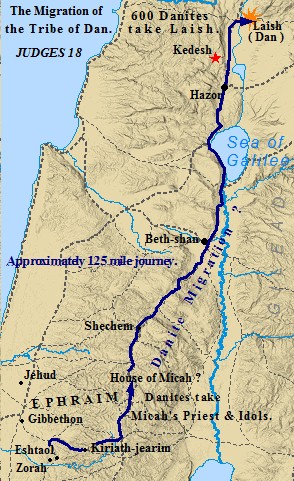 
Like the Israelites, we too have an inheritance, an eternal inheritance in the Kingdom of God. Let us persevere in the faith to keep our inheritance for what God gives us is good and worthy of fighting for. | |
|
| Passage: Joshua 22-24
On Saturday, March 26, 2011, Unmi wrote,
Joshua 22:10-12 When they came to Geliloth near the Jordan in the land of Canaan, the Reubenites, the Gadites and the half-tribe of Manasseh built an imposing altar there by the Jordan. And when the Israelites heard that they had built the altar on the border of Canaan at Geliloth near the Jordan on the Israelite side, the whole assembly of Israel gathered at Shiloh to go to war against them.
At first when I read this verse, I didn't understand why the the Eastern tribes built an altar in the first place, why build an altar on the western side of the Jordan when their land is on the eastern side of the Jordan? Even for the Israelites that became upset enough to prepare for war, what exactly about the altar made them so upset? Was it its location, its size, its purpose?
Throughout what we have read so far, it seemed that the Israelites were a very forgetful people. So often, God had to remind them to REMEMBER! What I find interesting about this entire episode is that the Israelites were angry because they finally DID remember! Not only did they remember the Sin at Peor in which 24,000 Israelites died (Numbers 25), Archan's sin (Joshua 7) in which 36 Israelites died at the hands of Ai, they even remembered the laws of Moses. In Deut 12, the Lord instructed that there shall be only ONE place where He will be worshipped, God himself will choose this place once they enter the Promised Land. "Be careful not to sacrifice your burnt offerings anywhere you please. Offer them only at the place the LORD will choose in one of your tribes, and there observe everything I command you." (Deut 12:13-14) The building of the altar in Geliloth was a violation of this law presumably because the Eastern tribes would use this altar to perform sacrifices, after all, that's what an altar is built for. When the Eastern tribes are confronted by Phinehas and the Israelite delegation, they explain that the altar was "not for burnt offerings or sacrifices" (Joshua 22:26) but as "a witness between us and you and the generations that follow, that we will worship the LORD at his sanctuary with our burnt offerings, sacrifices and fellowship offerings. Then in the future your descendants will not be able to say to ours, ‘You have no share in the LORD.’ " (Joshua 22:27) The Israelites were satisfied with the explanation and leave peacefully.
I see a few things we can all learn from this confrontation.
First, don't jump to conclusions: The Israelites assumed that the altar was built for unlawful sacrifices. Sometimes things are not as they appear.
Second, avoid doing things that would cause others to question your Christian character, thereby questioning the character of God. If a weaker member of the faith sees you walking into a place of ill-repute, they will jump to conclusions even if your actions are upright. If the Eastern tribes didn't build the altar in the first place, it would have avoided all this misunderstanding. Couldn't they have built something different to use as a memorial instead? Even though we have freedom in Christ, we shouldn't use that freedom to cause others to lose faith. Let us constantly look to what builds each other up even if it means sacrificing personal freedom.
Third, there are always two sides to every story! Many married friends have come to my husband and I after "arguments." It is absolutely amazing how one sided a story can be. Sometimes I wonder if the stories they tell are purposely one sided to make themselves look good or do people truly not see the big picture. When people confide in us, we need to be careful how we take it especially when the story involves another person, for every story there is another side.
Fourth, it is better to seek peaceful resolution through discussion. Instead of resorting to gossiping, fighting, backstabbing, It would be better to confront a person with a problem so that misunderstandings can be cleared up. Let us seek the truth in all things and let us speak the truth in love.
Finally, REMEMBER the Lord, REMEMBER what He has done for us, REMEMBER his precepts for this is what guides us in the way we should go!
| |
|
| Passage: Judges 1-2
On Monday, March 28, 2011, Unmi wrote,
Joshua was a book of victorious conquest. Now we reach Judges, a book of defeat and failure. The Israelites have occupation of the Promised land, at least a large portion of it, however, they did not drive out the nations as instructed by God. The book of Judges document the repetitive failure of the Israelites and how God brought up judges to deliver them.
Judges 2:10-19 essentially summarizes the entire book of Judges.
1. Disobedience: The Israelites fall into sin and idolatry.
They forsook the LORD, the God of their ancestors, who had brought them out of Egypt.
They followed and worshiped various gods of the peoples around them. (Judges 2:12)
2. Disciplinary Judgment: God becomes angry and gives them over to their enemies.
In his anger against Israel the LORD gave them into the hands of raiders who plundered them.
He sold them into the hands of their enemies all around, whom they were no longer able to resist. (Judges 2:14)
3. Repentance in the midst of suffering:
The Israelites are oppressed by their enemies and cry out to the Lord.
4. Deliverance: The Lord hears their cries for help and raise up judges to help them.
Then the LORD raised up judges, who saved them out of the hands of these raiders. (Judges 2:16)
5. Disobedience (again): When a judge dies, the Israelites far away from the Lord again,
however, they become more and more corrupt with successive generations.
But when the judge died, the people returned to ways even more corrupt than those of their ancestors,
following other gods and serving and worshiping them. They refused to give up their evil practices and stubborn ways. (Judges 2:19)
Although God raised up mighty judges during this time in Israel's history, none of them were able to break the cycle of disobedience. As each judge died, the nation quickly forgot the Lord, but God promised “The deliverer will come from Zion; he will turn godlessness away from Jacob. And this is my covenant with them when I take away their sins.” (Romans 11:26-27) Even though the Jews are still awaiting for they deliverer, we Christians know that this deliverer is Jesus Christ. He breaks this cycle as He delivers us not from our enemies, he delivers us from ourselves.
Let us cry out to the LORD to deliver us from "sexual immorality, impurity and debauchery; idolatry and witchcraft; hatred, discord, jealousy, fits of rage, selfish ambition, dissensions, factions and envy; drunkenness, orgies, and the like" (Galatians 5:19-21) so that we may receive the fruit of the Spirit: "love, joy, peace, forbearance, kindness, goodness, faithfulness, gentleness and self-control" (Galatians 5:22-23)
| |
|
| Passage: Judges 3-5
On Monday, March 28, 2011, Unmi wrote,
The Israelites were oppressed by Jabin king of Canaan who reigned in Hazor for 20 years and Sisera was the commander of his army. Hazor is a city that was located north of the Sea of Galilee in the territory of Naphtali. Deborah was a Ephraimite prophetess in central Israel. She send for Barak, a Naphtalite and gives him a prophetic message "The LORD, the God of Israel, commands you: ‘Go, take with you ten thousand men of Naphtali and Zebulun and lead them up to Mount Tabor. 7 I will lead Sisera, the commander of Jabin’s army, with his chariots and his troops to the Kishon River and give him into your hands.’” (Judges 4:6-7) The area described in the battle scenerio involved southern Naphtali as well as Zebulun, Barak is told to gather an army of 10,000 men from these two tribes to fight against Sisera.
In the song of Deborah in Judges 5, it mentions that other tribes also helped Deborah and Barak is this battle. According to Judges 5:13-18, Ephraim, Benjamin, Makir (Manasseh's son who was allotted territory east of the Jordan), Issachar came to help Zebulum and Naphtali, but Reuben, Gilead (Manasseh's grandson, Makir's son, also residing in east of the Jordan), Dan and Asher stayed home.
As the song continues, it curses Meroz. ‘Curse Meroz,’ said the angel of the LORD. ‘Curse its people bitterly, because they did not come to help the LORD, to help the LORD against the mighty.’ (Judges 5:23) There is no other reference in the Bible to this place. It seems that the only remembrance of Meroz will be the curse in Deborah's song. So it must be that Meroz was a city located close to where the battle was occurring but they did not lift a finger to help. Perhaps they were a people under the oppression of King Jabin and benefited from the victorious defeat (but this is speculation) In any case, the people of Meroz were cursed because they did not help those who were fighting against oppression.
As we see persecuted Christians, our brothers and sisters of the faith, throughout the world, I question what our role is supposed to be. Of course the people of Naphtali and Zebulun fought as the oppression was directly affecting them. But then we see that tribes such as Ephraim and Benjamin who don't have direct borders with the affected tribes still came to their aid and in the song of Deborah they are recognized for what they did. Dan and Asher are bordering tribes but did not come to help; they are not cursed for not coming but it is interesting that their names are specifically mentioned as people who stayed home.
Whether we act or don't act upon injustice that we directly witness or hear about in remote places, it appears that God makes note of our actions. Just something to think about!
| |
|
| Passage: Judges 6-7
On Tuesday, March 29, 2011, Unmi wrote,
Judges 6: 25 That same night the LORD said to him, “Take the second bull from your father’s herd, the one seven years old. Tear down your father’s altar to Baal and cut down the Asherah pole beside it. 26 Then build a proper kind of altar to the LORD your God on the top of this height. Using the wood of the Asherah pole that you cut down, offer the second bull as a burnt offering.”
Before Gideon takes his 300 men to fight the massive Midianite army, he is instructed by the LORD to tear down his father's altar and pole to false gods. It made me think about how we need to get our own household right before God before we can serve the Lord outside of our house. If we are not willing to take down the "altar to false gods" in our house, what army can be fight outside of our house. Let us offer up our homes properly to the Lord so that He may use us in mighty ways!
| |
|
| Passage: Judges 8-9
On Thursday, March 31, 2011, Unmi wrote,
As I read chapters 8-9, I thought that the story about the trees was interesting...and this is my understanding:
When Jotham was told about this, he climbed up on the top of Mount Gerizim and shouted to them, “Listen to me, citizens of Shechem, so that God may listen to you. One day the trees went out to anoint a king for themselves. They said to the olive tree, ‘Be our king.’ “But the olive tree answered, ‘Should I give up my oil, by which both gods and humans are honored, to hold sway over the trees?’ “Next, the trees said to the fig tree, ‘Come and be our king.’ “But the fig tree replied, ‘Should I give up my fruit, so good and sweet, to hold sway over the trees?’ “Then the trees said to the vine, ‘Come and be our king.’ “But the vine answered, ‘Should I give up my wine, which cheers both gods and humans, to hold sway over the trees?’ “Finally all the trees said to the thornbush, ‘Come and be our king.’ “The thornbush said to the trees, ‘If you really want to anoint me king over you, come and take refuge in my shade; but if not, then let fire come out of the thornbush and consume the cedars of Lebanon!’ (Judges 9:7-15)
The olive tree, fig tree and vine are three different trees that produce three different fruit, each fruit having its own special purpose. These trees understand what their primary role is in serving "both gods and humans" and decide not to give up their position in order to become "king of the trees." These trees represent people who understand and acknowledge the role God that has given them in this life and produce "fruit" abundantly for the benefit of man and to please God. In this story, Gideon represents one of these good trees. He understood his role in this life as a servant of the Lord and refused to become king over the Israelites. “I will not rule over you, nor will my son rule over you. The LORD will rule over you.” (Judges 8:22-23)
The thornbush is different. Instead of produce good fruit, it only produces useless thorns. It is interesting that the thornbush tells the trees to come take refuge in his shade for a thornbush doesn't produce any shade, it is too small. The trees would have to sink themselves very low to the ground to get any shade from it. The only mighty thing that a thornbush can do is produce destructive fire. Even the great cedars of Lebanon can be destroyed by destructive wildfire from thornbushes. In this story, Abimelek represents the thornbush. Those who took refuge in him, the Shechemites, were destroyed by him. It is prophetic that the Shechemites were destroyed by a fire caused by branches that Abimelek cut down from trees. On hearing this, the citizens in the tower of Shechem went into the stronghold of the temple of El-Berith. When Abimelek heard that they had assembled there, he and all his men went up Mount Zalmon. He took an ax and cut off some branches, which he lifted to his shoulders. He ordered the men with him, “Quick! Do what you have seen me do!” So all the men cut branches and followed Abimelek. They piled them against the stronghold and set it on fire with the people still inside. So all the people in the tower of Shechem, about a thousand men and women, also died. (Judges 9:46-49)
As Christians, we each have God-given talents and abilities and should serve one another by bearing good fruit. Jesus himself, the King of Kings, said that He came to serve not to be served. Jesus called them together and said, “You know that those who are regarded as rulers of the Gentiles lord it over them, and their high officials exercise authority over them. Not so with you. Instead, whoever wants to become great among you must be your servant, and whoever wants to be first must be slave of all. For even the Son of Man did not come to be served, but to serve, and to give his life as a ransom for many.” (Mark 10:42-45)
Let us each examine the impact of our lives...Are people around us enjoying the fruits of our labor or are they being hurt by the "fire" we cause?
| |
|
| Passage: Judges 10-12
On Friday, April 1, 2011, Unmi wrote,
The tribe of Ephraim in the book of Judges:
As the book of Judges progresses, it is sad to see what happens to Ephraim.
In the story of Deborah, Ephraim is credited in the Song of Deborah as one of the tribes who fought against King Jabin. Some came from Ephraim.. (Judges 5:14) Even though KIng Jabin wasn't directly affecting the Ephraimites, it appears that they helped the Naphtalites in their battle against the Canaanite King.
In the story of Gideon, as the remnants of the Midianite army are fleeing from Gideon and his 300 men, Ephraim as well as the other tribes join in the pursuit. So all the men of Ephraim were called out and they seized the waters of the Jordan as far as Beth Barah. 25 They also captured two of the Midianite leaders, Oreb and Zeeb. They killed Oreb at the rock of Oreb, and Zeeb at the winepress of Zeeb. They pursued the Midianites and brought the heads of Oreb and Zeeb to Gideon, who was by the Jordan. (Judges 7:24-25) However, after the Ephraimites capture the Midianite leaders, they question Gideon. “Why have you treated us like this? Why didn’t you call us when you went to fight Midian?” And they challenged him vigorously. (Judges 8:1) It appears that the Ephraimites were upset that they were not asked from the beginning to fight against the Midianites. But more than the desire to relieve the oppression of the Midianites on Israel, it appears that the Ephraimites were actually concerned about who would get credit for the victory. It was their pride and ego that was speaking to Gideon. Gideon appeased them by crediting them with capturing the Midianites leaders. But he answered them, “What have I accomplished compared to you? Aren’t the gleanings of Ephraim’s grapes better than the full grape harvest of Abiezer? God gave Oreb and Zeeb, the Midianite leaders, into your hands. What was I able to do compared to you?” At this, their resentment against him subsided. (Judges 8:2-3) At the smooth talk of Gideon, they are appeased and left peacefully with their pride and ego held high.
In the story of Jephthah, we see another confrontation with Ephraim. They repeat what they said to Gideon, “Why did you go to fight the Ammonites without calling us to go with you?" but this time, they are much more belligerent and actually threatened to kill them, "We’re going to burn down your house over your head" (Judges 12:1) From Jephthah's response, it appears that Jephthah and his people had cried out for help, but no one responded including the Ephraimites. Jephthah answered, “I and my people were engaged in a great struggle with the Ammonites, and although I called, you didn’t save me out of their hands. (Judges 12:2) The Ephraimites showed up only after the battle was over, seeking to claim some victory for themselves. Because of their pretentious accusations, Jephthah and the Gileadites killed 42,000 Ephraimites. Up to this point, the Israelites were fighting against the inhabitants of Canaan, now we see the tribes fighting against and killing each other.
The moral character of the tribe of Ephraim declined with each successive generation. Unfortunately, this is just one example of moral failure in the book of Judges. With each successive generation, the sins of the people both individually (we will read about Micah's Idols in Judges 17) and as a nation gets progressively worse. If left to themselves, they would have become just like those who died in Noah's flood. The LORD saw how great the wickedness of the human race had become on the earth, and that every inclination of the thoughts of the human heart was only evil all the time. (Genesis 6:5) Unless the Lord sovereignly intervenes, the human condition is on a fast pace track toward greater and greater evil. Not only is the human heart inclined toward evil, Paul says that it is actually "dead." As for you, you were dead in your transgressions and sins, in which you used to live when you followed the ways of this world...(Ephesians 2:1-2) Even as we were deserving of God's wrath, God showed his mercy toward us, not because we loved Him first, but because He loved us. But because of his great love for us, God, who is rich in mercy, made us alive with Christ even when we were dead in transgressions—it is by grace you have been saved. (Ephesians 2:4-5)
Let us each be truly thankful for what Christ has done for us. We were once dead, but have now been made alive in Christ!
| |
|
| Passage: Judges 13-15
On Friday, April 1, 2011, Unmi wrote,
God's will in the life of Samson:
2 A certain man of Zorah, named Manoah, from the clan of the Danites, had a wife who was childless, unable to give birth. 3 The angel of the LORD appeared to her and said, “You are barren and childless, but you are going to become pregnant and give birth to a son. 4 Now see to it that you drink no wine or other fermented drink and that you do not eat anything unclean. 5 You will become pregnant and have a son whose head is never to be touched by a razor because the boy is to be a Nazirite, dedicated to God from the womb. He will take the lead in delivering Israel from the hands of the Philistines.” (Judges 13:2-5)
Samson was born miraculously to a barren couple to achieve God's purposes. In Samon's life, we see God's sovereign will and permissive will play out. God choose Samson even before birth, not because of his foreknowledge of any goodness in Samson for his life was full of immoral decisions, but purely to achieve God's purposes. This is God's sovereign will. It was not based on anything that Samson did or said for he was chosen before birth. However, although Samson was chosen to fulfill God's purposes specifically with regards to delivering Israel from the hands of the Philistines, Samson still was able to make his own decisions regarding most aspects of his life. This free will is not something that is outside of God's sovereignty, but it is something that God allows even if our choices are bad. The result of our decisions are not necessarily sanctioned or approved by God as good, He simply permits it. Samson made multiple poor choices in his life especially with regards to women. However, even as God's permissive will allowed him "free will" to do so, God used these for His greater purpose which will not be thwarted.
There are multiple examples of this interplay between God's sovereign plan and man's permissive free will. In the life of Joseph, when he confronts his brothers, But Joseph said to them, “Don’t be afraid. Am I in the place of God? You intended to harm me, but God intended it for good to accomplish what is now being done, the saving of many lives. (Genesis 50:19-20) The brothers acted on their free will when they sold Joseph into slavery and they are held responsible for their actions. God's permissive will allowed them to do so. However, God's sovereign will had a greater purpose than what the brothers had intended.
Another example is seem in the life of Christ. God's sovereign will, even prior to the birth of Jesus, was that He would suffer and die for the purpose of redemption. (Isaiah 53) God allowed the wickedness of man in their free will to achieve this end by allowing the crucifixion of Jesus. The sovereign will of God does not free us from responsibility of our actions for God does not "make" us sin, it is the sin nature in us that causes us to sin and do evil.
In the book of Job, Then Job replied to the LORD: “I know that you can do all things; no purpose of yours can be thwarted. You asked, ‘Who is this that obscures my plans without knowledge?’ Surely I spoke of things I did not understand, things too wonderful for me to know. (Job 42:1-3) No one can thwart God's plan. God sovereignly chooses and anoints some to specifically fulfill his plans, despite their human propensity for evil.
So many of us ask, what is "God's will" for our lives? God has already revealed this:
Therefore, I urge you, brothers and sisters, in view of God’s mercy, to offer your bodies as a living sacrifice, holy and pleasing to God—this is your true and proper worship. Do not conform to the pattern of this world, but be transformed by the renewing of your mind. Then you will be able to test and approve what God’s will is—his good, pleasing and perfect will. (Romans 12:1-2)
Let us conform to the will of God by transforming our minds through the continued reading of His Words!
| |
|
| Passage: Judges 16-18
On Sunday, April 3, 2011, Unmi wrote,
The story of Micah's idol in Judges 17 has so many things wrong with that I don't know where to begin.... It appears that Micah stole money from his own mother, not just spare change from her purse, but 1100 shekels of silver, an amount equivalent to over 100 years of wages. We know this because the Levite, Jonathan, agrees to work for 10 shekels of silver per year (Judges 17:10). Micah only returns his mother's money because he heard his mother pronounce a curse on it (Judges 17:2) So the return of money was not because Micah was remorseful of what he did, he returned the money because he was afraid of the curse that his mother had pronounced. From this we can assume that either he did not know or had no regard for the curses that the Lord himself pronounced for disobeying God's law (Deut 28). So far he has broken the 5th commandment, Honor your father and your mother and 8th commandment, You shall not steal (Deut 5:16,19).
When Micah returned the money, mother says “The LORD bless you, my son!” What!!! I'm sure she was happy to get the money back, but no words of discipline? No wonder he stole her money! Upon receiving the money back, the mother vows to consecrate the silver to God. First of all, there was 1100 shekels of silver, but she only used 200 shekels to make the idol. What happened to the rest of the money? She promises to consecrate it to God, but it looks like she cheated God out of 900 shekels of silver. Then she proceeds to make an idol out of the silver for her son. There goes the 1st and 2nd commandment. You shall have no other gods before me. You shall not make for yourself an image. (Deut 5:7-8) Not only did Micah have multiple household gods, he had his own ephod, shrine and priest. Didn't the Lord tell the Israelites that there shall be only one place of worship which the Lord himself will choose! (Deut 12:13-14)
Then enters the Levite, Jonathan, into the scene. The Levite was looking for a place to stay. From this I gather that he was unemployed and homeless. Living in midst of a godless nation, I guess there wasn't much work for priests. Now the Levite could have brought reform into Micah's household, but instead of reform, he aided Micah in his idolatry. Even those who are supposed to know and teach God's word are just as lost. Either he was ignorant of what God commanded or he conveniently put it aside for personal gain. This just reinforces for me that not all those who call themselves servants of the Lord are truly following God's righteous path or even know what the word of God says. We have to be careful to follow Godly leaders who are rooted in the word of God, but how do we know whether they are rooted in the word of God if we ourselves don't know what it says. I believe many sincere people are lead astray into Christian cults because they place their faith more on a Charismatic leader than on what God has revealed in the Bible. In the midst of sin, Micah sincerely believed that his obtaining the services of a Levite to become a priest for his home would please God. And Micah said, “Now I know that the LORD will be good to me, since this Levite has become my priest.” (Judges 17:13)
I wonder how many Christians think that as long we appear godly by attending church, doing a certain amount of church activities, by giving a certain amount of monetary offering, then God will be pleased with us. But God doesn't look at the outward appearance, He looks at the heart, and not just at the sincerity of the heart for sincerity does NOT save, but a person who worships the true and living God in SPIRIT AND TRUTH!
Yet a time is coming and has now come when the true worshipers will worship the Father in the Spirit and in truth, for they are the kind of worshipers the Father seeks. God is spirit, and his worshipers must worship in the Spirit and in truth.” (John 4:23-24)
Let us worship the Lord our God tomorrow in Spirit and Truth.
| |
|
| Passage: Judges 19-21
On Sunday, April 3, 2011, Unmi wrote,
The beginning of this sad story begins with "In those days Israel had no king." (Judges 19:1) and ends with "In those days Israel had no king; everyone did as they saw fit." (Judges 21:25)
When I first read this, my initial thought was that it was talking about not having a human king since the Israeli monarchy had not been established yet, but as I thought about it more, I actually think that the "king" that this verse is referring to is God himself. God had established the nation of Israel in the land of Canaan as a theocracy. God was their king, and "in those days," Israel had rejected God as their king, they neither worshipped or obeyed Him. Instead, "everyone did as they saw fit."
So what happens when everyone does whatever they see fit? The entire book of Judges is about that exact situation and culminates in the story of the Levite and his concubine. With each progressive generation there is increasing depravity both individually and as a nation. Romans chapter 1 explains what happens when man rejects God. Therefore God gave them over in the sinful desires of their hearts...God gave them over to shameful lusts...God gave them over to a depraved mind...They have become filled with every kind of wickedness, evil, greed and depravity. They are full of envy, murder, strife, deceit and malice. They are gossips, slanderers, God-haters, insolent, arrogant and boastful; they invent ways of doing evil; they disobey their parents; they have no understanding, no fidelity, no love, no mercy. (Romans 1:24-31)
But God in His infinite wisdom and mercy, saved us from our own depravity for without the Spirit of God in our lives we are also doomed for the same fate. Therefore, let us acknowledge who our King is and become faithful and obedient servants to the King of Kings and Lord of Lords, Jesus Christ, our Savior.
| |
|
| Passage: Ruth 1-4
On Monday, April 4, 2011, Unmi wrote,
The story of Ruth takes place during the time period of the Judges when "everyone did as they saw fit." Presumably because of Israel's rebellion, the land was experiencing a period of famine. It was during this time, Naomi's family moved to Moab. During her 10 years there, she loses her husband and both her sons. From a human perspective, this is a woman cursed by God, she has lost her home and now her entire family. When she returned to her homeland, in her bitterness, she says "The LORD has afflicted me; the Almighty has brought misfortune upon me.” (Ruth 1:21) What she doesn't do is curse God for her plight in life. Remember Job's wife telling him to "Curse God and die!" (Job 2:9), What was Job's response to his wife? He replied, “You are talking like a foolish woman. Shall we accept good from God, and not trouble?” (Job 2:10) Naomi left Moab when she heard "that the LORD had come to the aid of his people" (Ruth 1:6) Naomi could have stayed in Moab instead of going back to Bethlehem to face the embarrassment of coming home empty handed, but she returned to the land of her God because there still was a glimmer of hope in the midst of her suffering. She must have believed that the Lord would come to her aid as well.
Now Ruth decides to go to Bethlehem with Naomi. At this point in her life, Naomi has absolutely nothing and no means to provide for herself, let alone her daughter-in-laws. Naomi tells her daughter-in-laws to go back to their own families for they are still young and could remarry. However, Ruth tells Naomi "Where you go I will go, and where you stay I will stay. Your people will be my people and your God my God. Where you die I will die, and there I will be buried. May the LORD deal with me, be it ever so severely, if even death separates you and me.” (Ruth 1:16-17) From her statement, it appears that Ruth knew about the God of Israel. During the last 10 years, it appears that Naomi told Ruth about her God for Ruth says that "your God" will be "my God." In the relationship between Ruth and Naomi, we see a beautiful picture of what a godly mother-in-law, daughter-in-law relationship can be. Naomi was thinking about what would be best for Ruth by telling her go back to her family so that she could remarry and Ruth was thinking about Naomi, not wanting her to be left alone. Each was thinking about the other's well-being without consideration of their own needs and wants.
As the story unfolds further, it is amazing what Naomi and Ruth do for each other. Ruth works hard to provide for their daily needs. She said, ‘Please let me glean and gather among the sheaves behind the harvesters.’ She came into the field and has remained here from morning till now, except for a short rest in the shelter.” (Ruth 2:7) In the meanwhile, Naomi is thinking of a way that Ruth could be provided for. Ruth’s mother-in-law Naomi said to her, “My daughter, I must find a home for you, where you will be well provided for. (Ruth 3:1)
What Boaz does as a kinsman-redeemer can be understood within the context of the Mosaic Laws. Under Levitical Law, the nearest relative was to redeem (buy-back) the property of a relative that was lost because of poverty . “If one of your fellow Israelites becomes poor and sells some of their property, their nearest relative is to come and redeem what they have sold." (Leviticus 25:25) Although Boaz was willing, he was second in line and asks the nearest kinsman-redeemer to buy the property. When the kinsman-redeemer is willing to buy the property, Boaz then points out the Levirate Law, the duties of the brother-in-law to marry his brother's widow. "If brothers are living together and one of them dies without a son, his widow must not marry outside the family. Her husband’s brother shall take her and marry her and fulfill the duty of a brother-in-law to her. The first son she bears shall carry on the name of the dead brother so that his name will not be blotted out from Israel. (Deut 25:5-6) The kinsman-redeemer is not willing to marry Ruth because he doesn't want to risk his own inheritance. It is not clear how this would affect his inheritance, but in any case, this allows Boaz to both redeem the land for Naomi and marry Ruth. God graciously provided for both Naomi and Ruth. When Ruth conceives a son, The women living there said, “Naomi has a son!” (Ruth 4:17) The first son that Ruth conceived is considered Naomi's son (or grandson) because he would bear the name of Ruth's dead husband. Because of Ruth's faithfulness to her mother-in-law, not only did Ruth work to provide daily sustenance for both herself and Naomi which in itself is commendable, but she was instrumental in redeeming the family land that was about to be lost and not only that, she provided an heir for Naomi who had lost all her sons. How beautiful is that!
As Christians, when we are suffering, we must remember "that our present sufferings are not worth comparing with the glory that will be revealed in us" (Romans 8:18) for "we know that in all things God works for the good of those who love him, who have been called according to his purpose." (Romans 8:28)
| |
|
| Passage: 1 Samuel 1-3
On Tuesday, April 5, 2011, Unmi wrote,
There was a spiritual famine in the land. In those days the word of the LORD was rare; there were not many visions. (1 Samuel 3:1) I previously thought that the Shekinah glory of the Lord left Israel when the Ark of the Covenant was taken by the Philistines (1 Samuel 4), but from this section of reading, it seems that God's glory had left the Tabernacle long before this time for Samuel who spent the majority of his time in the Tabernacle doesn't recognize the presence of God or His calling.
Now Samuel did not yet know the LORD: The word of the LORD had not yet been revealed to him. (1 Samuel 3:7) It is unclear exactly what this verse means. There are at least two different view points. (1) Samuel knows God from what has been revealed so far through the writings of Moses since He is working as a priest, but did not yet know the Lord in terms of a direct revelation from God. It is at this time that Samuel receives special revelation from the Lord. (2) Samuel literally did not know the LORD meaning that even God's previous revelation through the words of Moses was not known to Samuel because Eli didn't teach it to him (It appears Eli didn't teach it to his own sons either). Since the phrase "the word of the LORD" is used also in 1 Samuel 3:1 which is referring to direct revelation from the Lord, it appears that option (1) may fit better within the context of the whole chapter. Although the exact spiritual state of Samuel prior to his calling may be argued, it is at this time that Samuel receives a direct calling from the Lord to be his prophet.
When Samuel response to the Lord after his 3rd calling, God gives him a prophetic message about Eli. (1 Samuel 3:11-14) The prophecy is fulfilled in the next chapter when Eli's two sons and Eli himself dies. This is Samuel's first prophetic message. Deut chapter 18 gives the test of a false prophet "If what a prophet proclaims in the name of the LORD does not take place or come true, that is a message the LORD has not spoken." (Deut 18:22) Deut 13 also says that even if what a prophet says take place, if that prophet leads you to follow other gods, don't listen to him. "If a prophet, or one who foretells by dreams, appears among you and announces to you a sign or wonder, and if the sign or wonder spoken of takes place, and the prophet says, “Let us follow other gods” (gods you have not known) “and let us worship them,” you must not listen to the words of that prophet or dreamer. (Deut 13:1-3) The two tests for God's prophet is that his prophetic words will come to pass and that his words must not lead people astray to follow false gods. The LORD establishes Samuel as a true prophet of the Lord by upholding every word that he spoke. The LORD was with Samuel as he grew up, and he let none of Samuel’s words fall to the ground.(1 Samuel 3:19) In other words, every prophetic message that Samuel spoke came true. Samuel also was instrumental in leading the people back to the Lord and away from the worship of false gods. Then all the people of Israel turned back to the LORD. So Samuel said to all the Israelites, “If you are returning to the LORD with all your hearts, then rid yourselves of the foreign gods and the Ashtoreths and commit yourselves to the LORD and serve him only, and he will deliver you out of the hand of the Philistines.” So the Israelites put away their Baals and Ashtoreths, and served the LORD only. (1 Samuel 7:2-4) We should examine all prophetic messages with these "tests" in mind so as not to be lead astray by false prophets who fill people with false hope with words that come from their own mind and tell people essentially what they want to hear. (Jeremiah 23:16-17) This is what the LORD Almighty says: “Do not listen to what the prophets are prophesying to you; they fill you with false hopes.They speak visions from their own minds, not from the mouth of the LORD. They keep saying to those who despise me, ‘The LORD says: You will have peace.’ And to all who follow the stubbornness of their hearts they say, ‘No harm will come to you.’
Thank the Lord that in times of spiritual famine, He sent messengers like Samuel, to reveal His words to us. These words of God are recorded in the Holy Scriptures for all generations to have. Now that we have all that is sufficient to know God's will both through creation and through the revealed word, we are all without excuse. Let us "press on toward the goal to win the prize for which God has called me heavenward in Christ Jesus." (Philippians 3:14)
| |
|
| Passage: 1 Samuel 4-8
On Thursday, April 7, 2011, Unmi wrote,
The story of the Ark is somewhat ironic. In 1 Samuel 4, the Israelites thought that the Ark had powers to defeat their enemies. They thought that God would be with them if they took the Ark to battle. However, when the Ark was with the Israelites in the battlefield, they lost 30,000 men to the Philistines. In 1 Samuel 7, when the Ark was in seclusion in someone's home, the Israelites subdued the Philistines. So, obviously it wasn't the Ark itself that helped the Israelites defeat their enemies. What accounted for this turnaround in their "luck"? ....Repentance
Then all the people of Israel turned back to the LORD. So Samuel said to all the Israelites, “If you are returning to the LORD with all your hearts, then rid yourselves of the foreign gods and the Ashtoreths and commit yourselves to the LORD and serve him only, and he will deliver you out of the hand of the Philistines.”So the Israelites put away their Baals and Ashtoreths, and served the LORD only. Then Samuel said, “Assemble all Israel at Mizpah, and I will intercede with the LORD for you.” When they had assembled at Mizpah, they drew water and poured it out before the LORD. On that day they fasted and there they confessed, “We have sinned against the LORD.” (1 Samuel 7:2-9)
An object itself, no matter how sacred, doesn't bring someone closer to God, it is the repentant heart that draws you closer to the LORD.
| |
|
| Passage: 1 Samuel 9-12
On Friday, April 8, 2011, Unmi wrote,
In the previous day's reading, the people clamor for a king and Samuel warns the Israelites of what a king will do. The king will reign over you, he will take your sons, your daughter, your servants, the best of your animals and crops.
Samuel told all the words of the LORD to the people who were asking him for a king. He said, “This is what the king who will reign over you will claim as his rights: He will take your sons and make them serve with his chariots and horses, and they will run in front of his chariots. Some he will assign to be commanders of thousands and commanders of fifties, and others to plow his ground and reap his harvest, and still others to make weapons of war and equipment for his chariots. He will take your daughters to be perfumers and cooks and bakers. He will take the best of your fields and vineyards and olive groves and give them to his attendants. He will take a tenth of your grain and of your vintage and give it to his officials and attendants. Your male and female servants and the best of your cattle and donkeys he will take for his own use. He will take a tenth of your flocks, and you yourselves will become his slaves. (1 Samuel 8:10-17)
In Samuel's farewell speech, in contrast to the above description of what their king will do, Samuel describes what he did as a judge of Israel. He did not take their animals, did not cheat them, did not oppress them, did not take brides.
As for me, I am old and gray, and my sons are here with you. I have been your leader from my youth until this day. Here I stand. Testify against me in the presence of the LORD and his anointed. Whose ox have I taken? Whose donkey have I taken? Whom have I cheated? Whom have I oppressed? From whose hand have I accepted a bribe to make me shut my eyes? If I have done any of these things, I will make it right.” (1 Samuel 12:2-3)
Throughout Samuel's life as a judge, he was a fair and just judge and did nothing deserving of rejection from the people of Israel. God himself tells Samuel that the people are rejecting the Lord as their King, not Samuel as their judge. And the LORD told him: “Listen to all that the people are saying to you; it is not you they have rejected, but they have rejected me as their king. (1 Samuel 8:7)
During his farewell speech, Samuel reminds the Israelites what God has done for them thus far, how He saved them from their enemies. As a confirmation of what Samuel said, the Lord sent thunder and rain as a sign and the people ask Samuel to intercede for them for their sin. I love how Samuel response:
“Do not be afraid,” Samuel replied. “You have done all this evil; yet do not turn away from the LORD, but serve the LORD with all your heart. Do not turn away after useless idols. They can do you no good, nor can they rescue you, because they are useless. For the sake of his great name the LORD will not reject his people, because the LORD was pleased to make you his own. As for me, far be it from me that I should sin against the LORD by failing to pray for you. And I will teach you the way that is good and right. But be sure to fear the LORD and serve him faithfully with all your heart; consider what great things he has done for you. Yet if you persist in doing evil, both you and your king will perish.” (I Samuel 20-25)
Even though his position as a judge has now officially ended with the start of the monarchy, he says that he will remain and pray for them and continue to teach them the ways of the Lord as a priest and prophet of God. I thought this was very noble of him and consistent with the life of upright character that he has lived so far. His last message as a judge of Israel is to fear the Lord, serve the Lord, remember the Lord and do not persist in doing evil. We would all do well in remembering these admonitions from Samuel.
| |
|
| Passage: 1 Samuel 13-14
On Friday, April 8, 2011, Unmi wrote,
So why didn't Saul wait for Samuel? I think it is understandable why he panicked. His small army was facing "soldiers as numerous as the sand on the seashore" and "all the troops with him were quaking with fear." He had been waiting 7 days already and Samuel had not yet arrived as promised. But why not just pray to God? or just go into battle without performing the sacrifice? Why did Saul think performing the sacrifice was so critical for this battle? If we look back to 1 Samuel 7, I think there is a clue to why Saul thought that the sacrifice was so important. The Philistines came to attack the Israelites as they gathered before the Lord at Mizpah and the Israelites were afraid. When the Philistines heard that Israel had assembled at Mizpah, the rulers of the Philistines came up to attack them. When the Israelites heard of it, they were afraid because of the Philistines. (1 Samuel 7:7) So what did Samuel do? Then Samuel took a suckling lamb and sacrificed it as a whole burnt offering to the LORD. He cried out to the LORD on Israel’s behalf, and the LORD answered him. (1 Samuel 7:9) What did the Lord do in response? the LORD thundered with loud thunder against the Philistines and threw them into such a panic that they were routed before the Israelites. The men of Israel rushed out of Mizpah and pursued the Philistines, slaughtering them along the way to a point below Beth Kar. (1 Samuel 7:10-11) Perhaps Saul thought the Lord would do the same thing again if only the sacrifices were performed. Saul mistakenly thought that it was the sacrifice that pleased the Lord. However, if we go back to what happened at Mizpah, we see that the Israelites had gathered there to repent of their sins. When they had assembled at Mizpah, they drew water and poured it out before the LORD. On that day they fasted and there they confessed, “We have sinned against the LORD.” (1 Samuel 7:6) The Lord was pleased with the heart that was right before the Lord and therefore accepted the sacrifices that were made in repentance. David understood this when he wrote Psalm 51.
16 You do not delight in sacrifice, or I would bring it; you do not take pleasure in burnt offerings.
17 My sacrifice, O God, is a broken spirit; a broken and contrite heart, you, God, will not despise. (Psalm 51:16-17)
Again, the story of Saul and his sacrifice points out how many people even today tend to put more value in religious rituals or in sacred relics than in actually having a heart that is pure before God. Is changing our heart an impossible task? Yes, on our own it is impossible, this is the work of the Holy Spirit. As we grow and mature in our faith, the fruit of the Holy Spirit should become evident in our lives. But the fruit of the Spirit is love, joy, peace, forbearance, kindness, goodness, faithfulness, gentleness and self-control. Against such things there is no law. (Galatians 5:22-23)
| |
|
| Passage: 1 Samuel 15-17
On Saturday, April 9, 2011, Unmi wrote,
Moses already wrote about the future king of Israel in Deut 17. It is a short section and there aren't that many stipulations, but one major edict was that the king was to "write for himself on a scroll a copy of this law" and "read it all the days of his life." Why? "So that he may learn to revere the LORD his God and follow carefully all the words of this law and these decrees and not consider himself better than his fellow Israelites and turn from the law to the right or to the left. Then he and his descendants will reign a long time over his kingdom in Israel" (Deut 17:18-20) The Lord was prepared for the day when Israel would demand a king and provided instructions for this future king. In order to maintain a long reign for himself and his descendants, the king was to know the Law, mediate on the Law, and follow the Law so that he may show reverence for the God of Israel.
Saul performing the sacrifice prior to Samuel's arrival in 1 Samuel 13 revealed Saul's lack of understanding of what God considers as an acceptable sacrifice. Saving the best of the plunder and not killing their leader, King Agag, showed that Saul did not place high regard to the exact "literal" instructions to kill all the Amalekites that were given not only through Samuel but through Moses as well in Deut 25. Remember what the Amalekites did to you along the way when you came out of Egypt. When you were weary and worn out, they met you on your journey and attacked all who were lagging behind; they had no fear of God. When the LORD your God gives you rest from all the enemies around you in the land he is giving you to possess as an inheritance, you shall blot out the name of Amalek from under heaven. Do not forget! (Deut 25:17-19) Was God being metaphoric when he gave these instructions? Was it just a general guideline, not to be taken literally? Saul is found guilty without excuses because he did not obey the literal and exact instructions from the LORD. He and his descendants lose the kingdom as God already said he would in Deut 17. Samuel tells Saul:
“Does the LORD delight in burnt offerings and sacrifices
as much as in obeying the LORD?
To obey is better than sacrifice,
and to heed is better than the fat of rams.
For rebellion is like the sin of divination,
and arrogance like the evil of idolatry.
Because you have rejected the word of the LORD,
he has rejected you as king.”
It is sad that so many Christians today have rejected the word of the LORD in the name of "LOVE". What is clearly written is put aside as allegorical or metaphorical, they argue it shouldn't be taken literally as it goes against what they concoct in their own mind as to what LOVE is and should be. Wasn't that Saul's basic problem, he didn't take the word of the Lord literally and came up with what he thought was a better idea!
God is LOVE, and "Love does not delight in evil but rejoices with the truth." (1 Corinthians 13:6)
| |
|
| Passage: 1 Samuel 18-20
On Sunday, April 10, 2011, Unmi wrote,
As I read about David and Jonathan's friendship, it saddens me that we rarely see this kind of friendship. As I think about my personal friendship experiences in the past, it seems these friendships were filled more with jealousy and competition than the kind of love that David and Jonathan had for each other. Jonathan taking off this robe and given it to David was a sign of him relinquishing his future kingship to David. This wasn't something that Jonathan did lightly and without personal cost. How is it that Jonathan was able to love David in such a way? I think the key to this friendship is in the verse "Jonathan became one in spirit with David" (1 Samuel 18:1) What was this common spirit that each had? I think it was the Spirit of the LORD! When Samuel anointed David with oil, it says "from that day on the Spirit of the LORD came powerfully upon David." (1 Samuel 16:13) It seems that the Lord graciously gave this gift of His Spirit to Jonathan as well. It is only because the Spirit of God was in Jonathan that he could love David who essentially was his main competitor for the throne of Israel. Jesus said that the greatest commandment “is this: ‘Hear, O Israel: The Lord our God, the Lord is one. Love the Lord your God with all your heart and with all your soul and with all your mind and with all your strength.' The second is this: ‘Love your neighbor as yourself.’ There is no commandment greater than these.” (Mark 12:29-31) It amazes me that it says that Jonathan loved David "as himself". This is exactly what Jesus told us to do! We see this beautiful relationship recorded in the Bible and think that is great but deep down I don't know if many of us really want to have this kind of relationship! After all this kind of love requires personal sacrifice that many of us are not willing to give even in our own marriages.
Let us ask the Spirit of the Lord to transform us so that we can love each other with the kind of love that gives honor to God.
| |
|
| Passage: 1 Samuel 21-24
On Tuesday, April 12, 2011, Unmi wrote,
In this section of reading, David is on the run from Saul who is trying to kill him. He seeks assistance from Ahimelek the priest of Nob who gives him the consecrated bread and the sword of Goliath. Doeg, the Edomite, happened to be there that day and observed everything. It is this same Edomite that later reports everything he saw to Saul. Saul sends for Ahimelek and all the men of his family and questions him. King Saul command his guards to kill Ahimelek and his entire family, but they refuse. Unfortunately Doeg, the Edomite is more than willing. That day, Doeg killed 85 priests as well a all the other men, women, children, infants and animals of the entire town on Nob. Abiathar, one of Abimelek's escape and flee to David. David says “That day, when Doeg the Edomite was there, I knew he would be sure to tell Saul. I am responsible for the death of your whole family." (1 Samuel 22:22) I could only imagine how David felt when he found out what happened. There must have been a great deal of guilt as well as anger...
As David continues to run away from Saul, he finally gets a chance to confront him in 1 Samuel 24. Unbeknowst to Saul, David and his men are hiding in a cave that Saul uses to "relieve himself." David's men say “This is the day the LORD spoke of when he said to you, ‘I will give your enemy into your hands for you to deal with as you wish.’” (1 Samuel 24:4) David has a chance to kill Saul, but what does he do? David creeps up to Saul and cuts off only a corner of his robe. Not only does David not kill Saul, but he feels remorse just for cutting off a corner of his robe. Why did he feel this way? David has killed thousands of people previously in his military campaigns. The women even sang about David killing his ten-thousands. For David, Saul was different, not any ordinary man, but a man that God himself anointed. "He said to his men, “The LORD forbid that I should do such a thing to my master, the LORD’s anointed, or lay my hand on him; for he is the anointed of the LORD.” (1 Samuel 24:6) David comes out of the cave and tried to convince Saul that he means him to harm.
David says to Saul, "may the LORD avenge the wrongs you have done to me, but my hand will not touch you." (1 Samuel 24:12). David had the perfect opportunity to kill Saul, the man who had alrady tried to kill him multiple times, the man who has been hunting him down like an animal and forces him to live in caves, the man who massacred the people of Nob, the man who caused his family to flee from their home and go to Moab for safety, however, David says that it is the LORD who will avenge him! David's faith in the is amazing. That is why "God testified concerning him: "I have found David son of Jesse, a man after my own heart; he will do everything I want him to do." (Acts 13:22)
| |
|
| Passage: 1 Samuel 25-27
On Tuesday, April 12, 2011, Unmi wrote,
When I first read about Abigail, I had mixed feelings... Here is a woman married to a very rich "fool." Not knowing it could cost him his life as well as the life of his entire household, Abigail's husband foolishly refuses David's request for provisions which obviously he could afford. When Abigail hears the news from the servants, she is quick to act. She prepares a feast for David and his men and send it off on donkeys ahead of her. "But she did not tell her husband Nabal." (1 Samuel 25:19) When she meets David, she says "Please pay no attention, my lord, to that wicked man Nabal. He is just like his name—his name means Fool, and folly goes with him."(1 Samuel 25:25) When she goes back home, she finds her husband having a party and is " high spirits and very drunk. So she told him nothing at all until daybreak." (1 Samuel 25:36) Abigail waits until morning and tells him of everything when he is sober.
How do we reconcile Abigail's actions with the teaching for wives to submit to her husband?
Wives, submit yourselves to your own husbands as you do to the Lord. (Ephesians 5:22) What does it mean to "submit" and what if the husband is ungodly? Were Abigail's actions right before God? Can wives choose to go against their husbands under certain circumstances? If so, what are these circumstances? I think the key to the Ephesians 5 verse is "as you do to the Lord." This verse is assuming that the wife is already under submission to the Lord. Submission to the Lord is first priority, then submission to the husband naturally follows. For a dramatic example, if a husband plots to kill someone and demands the wife to help, the wife is not under obligation to submit since it goes against God's law. In the case of Abigail, she finds herself caught between two men, her foolish husband and a very angry David. In recognition of David as God's anointed king, Abigail honors God in what she did. Not only does she give honor to God, she saves her household from certain death.
Now I was bothered by Abigail calling her husband a "fool" in public. I guess one can argue that Abigail had to debase her husband's character in order to get David to relent. After all the statement itself is true. In any case, I don't think wives should use this account to go around telling people that their husbands are "fools" (even if it is true)
I did find it wise of Abigail to wait until morning to confront her husband. She must have been physically and mentally exhausted when she returned. I'm sure she was thinking of what she was going to tell her husband as she made her way back home. However, when she arrives, Nabal was having a party and was drunk. (I would have been furious!) However, a confrontation under those circumstances wouldn't have been wise. I do think wives could learn something from this example. When our husbands are not in a "sober" state of mind, whether from intoxication, or from anger, or from exhaustion and fatigue, these are likely not the best time to bring up "issues" that wives want to address. Bringing up difficult issues under these circumstances is just asking for a fight and would likely not produce any resolution to problems within the marriage. It would be more fruitful to bring up difficult issues when our husbands are in a "sober" state of mind. | |
|
| Passage: 1 Samuel 28-31
On Thursday, April 14, 2011, Unmi wrote,
The Law clearly taught about witchcraft and sorcery:
“‘Do not turn to mediums or seek out spiritists, for you will be defiled by them. I am the LORD your God. (Leviticus 19:31)
“‘I will set my face against anyone who turns to mediums and spiritists to prostitute themselves by following them, and I will cut them off from their people. (Leviticus 20:6)
“‘A man or woman who is a medium or spiritist among you must be put to death. You are to stone them; their blood will be on their own heads.’” (Leviticus 20:27)
Let no one be found among you who sacrifices their son or daughter in the fire, who practices divination or sorcery, interprets omens, engages in witchcraft, or casts spells, or who is a medium or spiritist or who consults the dead. Anyone who does these things is detestable to the LORD; because of these same detestable practices the LORD your God will drive out those nations before you. (Deut 18:10-12)
Now, it appears that Saul was not ignorant about these command for the Scriptures says that "Saul had expelled the mediums and spiritists from the land." (If this wasn't mentioned, then one could possibly argue that Saul went to the Witch of Endor out of ignorance) In any case, it is clear that Saul knew that consulting the practices of the occult was a "detestable" before the Lord. However, out of desperation because "the LORD did not answer him by dreams or Urim or prophets," Saul goes to Endor. Saul asks the woman to call up Samuel. Samuel unfortunately does not give a favorable reply to Saul and tells him that he and his sons will die tomorrow. The key to this section is how Saul reacts to this message. He is filled with fear, but there is no mention of any repentance! The next day, Saul and his sons are killed by the Philistines.
Later on, King Manasseh would also consult with mediums and spiritists; he even sacrificed his own son. He sacrificed his own son in the fire, practiced divination, sought omens, and consulted mediums and spiritists. He did much evil in the eyes of the LORD, arousing his anger. (2 Kings 21:6). The LORD's judgment came upon Manasseh as well. The King of Assyria took him prisoner, put a hook in his nose and bound him with shackles. However, unlike Saul, this most evil of kings repented while in prison. In his distress he sought the favor of the LORD his God and humbled himself greatly before the God of his ancestors. And when he prayed to him, the LORD was moved by his entreaty and listened to his plea; so he brought him back to Jerusalem and to his kingdom. Then Manasseh knew that the LORD is God. (2 Chronicles 33:12-13)
The Lord gave the Israelites clear commandments to follow. These commands come with blessings for obedience and curses for disobedience. However, even in disobedience, God is moved by a humble repentant heart. Even for us, because of our flesh, there are times when we knowingly disobey God, but what a gracious God we have. If we humble ourselves before him and are truly repentant of our ways, God is willing to forgive.
| |
|
| Passage: 2 Samuel 1-3
On Friday, April 15, 2011, Unmi wrote,
After David makes a peace agreement with Abner, the commander of Saul's army, Joab kills Abner in revenge for his brother's death. David speaks harshly of this and even curses Joab and his family. 28 Later, when David heard about this, he said, “I and my kingdom are forever innocent before the LORD concerning the blood of Abner son of Ner. 29 May his blood fall on the head of Joab and on his whole family! May Joab’s family never be without someone who has a running sore or leprosy or who leans on a crutch or who falls by the sword or who lacks food.” After morning Abner's death, 38 Then the king said to his men, “Do you not realize that a commander and a great man has fallen in Israel this day? 39 And today, though I am the anointed king, I am weak, and these sons of Zeruiah are too strong for me. May the LORD repay the evildoer according to his evil deeds!”
However, we later find out that Joab becomes the commander of David's army. 15 David reigned over all Israel, doing what was just and right for all his people. 16 Joab son of Zeruiah was over the army... (2 Samuel 8:15) Although no mention of it is made in the 2 Samuel 5 account of David's conquest of Jerusalem, in the 1 Chronicles 11 account of the same battle, it says 6 David had said, “Whoever leads the attack on the Jebusites will become commander-in-chief.” Joab son of Zeruiah went up first, and so he received the command. (1 Chronicles 11:6)
Even though Joab was of questionable moral character for David himself calls him "evil," it appears that King David kept Joab as commander over his army because Joab was victorious in his military battles. David who quickly passed judgment on others (the Amalekite who was killed when he brought Saul's crown to David, the brothers who were killed after they brought the decapitated head of Ish-Bosheth to David), was not so swift to pass sentencing on Joab.
Even today, we often face the conflicting dilemma between morality and prosperity. Personal indiscretions of politicians are easily forgiveness as long as he votes favorably for our political views. Unscrupulous employees are promoted as long as it is profitable for the business... For David, keeping Joab by his side may have helped him succeed in battle, but it does come at a personal cost later in his life. During David's adulterous relationship with Bathsheba, it is Joab who puts Uriah in the front lines to be killed. 14 In the morning David wrote a letter to Joab and sent it with Uriah. 15 In it he wrote, “Put Uriah out in front where the fighting is fiercest. Then withdraw from him so he will be struck down and die.” (2 Samuel 11:15-16) Of course it was David who told Joab to do this, however, if Joab was of noble character, I wonder if David could have so easily gotten away with murder. Remember when King Saul instructed his guards to kill Ahimelek, the priest of Nob, they refused. 17 Then the king ordered the guards at his side: “Turn and kill the priests of the LORD, because they too have sided with David. They knew he was fleeing, yet they did not tell me.” But the king’s officials were unwilling to raise a hand to strike the priests of the LORD. (1 Samuel 22:17)
I am thankful that I am surrounded by so many faithful brothers and sisters who will rejoice with me when I success, mourn with me when I am in despair, encourage me when I do good and rebuke me when I fall.
| |
|
| Passage: 2 Samuel 4-7
On Friday, April 15, 2011, Unmi wrote,
1 After the king was settled in his palace and the LORD had given him rest from all his enemies around him, 2 he said to Nathan the prophet, “Here I am, living in a house of cedar, while the ark of God remains in a tent.” (2 Samuel 7:1-2)
This is why it is said that David was a man after God's own heart. The previous great leaders of Israel were considered good because they obeyed God. Not only did David obey, he went one step further. David was thinking about what he could do for the LORD beyond what was commanded. For this heart, God gives him a tremendous blessing, the "Davidic Covenant." (2 Samuel 11-16) The Davidic kingdom will last forever. God promises that He will discipline those who need discipline, but He will never take His love away as He did to Saul. This covenant that the Lord makes with David is like that of the Abrahamic covenant in that it is "unilateral." God will fulfill his promises no matter what! There are no stipulations made for David or his descendants. God will do what He will do and it is not dependent on man.
Even with the fall of Jerusalem to the Babylonians, they was still hope. Jeremiah prophesied about the righteous Branch from David, a King who will reign wisely (Jeremiah 23:5-6) and Isaiah prophesied about the "child" who would reign on David's throne "forever". (Isaiah 9:6-7)
When the angel appeared to Mary, the angel told her: 30 But the angel said to her, “Do not be afraid, Mary; you have found favor with God. 31 You will conceive and give birth to a son, and you are to call him Jesus. 32 He will be great and will be called the Son of the Most High. The Lord God will give him the throne of his father David, 33 and he will reign over Jacob’s descendants forever; his kingdom will never end.” (Luke 1:30-33)
In the epilogue of the book of Revelation: 16 “I, Jesus, have sent my angel to give you this testimony for the churches. I am the Root and the Offspring of David, and the bright Morning Star.” .....20 He who testifies to these things says, “Yes, I am coming soon.” (Revelation 22:16, 22)
The scriptures testify that the LORD keeps all His promises. So we live with this hope as Jesus himself testifies "I am coming soon."
“Come!” And let the one who hears say, “Come!” Let the one who is thirsty come; and let the one who wishes take the free gift of the water of life. (Revelation 22:17)
| |
|
| Passage: 2 Samuel 8-12
On Sunday, April 17, 2011, Unmi wrote,
Then David said to Nathan, “I have sinned against the LORD.” Nathan replied, “The LORD has taken away your sin. You are not going to die...
The story of David's repentance seems too simplified in its presentation in 2 Samuel 12. Nathan confronts David, David says "I have sinned" and the Lord takes away his sin. I think we have to look at Psalm 51 to see David's heart of repentance. (Psalm 51:1-19) David wasn't forgiven for the words "I have sinned," he was forgiven because his heart was right before God. Psalm 51 reflects David's "broken and contrite heart" before the LORD.
Let us all have a "broken and contrite heart" before the Lord as we come together for Palm Sunday tomorrow, remembering Jesus as he entered Jerusalem as the Lamb of God who was about to take away the sins of this world! (John 1:29)
| |
|
| Passage: 2 Samuel 13-15
On Monday, April 18, 2011, Unmi wrote,
The sons of David
2 Sons were born to David in Hebron:
His firstborn was Amnon the son of Ahinoam of Jezreel;
3 his second, Kileab the son of Abigail the widow of Nabal of Carmel;
the third, Absalom the son of Maakah daughter of Talmai king of Geshur;
4 the fourth, Adonijah the son of Haggith;
the fifth, Shephatiah the son of Abital;
5 and the sixth, Ithream the son of David’s wife Eglah.
These were born to David in Hebron. (2 Samuel 3:2-5)
In today's section of scripture, we see the beginnings of the disintegration of David's family. Amnon is David's first born son. Amnon rapes his half-sister Tamar. What was supposed to be the punishment for this sin? “‘Do not have sexual relations with your sister, either your father’s daughter or your mother’s daughter, whether she was born in the same home or elsewhere.... “‘Everyone who does any of these detestable things—such persons must be cut off from their people. (Leviticus 18:9, 29) Amnon should have been excommunicated, but it appears that he did not receive any kind of punishment. 2 years later, Amnon is killed by Absalom to avenge his sister's rape. (2 Samuel 13) Absalom commits premeditated murder. What was supposed to be the punishment for this sin? “‘Anyone who takes the life of a human being is to be put to death. (Leviticus 24:7) Later on, Absalom also sleeps with his father's concubines. What was supposed to be the punishment for this sin? “‘If a man has sexual relations with his father’s wife, he has dishonored his father. Both the man and the woman are to be put to death; their blood will be on their own heads. (Leviticus 20:11) Absalom committed at least 2 capital crimes.
As I see David's family falling apart, I see why Christ had to die on the cross for our sins. As I reflect upon the sinful nature of mankind and its inclination for evil, without the atoning sacrifice of Christ, we would all be found guilty. "We all, like sheep, have gone astray, each of us has turned to our own way" (Isaiah 53:6) but Christ "poured out his life unto death, and was numbered with the transgressors. For he bore the sin of many, and made intercession for the transgressors." (Isaiah 53:12)
Let us remember what Christ accomplished through His death on the cross.
| |
|
| Passage: 2 Samuel 16-18
On Tuesday, April 19, 2011, Unmi wrote,
2 Samuel 16 begins with the story of Ziba, the steward of Mephibosheth. As David and his men flee from Absalom, Ziba greets David with donkeys, bread, cakes and wines. Ziba answered, “The donkeys are for the king’s household to ride on, the bread and fruit are for the men to eat, and the wine is to refresh those who become exhausted in the wilderness.” The king then asked, “Where is your master’s grandson?” Ziba said to him, “He is staying in Jerusalem, because he thinks, ‘Today the Israelites will restore to me my grandfather’s kingdom.’” Then the king said to Ziba, “All that belonged to Mephibosheth is now yours.” (2 Samuel 16:2-4)
When I read this, my initial thought was about how ungrateful Mephibosheth was. However, as we continue reading, we are again reminded that there are always two sides to every story. After Absalom is killed and David returns. Mephibsheth goes to meet the king. Mephibosheth, Saul’s grandson, also went down to meet the king. He had not taken care of his feet or trimmed his mustache or washed his clothes from the day the king left until the day he returned safely. When he came from Jerusalem to meet the king, the king asked him, “Why didn’t you go with me, Mephibosheth?” He said, “My lord the king, since I your servant am lame, I said, ‘I will have my donkey saddled and will ride on it, so I can go with the king.’ But Ziba my servant betrayed me. And he has slandered your servant to my lord the king. My lord the king is like an angel of God; so do whatever you wish. All my grandfather’s descendants deserved nothing but death from my lord the king, but you gave your servant a place among those who eat at your table. So what right do I have to make any more appeals to the king?” (2 Samuel 19:24-28)
With two completely different story, one accusing the other, who is David supposed to believe? Ziba could be telling the truth. Although Mephibosheth himself would unlikely be king secondary to physical handicap, he did have a son, Mika. (2 Samuel 9:12) Mephibosheth could have held out hope for his son to be king one day. However, from the account given in 2 Samuel 19, I tend to believe that Ziba was lying. Detail is given to say that Mephibosheth "had not taken care of his feet or trimmed his mustache or washed his clothes from the day the king left." This is not something Mephibosheth could have done overnight in order to trick David, it shows that Mephibosheth was in mourning during the time David was absent.
Without knowing who is believe, David orders Mephibosheth and Ziba to divide the land. Then "Mephibosheth said to the king, “Let him take everything, now that my lord the king has returned home safely.” (2 Samuel 19:30) Giving up everything to a lying servant, shows where Mephibosheth's heart was. Mephibosheth understood that his own earthly wealth was nothing compared to the love and provision that his King could provide for him.
I think we need to be like Mephibosheth, trusting more in our "King" than in our earthly possessions.
| |
|
| Passage: 2 Samuel 22-24
On Wednesday, April 20, 2011, Unmi wrote,
The historical account of David's Census is described in 2 Samuel 24 and in 1 Chronicles 21. Although we tend to focus on David's sin, the text actually states that the anger of the LORD burned against "Israel." It doesn't say exactly why the LORD was angry against Israel, but that's where is starts from...
The 2 Samuel's account says that "the anger of the LORD burned against Israel, and he incited David against them," (2 Samuel 24:1) but the 2 Chronicles account says "Satan rose up against Israel and incited David to take a census of Israel." (1 Chronicles 21:1) I don't think that the two statements contradict each other. The Lord used Satan has His instrument, just as He used David's pride as His instrument against the sins of Israel.
In all 70,000 Israelites died in the plague. Now we shouldn't be surprised by this plague. In Exodus 30:11-12, "Then the LORD said to Moses, “When you take a census of the Israelites to count them, each one must pay the LORD a ransom for his life at the time he is counted. Then no plague will come on them when you number them." All those who were counted in a census were required to pay half-shekel. "This half shekel is an offering to the LORD." (Exodus 30:13). In the historical account of David's census, no mention is made of paying this atonement money.
However, I love the way this story ends. When the angel of the LORD reaches the threshing floor of Araunah the Jebusite, the LORD relented and tells the angel "“Enough! Withdraw your hand.” David is instructed to build an altar and make sacrifices before the LORD. The Jebusite was more than willing to give the land and well as the animals and grains that were needed for the sacrifice, But the king replied to Araunah, “No, I insist on paying you for it. I will not sacrifice to the LORD my God burnt offerings that cost me nothing.” (2 Samuel 24:24)... David built an altar to the LORD there and sacrificed burnt offerings and fellowship offerings. He called on the LORD, and the LORD answered him with fire from heaven on the altar of burnt offering. (1 Chronicles 21:26) It is at this exact location that David dedicates as the site of the future Temple. 1 Then David said, “The house of the LORD God is to be here, and also the altar of burnt offering for Israel.” (1 Chronicles 22:1) Solomon follows his father's instruction in building the Temple at this site. Then Solomon began to build the temple of the LORD in Jerusalem on Mount Moriah, where the LORD had appeared to his father David. It was on the threshing floor of Araunah the Jebusite, the place provided by David. (2 Chronicles 3:1)
David was not willing to offer to the LORD that which costs him nothing. When we give to the LORD the left over of our time, of our talents, or our treasures, aren't we giving him that which costs us nothing. We say that God is our first priority, but in reality, aren't we really just giving him our leftovers? Remember Jesus?
♫ Jesus paid it all, All to him I owe, Sin had left a crimson stain, He washed it white as snow ♫
| |
|
| Passage: 1 Kings 1-2
On Friday, April 22, 2011, Unmi wrote,
1 When the time drew near for David to die, he gave a charge to Solomon his son. 2 “I am about to go the way of all the earth,” he said. “So be strong, act like a man, 3 and observe what the LORD your God requires: Walk in obedience to him, and keep his decrees and commands, his laws and regulations, as written in the Law of Moses. Do this so that you may prosper in all you do and wherever you go 4 and that the LORD may keep his promise to me: ‘If your descendants watch how they live, and if they walk faithfully before me with all their heart and soul, you will never fail to have a successor on the throne of Israel.’
What a legacy for a father to leave his son. "Act like a man and observe what the Lord your God requires! If only more fathers instructed their sons in such a way... Even though David wasn't a sinless man, he remained faithful to the one true God of Israel. When he sinned, he repented and found forgiveness as he turned his heart back to the LORD. One sin that David did NOT commit was idol worship.
Solomon had a great beginning. He firmly established his kingdom against all his enemies, the LORD gave him wisdom, wealth and honor. What was Solomon's downfall? He married foreign women who turned his heart to other gods. As Solomon grew old, his wives turned his heart after other gods, and his heart was not fully devoted to the LORD his God... The LORD became angry with Solomon because his heart had turned away from the LORD, the God of Israel, who had appeared to him twice. Although he had forbidden Solomon to follow other gods, Solomon did not keep the LORD’s command. (1 Kings 11:4, 9-10) Because of this sin, the Lord tells Solomon that he will take tear the kingdom away from his son. When Solomon's son Rehoboam comes to power, the kingdom is divided as the LORD said he would do. Our God is a jealous God. He will not be worshipped along side other false gods....but it appears that the LORD was gracious to even Solomon, for as he begins the book of Ecclesiastes with “Meaningless! Meaningless!” says the Teacher. “Utterly meaningless! Everything is meaningless.” (1 Ecclesiastes 1:2), he ends the book with "here is the conclusion of the matter: Fear God and keep his commandments, for this is the duty of all mankind. For God will bring every deed into judgment, including every hidden thing, whether it is good or evil. (Ecclesiastes 12:13-14) The man who had everything (money, women, power) says everything is meaningless and that the one thing that remains is to fear the Lord and obey his commands. Isn't that exactly what his father David told him even before he became the biggest and the greatest king on earth?
How far will we fall before we learn the same life lessons that Solomon came to realize at his old age?
| |
|
| Passage: 1 Kings 3-5
On Saturday, April 23, 2011, Unmi wrote,
When I first read this section, I was a little confused by why God appeared to Solomon at Gibeon. It says that "Solomon showed his love for the LORD by walking according to the instructions given him by his father David, except that he offered sacrifices and burned incense on the high places" (1 Kings 3:3) So the LORD disapproved of him offering sacrifices on the high places. But then "The king went to Gibeon to offer sacrifices, for that was the most important high place, and Solomon offered a thousand burnt offerings on that altar. At Gibeon the LORD appeared to Solomon during the night in a dream" (1 Kings 3:4-5) If God didn't approve of Solomon making sacrifices at the high places, why did the LORD appear to him at Gibeon????
The question is answered in 2 Chronicles 1, the same event is retold with more details. Solomon and the whole assembly went to the high place at Gibeon, for God’s tent of meeting was there, which Moses the LORD’s servant had made in the wilderness. Now David had brought up the ark of God from Kiriath Jearim to the place he had prepared for it, because he had pitched a tent for it in Jerusalem. But the bronze altar that Bezalel son of Uri, the son of Hur, had made was in Gibeon in front of the tabernacle of the LORD; so Solomon and the assembly inquired of him there. Solomon went up to the bronze altar before the LORD in the tent of meeting and offered a thousand burnt offerings on it. (2 Chronicles 1:3-6) It says Solomon went to Gibeon because the tent of meeting as well as the bronze altar for the sacrifices were located there. It was on the bronze altar that Solomon offered his 1000 sacrifices and it was under these circumstances that the LORD appeared to Solomon.
So it appears that Solomon did start off well. He walked according to the instructions given by his father. He made pleasing sacrifices to the Lord. But at the end, it is not how we start, but how we finish the race that matters. Like Paul, I hope to be able to say at the end:
"I have fought the good fight, I have finished the race, I have kept the faith. Now there is in store for me the crown of righteousness, which the Lord, the righteous Judge, will award to me on that day" (2 Timothy 4:7-8)
| |
|
| Passage: 1 Kings 6-7
On Sunday, April 24, 2011, Unmi wrote,
It took 7 years for Solomon to build the temple. This temple was later destroyed by Nebuchadnezzar king of Babylon.
When the exiles returned from they captivity, they rebuilt the temple.
But what did Jesus say about the temple?
13 When it was almost time for the Jewish Passover, Jesus went up to Jerusalem. 14 In the temple courts he found people selling cattle, sheep and doves, and others sitting at tables exchanging money. 15 So he made a whip out of cords, and drove all from the temple courts, both sheep and cattle; he scattered the coins of the money changers and overturned their tables. 16 To those who sold doves he said, “Get these out of here! Stop turning my Father’s house into a market!” 17 His disciples remembered that it is written: “Zeal for your house will consume me.” 18 The Jews then responded to him, “What sign can you show us to prove your authority to do all this?” 19 Jesus answered them, “Destroy this temple, and I will raise it again in three days.” 20 They replied, “It has taken forty-six years to build this temple, and you are going to raise it in three days?” 21 But the temple he had spoken of was his body. 22 After he was raised from the dead, his disciples recalled what he had said. Then they believed the scripture and the words that Jesus had spoken. (John 2)
The place of worship is no longer important, it is the person of worship! He could not even be destroyed by death on a cross.
Praise the LORD, Hallelujah, HE has RISEN!!!!
| |
|
| Passage: 1 Kings 8-9
On Monday, April 25, 2011, Unmi wrote,
41 “As for the foreigner who does not belong to your people Israel but has come from a distant land because of your name— 42 for they will hear of your great name and your mighty hand and your outstretched arm—when they come and pray toward this temple, 43 then hear from heaven, your dwelling place. Do whatever the foreigner asks of you, so that all the peoples of the earth may know your name and fear you, as do your own people Israel, and may know that this house I have built bears your Name. (1 Kings 8:41-43)
Just like Stephen mentioned already today, this section of Solomon's prayer caught my attention. Solomon understood that the LORD was not only the God of Israel, but the God of all peoples of the earth and asked the LORD to hear the prayer of foreigners who would come and pray at this temple. Many Christians think that God's heart for the nations began in Matthew 28 when Jesus told his disciples to "Therefore go and make disciples of all nations, baptizing them in the name of the Father and of the Son and of the Holy Spirit, and teaching them to obey everything I have commanded you." (Matthew 28:19-20). However, the Old Testament clearly shows that God was thinking about the nations even when he called Abraham.
The LORD had said to Abram, “Go from your country, your people and your father’s household to the land I will show you. “I will make you into a great nation, and I will bless you; I will make your name great, and you will be a blessing. I will bless those who bless you, and whoever curses you I will curse; and all peoples on earth will be blessed through you." (Genesis 12:1-3)
Abraham will surely become a great and powerful nation, and all nations on earth will be blessed through him. (Genesis 18:18)
As a chosen nation, Abraham and his descendants were to be a witness to all the nations of the earth of the great and mighty hand of the Lord Almighty. Not only was Israel to receive God's blessing, but through Israel, all the nations were to be blessed through them. Paul said in Galatians: He redeemed us in order that the blessing given to Abraham might come to the Gentiles through Christ Jesus, so that by faith we might receive the promise of the Spirit. (Galatians 3:14) The promise given to Abraham to bless all the nations has been fulfilled through the redemptive work of Jesus Christ.
Not only Paul, but Peter also came to understand this as well. Peter was addressing his fellow Israelites, when he said: “Indeed, beginning with Samuel, all the prophets who have spoken have foretold these days. And you are heirs of the prophets and of the covenant God made with your fathers. He said to Abraham, ‘Through your offspring all peoples on earth will be blessed.’” (Acts 3:24-25)
Those who seek the Lord by faith are no longer "foreigners." Peter calls us a "chosen people, a royal priesthood, a holy nation, God’s special possession, that you may declare the praises of him who called you out of darkness into his wonderful light. Once you were not a people, but now you are the people of God; once you had not received mercy, but now you have received mercy. (1 Peters 2:9-10)
Let us thank the LORD for his mercy and grace that He thought of us even before we were thinking of Him.
| |
|
| Passage: 1 Kings 10-11
On Monday, April 25, 2011, Unmi wrote,
For me, this section on Solomon's fall is very disheartening. Solomon was the wisest man that ever lived. If Solomon didn't follow the LORD, then what hope is there for the rest of us? What exactly does it mean to be wise? Solomon himself said "The fear of the LORD is the beginning of wisdom, and knowledge of the Holy One is understanding." (Proverbs 9:10) Is having knowledge and understanding enough to keep the precepts of the law? From an examination of Solomon's life, it appears that wisdom itself is not enough. Why couldn't the wisest man in history follow his own advise???? Solomon was still living in the flesh and his fleshly body was still a slave to sin.
Romans 7 describes a man that struggles with sin.
14 We know that the law is spiritual; but I am unspiritual, sold as a slave to sin. 15 I do not understand what I do. For what I want to do I do not do, but what I hate I do. 16 And if I do what I do not want to do, I agree that the law is good. 17 As it is, it is no longer I myself who do it, but it is sin living in me. 18 For I know that good itself does not dwell in me, that is, in my sinful nature. For I have the desire to do what is good, but I cannot carry it out. 19 For I do not do the good I want to do, but the evil I do not want to do—this I keep on doing. 20 Now if I do what I do not want to do, it is no longer I who do it, but it is sin living in me that does it. 21 So I find this law at work: Although I want to do good, evil is right there with me. 22 For in my inner being I delight in God’s law; 23 but I see another law at work in me, waging war against the law of my mind and making me a prisoner of the law of sin at work within me. 24 What a wretched man I am! Who will rescue me from this body that is subject to death? 25 Thanks be to God, who delivers me through Jesus Christ our Lord!
I think all of us can identify with the struggling man in Romans 7. We know and understand what we ought to do, we say we love the LORD, but we struggle everyday with sin in our thoughts, in our actions, in our attitudes. Left to ourselves, we could not save ourselves, no matter how hard we tried. But thanks be to God, it is through Christ and his righteousness that we have been redeemed! | |
|
| Passage: 1 Kings 12-14
On Wednesday, April 27, 2011, Unmi wrote,
1 Kings 13:The man of God from Judah:
Upon receiving the word from the Lord, a man of God travels from Judah, the Southern Kingdom, and goes to Bethel in the Northern Kingdom to give a prophetic message about the altar at Bethel. The man gives his prophetic message as well as a sign to King Jeroboam. King Jeroboam asks him to stay and have a meal with him, 8 But the man of God answered the king, “Even if you were to give me half your possessions, I would not go with you, nor would I eat bread or drink water here. 9 For I was commanded by the word of the LORD: ‘You must not eat bread or drink water or return by the way you came.’” 10 So he took another road and did not return by the way he had come to Bethel. So far, so good... But then what happens? This man meets an old prophet who was living in Bethel. The old prophet lies to the man and tells him: “I too am a prophet, as you are. And an angel said to me by the word of the LORD: ‘Bring him back with you to your house so that he may eat bread and drink water.’” (But he was lying to him.) 19 So the man of God returned with him and ate and drank in his house. For this transgression, the man of God falls under judgment and is killed by lion for his disobedience.
I read this chapter over and over again because it disturbed me. The man of God was following the Lord's instruction when he went to Bethel and was leaving Bethel when he was tricked into staying by the old prophet. So the man from Judah was condemned for believing the old prophet. Why did he believe him? the man from Bethel was older? the man from Bethel was a prophet and was more experienced in the ways of the Lord?
So when someone comes to us with a "prophetic message" what are we to do? This story tells us that we must examine the message in light of the revelation that we have already received. The man from Judah had a direct revelation from God, so when the old man came to him with a conflicting message, he should have followed the revelation that he received from God. Any message that conflicts with what God has already made known to us is false.
For us, we also have received revelation from the Lord. It is written in the Bible. If someone preaches a new revelation that conflicts with what has already been revealed in the Bible, then it is false. Even if the preacher is older and more experienced than us, his personal qualifications does not surpass the Word of God! But the dilemma is that most Christians do NOT know what has already been revealed because the majority of Christians have NOT read the Bible, so when a "new" message comes along, they quickly follow because they do not know any better. As was the case of the man from Judah, there is no excuse for disobedience whether through ignorance or deception, we will be held responsible.
Remember how the serpent tricked Eve? By bringing doubt in her mind...Now the serpent was more crafty than any other beast of the field that the Lord God had made. He said to the woman, “Did God actually say, ‘You shall not eat of any tree in the garden’?” (Genesis 3:1)
Let us stand firm in the TRUTH revealed in God's word. Jesus prayed for his disciples: "Sanctify them by the truth; your word is truth." (John 17:17)
| |
|
| Passage: 1 Kings 15-17
On Friday, April 29, 2011 (Last Updated on 4/27/2012), Unmi wrote,
The Prophet Elijah comes into the scene during the reign of Ahab, king of the Northern Kingdom. King Ahab "not only considered it trivial to commit the sins of Jeroboam son of Nebat, but he also married Jezebel daughter of Ethbaal king of the Sidonians, and began to serve Baal and worship him." (1 Kings 16:31) So Ahab's wife was a daughter of the King of Sidon, a Phoenician city north of Israel in modern day Lebanon. Baal was the Phoenician god of rain and fertility (rain makes the land fertile). It is in this setting that Elijah comes into the scene with his great proclamation: drought throughout the land! Essentially saying if Baal is a true god, he will bring rain, but the God of Israel pronounces drought. The drought is so severe that even the brook at the Kerith Ravine from which Elijah has been drinking dries up. So what does God tell Elijah to do? Go to SIDON! What? Sidon is in heart of Baal territory, why would God tell Elijah to go there? When Elijah arrives at Sidon, he finds a widow who is about to eat her last meal with her son and is prepared to die. It appears that the drought not only affected Israel, but also Sidon and perhaps the other neighboring nations as well.
Elijah said to her, “Don’t be afraid. Go home and do as you have said. But first make a small loaf of bread for me from what you have and bring it to me, and then make something for yourself and your son. For this is what the LORD, the God of Israel, says: ‘The jar of flour will not be used up and the jug of oil will not run dry until the day the LORD sends rain on the land.’” (1 Kings 17:13-14)
On hearing this, the woman must choose whether to believe Elijah or not. She only had enough food for one last meal for her and her son. Will she believe this foreigner and give him her last bit of food? From her personal experience, the god of her nation, Baal, had failed her. Will she believe the God of Israel? But of course we know that she will believe for God had already ordained it. So for approximately 3 years the Lord provided for Elijah, the widow and her son. It is puzzling why God saved this particular Sidonian widow. In such a severe drought, there were probably numerous starving widows throughout the land of Israel, but God chooses to send Elijah to a Gentile woman living in the heart of Baal country. Perhaps God was teaching Elijah that He is not only the God of Israel but the God of all peoples and He will have mercy on whom He will have mercy and compassion on whom He will have compassion. (Exodus 33:19) Upon Elijah pleading for her dead son, he is brought back to life. This is the first recorded resuscitation in the Bible. Seeing this, the woman said to Elijah, “Now I know that you are a man of God and that the word of the LORD from your mouth is the truth.” (1 Kings 17:24) The widow gives a profession of faith in the one true God, the only God who can bring life from death!
I am the First and the Last. I am the Living One; I was dead, and now look, I am alive for ever and ever! And I hold the keys of death and Hades. (Revelation 1:17-18)
| |
|
| Passage: 1 Kings 18-20
On Friday, April 29, 2011, Unmi wrote,
The Still Small Voice of God:
As Elijah goes to Mount Carmel, he is bold and fearless as he proclaims the God of Israel as the only true God. The Lord shows himself in a miraculous sign and everyone falls prostate before the Lord. In his excitement, Elijah even out runs Ahab to Jezreel to meet Jezebel. What was Elijah expecting to find in Jezreel? What was his expectation from Jezebel? Upon hearing about the great and spectacular signs, was Elijah expecting Jezebel to repent before the Lord? It seems that Elijah's expectations were very high, but when he hears the threats from Jezebel, he flees into the wilderness and wants to die!
The mighty hand of God was revealed to the people of Israel as well as their king, but there was no true repentance. The people cried out “The LORD—he is God! The LORD—he is God!” But it seems that this was just acknowledging who God is, for Satan himself can say this, but what is missing from what they professed? There is no "We have sinned." Remember when Samuel had gathered the Israelites at Mizpah, what did the Israelites say?
Then Samuel said, “Assemble all Israel at Mizpah, and I will intercede with the LORD for you.” When they had assembled at Mizpah, they drew water and poured it out before the LORD. On that day they fasted and there they confessed, “We have sinned against the LORD.” (1 Samuel 7:5-6) Because of this confession, the Lord accepted their sacrifices and heard their pleas for help.
Disheartened by their lack of repentance, Elijah runs away and goes to Mount Horeb, the mountain of God. This journey should have only taken approximately 11 days (Deut 1:2), but Elijah wanders in the wilderness for 40 days and 40 nights. I don't think this is by coincidence. The Israelites wandered in the same place for 40 years because of their failure to trust the LORD.
When he arrives, the Lord asks him,“What are you doing here, Elijah?” (1 Kings 19:9). The Lord had sent Elijah as a prophet of Israel but he had left his commission, so the Lord asks him why are you here? Elijah boasts about his own zeal and complains about the unfaithfulness of Israel. Then the Lord shows himself to Elijah, not in the powerful wind, not in the earthquake, not in the fire, but in a gentle whisper. Elijah had become despondent because of his expectations. When the mighty power of God was revealed at Mount Carmel, he had expected the Israelites to repent and turn back to the Lord. Although people may be awestruck, their hearts are not necessarily changed by a display of power or a miraculous sign. Jesus himself said ‘If they do not listen to Moses and the Prophets, they will not be convinced even if someone rises from the dead.’” (Luke 16:31) People's heart are not changed by a mighty wind, by a powerful earthquake, or by a devastating fire, they are changed when they hear the voice of God in their hearts. After hearing God's gentle voice, the Lord asks him again, “What are you doing here, Elijah?” (1 Kings 19:13), but sadly Elijah's response didn't change. So the Lord tells him that he will use Hazael, Jehu and Elisha to continue to do the work of the Lord.
The work of redemption that the Lord had in mind from the beginning will not be stopped by the unfaithfulness of his chosen people or even the spiritual backsliding of his servants. Yet I reserve seven thousand in Israel—all whose knees have not bowed down to Baal and whose mouths have not kissed him.” (1 Kings 19:18) Even though it is sad to see Elijah backsliding, isn't it reassuring that God's plan of redemption is not dependent on people? It is because of HIS faithfulness that we have hope in the promise of eternal life. | |
|
| Passage: 1 Kings 21-22
On Saturday, April 30, 2011, Unmi wrote,
Even though Ahab was the worst of the kings of the Northern Kingdom, God graciously showed him some mercy because he humbled himself. Then the word of the LORD came to Elijah the Tishbite: “Have you noticed how Ahab has humbled himself before me? Because he has humbled himself, I will not bring this disaster in his day, but I will bring it on his house in the days of his son.” (1 Kings 21:28-29)
It was after Ahab's death that judgment would fall on his entire household through Jehu.
When Jehu came to Samaria, he killed all who were left there of Ahab’s family; he destroyed them, according to the word of the LORD spoken to Elijah. (2 Kings 10:17)
If only Ahab repented further and actually got rid of Baal worship in Israel, I wonder if God would have been even more gracious in extending his mercy. As I read this section on Naboth's vineyard, Ahab appears to be a man of weak character, easily intimidated and somewhat childish. When Naboth refuses to sell his vineyard, he goes home sullen and angry. He lay on his bed sulking and refused to eat. (1 Kings 4) It seems that his wife had a much stronger personality, unfortunately she was the most evil of all woman in the Bible. With a woman like Jezebel at his side, a man of Ahab's weak character probably couldn't do much against her wishes. It just shows how much influence our spouse has on our lives.
I must admit that when I got married, I had no idea what I was getting myself into. When I look back on my mental list of what I wanted in a husband, "god-fearing" was NOT on the top of my list. These things we learn as we mature in our walk with Christ. The Bible clearly teaches us that it is never too late to humble ourselves before the Lord. Let us each examine where our heart is today. | |
|
| Passage: 2 Kings 1-3
On Sunday, May 1, 2011, Unmi wrote,
Elijah said to Elisha, “Tell me, what can I do for you before I am taken from you?” “Let me inherit a double portion of your spirit,” Elisha replied. (2 Kings 2:9)
This request has to be understood from the laws of inheritance that governed how sons received their inheritance from their father. The first born son received a "double portion", twice as much as all other sons. In essence Elisha is asking for the rights of the first born son in succeeding him. In asking for a double portion of his spirit, I think Elisha was asking to succeed Elijah as a prophet of the Lord with same authority and power that the Spirit of the Lord had given Elijah.
“You have asked a difficult thing,” Elijah said, “yet if you see me when I am taken from you, it will be yours—otherwise, it will not.” (2 Kings 2:10)
This request is difficult because Elijah doesn't dictate who the Lord will give His spirit to. This is something that God himself determines. However, if Elisha sees Elijah taken up by the whirlwind, then he says that it will be his. The journey from Gilgal to Bethel to Jericho to the Jordan seems to be a test of Elisha's perseverance. Remaining with Elijah until he is taken up is showing Elisha's faithfulness. For his faithfulness, the Spirit of the Lord which was upon Elijah is now given to Elisha and Elijah's authority as a prophet of the Lord is given to Elisha.
Let us persevere in our faith so that we too can receive our inheritance.
When you believed, you were marked in him with a seal, the promised Holy Spirit, who is a deposit guaranteeing our inheritance until the redemption of those who are God’s possession—to the praise of his glory. (Ephesians 1:13-14) | |
|
| Passage: 2 Kings 4-5
On Monday, May 2, 2011, Unmi wrote,
As I read the passages today, I was stuck by the similarity of Elisha's ministry with Jesus' ministry: restoring the life of a dead child, miraculous feeding of the hungry, healing of lepers. It seems that Elisha was foreshadowing the life of the future Messiah..
Similarly Elijah was foreshadowing the ministry of John the Baptist. The Jews believe that the return of Elijah would herald the coming of the Messiah as it is written in Malachi. “See, I will send the prophet Elijah to you before that great and dreadful day of the LORD comes. (Malachi 4:5) What was Elijah's ministry? He preached about the judgment to come (drought). He was calling people who had gone astray back to repentance. Elijah went before the people and said, “How long will you waver between two opinions? If the LORD is God, follow him; but if Baal is God, follow him.” (1 Kings 18:21) Similarly, John the Baptist's message was one of repentance and calling people back to LORD. In those days John the Baptist came, preaching in the wilderness of Judea and saying, “Repent, for the kingdom of heaven has come near.” This is he who was spoken of through the prophet Isaiah:
“A voice of one calling in the wilderness,
‘Prepare the way for the Lord, make straight paths for him.'" (Matthew 3:1-3) Even before he was born,
the angel of the Lord appeared before Zechariah, John's father, and told him that his son will go on before the Lord, in the spirit and power of Elijah, to turn the hearts of the parents to their children and the disobedient to the wisdom of the righteous—to make ready a people prepared for the Lord.” (Luke 1:17). Jesus himself testified that John the Baptist was "the Elijah who was to come." (Matthew 11:14)
When Elijah is taken up in the whirlwind, his mantle is passed onto Elisha. Instead of a message of doom and gloom, Elisha brings a message of mercy and grace, bringing hope to the people. This section of reading today describes some of these miraculous events. What is amazing is that Elisha's power didn't end with his death. Elisha's dead body restored a dead man back to life. (2 Kings 13:21) His power did not "die" with his body. Jesus took it one step further than Elisha. Although Elisha's body still lies in his tomb, on the third day, Jesus' tomb was found empty for the grave could not keep him. Elisha's bones brought a man back to physical life, but at the end, this man would one day die. However, Jesus overcame death itself, Jesus brings those "dead in sin" back to EVERLASTING life.
My sheep listen to my voice; I know them, and they follow me. I give them eternal life, and they shall never perish; no one will snatch them out of my hand. (John 10:27-28) | |
|
| Passage: 2 Kings 6-8
On Monday, May 2, 2011 (Last Updated on 5/2/2012), Unmi wrote,
10 Elisha answered, “Go and say to him, ‘You will certainly recover.’ Nevertheless, the LORD has revealed to me that he will in fact die.” 11 He stared at him with a fixed gaze until Hazael was embarrassed. Then the man of God began to weep.12 “Why is my lord weeping?” asked Hazael. “Because I know the harm you will do to the Israelites,” he answered. “You will set fire to their fortified places, kill their young men with the sword, dash their little children to the ground, and rip open their pregnant women.” (2 Kings 8:10-12)
Elisha's tears reveal the heart of God. Even though the Lord brings judgment, it is not with a cold and callous heart, but with sorrow for a people who have turned their hearts away from Him. Jesus had a similar experience, on Palm Sunday as he approached Jerusalem, he wept as He foretold what would happen to Jerusalem.
41 As he approached Jerusalem and saw the city, he wept over it 42 and said, “If you, even you, had only known on this day what would bring you peace—but now it is hidden from your eyes. 43 The days will come upon you when your enemies will build an embankment against you and encircle you and hem you in on every side. 44 They will dash you to the ground, you and the children within your walls. They will not leave one stone on another, because you did not recognize the time of God’s coming to you." (Luke 19:41-44)
God's justice demands judgment for sin and disobedience, but his heart is that no one should perish. As Americans rejoice over the death of what Osama bin Laden represents, I think we should weep even over the death of this lost soul.
Do not gloat when your enemy falls; when they stumble, do not let your heart rejoice...(Proverbs 24:17)
Let us remember to left up in prayer those Christians living in Islamic countries today as there is a possibility for backlash
| |
|
| Passage: 2 Kings 9-11
On Tuesday, May 3, 2011, Unmi wrote,
Jehoshaphat was one of Judah's righteous kings (The Southern Kingdom, the line of David). The Lord blessed him and firmly established his kingdom with wealth, power and honor. However, one of his biggest mistakes was to align himself with Ahab, King of Israel (The Northern Kingdom). He allowed his firstborn son, Jehoram to married Athaliah, daughter of Ahab and Jezebel. After his father's death, Jehoram killed all his brothers in order to establish the kingdom under his control. He followed the ways of the kings of Israel, as the house of Ahab had done, for he married a daughter of Ahab. He did evil in the eyes of the LORD.(2 Chronicles 21:6) Elijah prophesied against Jehoram: “This is what the LORD, the God of your father David, says: ‘You have not followed the ways of your father Jehoshaphat or of Asa king of Judah. But you have followed the ways of the kings of Israel, and you have led Judah and the people of Jerusalem to prostitute themselves, just as the house of Ahab did. You have also murdered your own brothers, members of your own family, men who were better than you. So now the LORD is about to strike your people, your sons, your wives and everything that is yours, with a heavy blow. You yourself will be very ill with a lingering disease of the bowels, until the disease causes your bowels to come out.’” (2 Chronicles 21:12-15)
Fulfilling the words of this prophetic message, all of Jehoram's son were killed by raiders except his youngest, Ahaziah, Jehoram himself dies a painful death from his bowel ailment. After Jehoram's death, Ahaziah becomes the next King of Judah (The Southern Kingdom). He too followed the ways of the house of Ahab, for his mother encouraged him to act wickedly. He did evil in the eyes of the LORD, as the house of Ahab had done, for after his father’s death they became his advisers, to his undoing. (2 Chronicles 22:3-4)
This now brings us into today's reading. Jehu is anointed the new King of Israel (The Northern Kingdom) and commissioned by the Lord to kill Ahab's entire household. He kills both the King of Israel, Joram (Ahab's son) and the King of Judah, Ahaziah (Ahab's grandson through his daughter Athaliah)
With her son dead, Athaliah decides to take control over Judah (The Southern Kingdom) and sets herself up as ruler by killing the entire royal family. By God's grace and provision, one son, Joash, who was one year old is protected and hidden away for 6 years by those faithful to the Lord.
The royal family of Judah (The Southern Kingdom, the line of David) was almost destroyed by its intermarriage with the household of Ahab and his wicked wife, Jezebel (The Northern Kingdom). Everyone is Jehoram's generation was killed by Jehoram. Everyone in Ahaziah's generation was killed by raiders. Everyone in Joash's generation was killed by Athaliah. For 3 generations after Jehoshaphat, only one male son was preserved. It is written, Nevertheless, because of the covenant the LORD had made with David, the LORD was not willing to destroy the house of David. He had promised to maintain a lamp for him and his descendants forever. (2 Chronicles 21:7)
It was only because of God's faithfulness to the promise that he made to David was the blood line of David through which Christ would be born was preserved.
Because of the LORD’s great love we are not consumed, for his compassions never fail. They are new every morning; great is your faithfulness. (Lamentations 3:22-23)
| |
|
| Passage: 2 Kings 12-14
On Thursday, May 3, 2012, Unmi wrote,
In 2 Kings 14, we read the story of King Amaziah. There is also a parallel account of his story in 2 Chronicles 25. Amaziah is the story of a man who "did what was right in the eyes of the Lord, but not wholeheartedly."
In the account of killing his father's slayers, he did good. 5 Now it came about, as soon as the kingdom was firmly in his hand, that he killed his servants who had slain the king his father. 6 But the sons of the slayers he did not put to death, according to what is written in the book of the Law of Moses, as the Lord commanded, saying, “The fathers shall not be put to death for the sons, nor the sons be put to death for the fathers; but each shall be put to death for his own sin.” (2 Kings 14:5-6) He followed the written word of the Law.
The next event describes his battle with Edom. He killed of Edom in the Valley of Salt 10,000...(2 Kings 14:7) However, the 2 Kings account doesn't tell the full story. The account in 2 Chronicles described what he did after the battle. When Amaziah returned from slaughtering the Edomites, he brought back the gods of the people of Seir. He set them up as his own gods, bowed down to them and burned sacrifices to them. (2 Chronicles 25:14)
The anger of the Lord burned against Amaziah, and he sent a prophet to him, who said, “Why do you consult this people’s gods, which could not save their own people from your hand?” (2 Chronicles 25:15)
Why would King Amaziah bow down to Edomite idols that could not even save his own people? Is doesn't make sense! As I read this account it made me think about whether we are doing the same thing today. We follow some of God's laws and like to think of ourselves as righteous in what we are doing, but are we truly wholeheartedly devoted to the LORD or are we trusting in "gods" which can not save. Is our hope in our education? in our finances? In our children? In our physical appearance? We know that these do not save, but we still strive for these things more than striving toward living a life wholeheated devoted and obedient to one true God.
| |
|
| Passage: 2 Kings 15-17
On Friday, May 6, 2011, Unmi wrote,
2 Kings chapter 16 provides a rough outline of the reign of Ahaz, king of Judah. During his reign, the king of Aram and the king of Israel (the Northern Kingdom) apparently united to march against Judah (the Southern Kingdom). They inflicted heavy casualties and took many prisoners from Judah. (2 Chronicles 28) Fearful of further loss, King Ahaz makes himself a vassal to the king of Assyria.
Prior to these events, the LORD himself appeared to Ahaz to reassured him and told him to "Be careful, keep calm and don’t be afraid. Do not lose heart because of these two.." (Isaiah 7:4) The LORD told King Ahaz that what his enemies plan "will not take place, it will not happen..if you do not stand firm, you will not stand at all." (Isaiah 7:7-9). The Lord even tells Ahaz to ask for "a sign, whether in the deepest depths or in the highest heights.” However, in false humility, Ahaz said, “I will not ask; I will not put the LORD to the test.” (Isaiah 7:11-12). In response, Isaiah tells Ahaz "The LORD will bring on you and on your people and on the house of your father a time unlike any since Ephraim broke away from Judah—he will bring the king of Assyria.” (Isaiah 7:17)
After hearing this from the Lord, Ahaz still aligns himself with Assyria. Instead of trusting in the Lord, he trusts the king of Assyria to deliver him from his enemies. The king of Assyria indeed does conquer Aram and The Northern Kingdom of Israel. (2 Kings 17) Not only the Northern Kingdom, the Southern Kingdom is also oppressed by the Assyrians. (2 Kings 18)
I still find it amazing that the LORD would appear before Ahaz, a king who was evil in the eyes of the God. He engaged in detestable practices, offered sacrifices and incense at the high places and even sacrificed his own son in the fire, but the LORD still appeared before him and gave him every chance to follow Him.
We think if only the LORD appeared physically or spoke audibly to someone, then that person would have a change of heart, but there are so many examples for people rejecting the LORD just like King Ahaz. Even those who saw Jesus, God incarnate, face to face still rejected and crucified Him.
In our fallen state, we can not choose to follow the LORD. It is the Holy Spirit that regenerates us. I will give you a new heart and put a new spirit in you; I will remove from you your heart of stone and give you a heart of flesh. 27 And I will put my Spirit in you and move you to follow my decrees and be careful to keep my laws. (Ezekiel 36:26)
| |
|
| Passage: 2 Kings 18-19
On Saturday, May 7, 2011, Unmi wrote,
Why do bad things happen to good people?
Hezekiah is considered one of the most faithful kings of Israel. Today's text even states that "There was no one like him among all the kings of Judah, either before him or after him" (2 Kings 18:5) Hezekiah purified the Temple and reestablished its services. He called together all of Israel to celebrate the Passover after years of not observing this requirement. There was great joy in Jerusalem, for since the days of Solomon son of David king of Israel there had been nothing like this in Jerusalem. (2 Chronicles 30:26)
Then what happens? Sennacherib, king of Assyria threatens Jerusalem. King Hezekiah and the prophet Isaiah son of Amoz cried out in prayer to heaven about this. (2 Chronicles 32:20) The LORD miraculously deliver Jerusalem from the hands of the Assyrians. Afterwards, Hezekiah became ill and was at the point of death (2 Kings 20:1) Again, Hezekiah turned to the LORD. Hezekiah turned his face to the wall and prayed to the LORD...(2 Kings 20:2) The LORD heard his prayers, saw his tears and healed Hezekiah adding 15 years to his life. It was in times of trouble and uncertainty that Hezekiah turned to the LORD in prayer. After he was healed, Hezekiah himself wrote "Surely it was for my benefit that I suffered such anguish." (Isaiah 38:17)
It is difficult to see any "benefit" while in the midst of personal suffering. Like Hezekiah, it is in hindsight that we see that the hand of the LORD was working even in the difficult times of our lives. What is the LORD expecting from us during these times? Come to Him in prayer, cry out to Him with tears, plead to Him for mercy and then trust Him saying "Yet not what I will, but what you will." (Mark 14:36)
To God be all the glory! | |
|
| Passage: 2 Kings 20-22
On Sunday, May 8, 2011, Unmi wrote,
Prior to entering the Promised Land, Moses wrote: it is on account of the wickedness of these nations that the LORD is going to drive them out before you. It is not because of your righteousness or your integrity that you are going in to take possession of their land; but on account of the wickedness of these nations, the LORD your God will drive them out before you (Deut 9:4-5)
Moses clearly says that it is because of the wickedness of the Canaanites that the Lord gave the land over to the Israelites. But by the time of Manasseh's reign, the wickedness of the Israelites became even greater than that of the Canaanites. “Manasseh king of Judah has committed these detestable sins. He has done more evil than the Amorites who preceded him and has led Judah into sin with his idols. (2 Kings 21:11)
The prophet Jeremiah wrote: Then the LORD said to me: “Even if Moses and Samuel were to stand before me, my heart would not go out to this people. Send them away from my presence! Let them go! And if they ask you, ‘Where shall we go?’ tell them, ‘This is what the LORD says: “‘Those destined for death, to death; those for the sword, to the sword; those for starvation, to starvation; those for captivity, to captivity.’ “I will send four kinds of destroyers against them,” declares the LORD, “the sword to kill and the dogs to drag away and the birds and the wild animals to devour and destroy. I will make them abhorrent to all the kingdoms of the earth because of what Manasseh son of Hezekiah king of Judah did in Jerusalem. (Jeremiah 15:1-4) This shows how angry God was with Manasseh for what he had done.
What I find interesting is that Manasseh, the most wicked king of Judah, actually had the longest reign. Manasseh was twelve years old when he became king, and he reigned in Jerusalem fifty-five years. (2 Kings 21:1) Why did God allow this wicked king to reign so long? I think God was being merciful and patient with him.
2 Kings 21 only describes Manasseh's evil but doesn't mention how Manasseh finally humbles himself before the LORD. So the LORD brought against them the army commanders of the king of Assyria, who took Manasseh prisoner, put a hook in his nose, bound him with bronze shackles and took him to Babylon. In his distress he sought the favor of the LORD his God and humbled himself greatly before the God of his ancestors. And when he prayed to him, the LORD was moved by his entreaty and listened to his plea; so he brought him back to Jerusalem and to his kingdom. Then Manasseh knew that the LORD is God. (2 Chronicles 33:11-13)
Manasseh is the story of second chances. Even with the most wicked past, God will hear the prays of a repentant heart. The LORD declares "I take no pleasure in the death of anyone..repent and live!" (Ezekiel 18:32)
That is why Scripture says: “God opposes the proud but shows favor to the humble.” Submit yourselves, then, to God. Resist the devil, and he will flee from you. Come near to God and he will come near to you. Wash your hands, you sinners, and purify your hearts, you double-minded. Grieve, mourn and wail. Change your laughter to mourning and your joy to gloom. Humble yourselves before the Lord, and he will lift you up. (James 4:6-9)
Thank you LORD that you are "compassionate and gracious, slow to anger, abounding in love." You forgive the sins of those who humble themselves before You.
| |
|
| Passage: 2 Kings 23-25
On Monday, May 9, 2011, Unmi wrote,
Josiah and the last 4 kings of Judah:
Josiah lived in a pivotal time in world history. The old powers, Egypt and Assyria were now facing the emergence of a new world power, the Babylonians. As Egypt sees Assyria falling, they realize that this will affect their own national safety and set out to help the Assyrians. However, in order for the Egyptian army to go to Assyria, they must travel through Israel. For unknown reasons, Josiah does not grant permission and meets to fight the Egyptians at the Battle of Megiddo (609 BC). Josiah is killed in this battle.
Josiah's 4th son, Jehoahaz is made king, but is deposed after 3 months by Pharaoh Necho and taken to Egypt. Jeremiah was the major prophetic voice during the reign on these last 4 kings. Jeremiah said: Do not weep for the dead king (Josiah) or mourn his loss; rather, weep bitterly for him who is exiled (Jehoahaz), because he will never return nor see his native land again. For this is what the LORD says about Shallum (Jehoahaz) son of Josiah, who succeeded his father as king of Judah but has gone from this place: “He will never return. He will die in the place where they have led him captive; he will not see this land again.” (Jeremiah 22:10-12) As Jeremiah prophesied, Jehoahaz dies in Egypt. (2 Kings 23:34)
Then Josiah's 2nd son, Jehoiakim, is made king. During his reign, Nebuchadnezzar king of Babylon, invade the land, and Jehoiakim becomes a vassal to the king of Babylon. This king rebels against Babylon and he is deposed. His reign lasts 11 years (608-598 BC). Jeremiah prophesied against this king, but Jehoiakim would not repent. He even burned the LORD's word that were written on a scroll. Therefore this is what the LORD says about Jehoiakim king of Judah: He will have no one to sit on the throne of David; his body will be thrown out and exposed to the heat by day and the frost by night. I will punish him and his children and his attendants for their wickedness; I will bring on them and those living in Jerusalem and the people of Judah every disaster I pronounced against them, because they have not listened.’” (Jeremiah 36:29-31)
Next Jehoiakin's son, Jehoiachin, is made king but reigned only 3 months before Nebuchadnezzar began his siege upon Jerusalem, Jehoiachin surrenders and is carried off into exile without being killed. Later it is his grandson that returns from captivity. However, Jeremiah prophesied that none of his descendants would sit on the throne of David. I will deliver you into the hands of those who want to kill you, those you fear—Nebuchadnezzar king of Babylon and the Babylonians.... This is what the LORD says: “Record this man as if childless, a man who will not prosper in his lifetime, for none of his offspring will prosper, none will sit on the throne of David or rule anymore in Judah.” (Jeremiah 22:25,30) Even after the return of Jehoiachin's grandson, Jerubbabel, from captivity, there were no more Davidic kings that sat on the throne in Jerusalem. I wonder if Jehoiachin surrendered because he was afraid of Nebuchadnezzer or because he was listening to the words of Jeremiah. In any case, it was because of his surrender that he was not killed and the line of David was preserved.
After Jehoiachin is sent off into exile, Nebuchadnezzar sets Zedekiah (Josiah's 3rd son) up as king. He reigns for 11 years before the fall of Jerusalem in 586 BC. Zedekiah is captured while he tries to escape, all his sons are killed. The prophet Jeremiah met with King Zedekiah on several occasions, on each occasion, Jeremiah tells him not to rebel against Babylon and to surrender to the king of Babylon. Then Jeremiah said to Zedekiah, “This is what the LORD God Almighty, the God of Israel, says: ‘If you surrender to the officers of the king of Babylon, your life will be spared and this city will not be burned down; you and your family will live. But if you will not surrender to the officers of the king of Babylon, this city will be given into the hands of the Babylonians and they will burn it down; you yourself will not escape from them.’” (Jeremiah 38:17-18) Zedekiah would not accept Jeremiah's advise. He did evil in the eyes of the LORD his God and did not humble himself before Jeremiah the prophet, who spoke the word of the LORD. He also rebelled against King Nebuchadnezzar, who had made him take an oath in God’s name. He became stiff-necked and hardened his heart and would not turn to the LORD, the God of Israel. (2 Chronicles 36:12-13)
As we read about this last four kings, they don't seem any different than people of today. They listen to what tickles their ears and reject words of godly advise. Jeremiah said "To whom can I speak and give warning? Who will listen to me? Their ears are closed so they cannot hear. The word of the LORD is offensive to them; they find no pleasure in it." (Jeremiah 6:10) Political correctness is the driving force of modern America. As in Jeremiah's time, in our world, "The word of the LORD is offensive" to many people. But what did David say?
7 The law of the LORD is perfect, refreshing the soul.
The statutes of the LORD are trustworthy, making wise the simple.
8 The precepts of the LORD are right, giving joy to the heart.
The commands of the LORD are radiant, giving light to the eyes.
9 The fear of the LORD is pure, enduring forever.
The decrees of the LORD are firm, and all of them are righteous.
10 They are more precious than gold, than much pure gold;
they are sweeter than honey, than honey from the honeycomb. (Psalm 19:7-10)
| |
|
| Passage: 1 Chronicles 1-2
On Tuesday, May 10, 2011, Unmi wrote,
This part of the book of Chronicles is a genealogy from Adam to the kings of Judah including the line of David as well as Saul. Mostly just names are mentioned, but occasionally there are comments added to the names.
Two sons were born to Eber: One was named Peleg, because in his time the earth was divided. (1 Chronicles 1:19) This is the same comment in the Table of Nations in Genesis 10. Two sons were born to Eber: One was named Peleg, because in his time the earth was divided (Genesis 10:25)
Peleg means "division." Peleg was born 4 generations after Noah's flood in the line of Shem.
Although I've read this before, I admit that I passed by this text without knowing what it was referencing. What does "the earth was divided" mean? Is this a physical division of the earth? Is this talking about world wide continental drift that separates continents? Is this a local phenomona, a large local earthquake that caused some sort of land division? However, if we look at the surrounding context of when this happened, it seems to be pointing to the division of the earth "linguistically" during the events at the Tower of Babel. Genesis 10 gives a Table of Nations "each with its own language." Genesis 11 is the story of the Tower of Babel and actually preceeds Genesis 10, it was written to explain how the Table of Nations with its different peoples came to be.
| |
|
| Passage: 1 Chronicles 3-5
On Wednesday, May 11, 2011, Unmi wrote,
In this section of readings, we find the famous Prayer of Jabez.
Jabez was more honorable than his brothers. His mother had named him Jabez, saying, “I gave birth to him in pain.” Jabez cried out to the God of Israel, “Oh, that you would bless me and enlarge my territory! Let your hand be with me, and keep me from harm so that I will be free from pain.” And God granted his request. (1 Chronicles 4:9-10)
So what can we learn from these verses? How can we apply these verses to our lives?
First of all, prayer is an important part of the life of an "honorable" person. So, like Jabez, we should come before the LORD in prayer.
Second, God does listen to the prayers of an "honorable" man.
Third, in the specific case of Jabez, God grants his request. Does that mean if other "honorable" people prayed this specific prayer or a prayer similar to this, then God will grant their requests? Is the spiritual state of the person who is praying the "key to success" in this prayer? If God does not grant the request, does this imply that there is a spiritual problem within the person who is praying?
Fourth, if a person does not ask for blessing, then will God not bless that person? Is God waiting with a basket full of blessings to give out only to those who pray for it? Are we not receiving blessings from God because we are not asking?
Bruce Wilkerson, the author of the book, The Prayer of Jabez, states he has prayed this specific prayer for himself on a daily basis for over 30 years. He encourages his readers to pray this prayer for themselves. He states in the preface of his book, "I want to teach you how to pray a daring prayer that God always answers." He even goes on to say that the purpose of redemption is to experience this kind of blessing. "You know beyond a doubt that you were redeemed for this: to ask Him for the God-sized best He has in mind for you, and to ask for it with all your heart." (pg. 91).
What does the Bible say is the purpose of redemption?
1 After Jesus said this, he looked toward heaven and prayed: “Father, the hour has come. Glorify your Son, that your Son may glorify you. 2For you granted him authority over all people that he might give eternal life to all those you have given him. 3 Now this is eternal life: that they know you, the only true God, and Jesus Christ, whom you have sent. 4 I have brought you glory on earth by finishing the work you gave me to do. 5 And now, Father, glorify me in your presence with the glory I had with you before the world began. (John 17:1-5) The main purpose of the life of Christ was to give GLORY to the Father. Likewise, we are redeemed for this same purpose: To give God the Glory!
With this purpose in mind, we can now answer the questions about prayer and blessing. What should we be praying for? That God be glorified in our lives! If God is glorify through a life of blessing, so let it be! If God is glorified through a life of suffering, so let it be! A few days ago, I read the Book of Jeremiah, a man of God who was set apart even before he was born, to be a prophet to the nations. He is commonly known as the "weeping prophet". He lead a miserable life. Did he have such a miserable life because he didn't pray for blessing? No. Did he glorify God in the life that he lived? Yes!
Let us pray like Jesus taught. Even before asking for daily provision, what did Jesus say? “‘Our Father in heaven, hallowed be your name, your kingdom come, your will be done" (Matthew 6:9-10)
Let the name of our God be glorified in our lives and in our prayers! | |
|
| Passage: 1 Chronicles 6
On Thursday, May 12, 2011, Unmi wrote,
The Temple musicians are specifically mentioned by name with their genealogy. Heman, Asaph and Ethan were the chief musicians, appointed by King David. Along with David himself, it was these three men who wrote many of the Psalms.
Written by Asaph, Psalm 73 is one that particularly stands out for me. Asaph says he "almost slipped" because of envy. "But as for me, my feet had almost slipped; I had nearly lost my foothold. For I envied the arrogant when I saw the prosperity of the wicked." (Psalm 73:2-3) He talks about how the wicked have no struggles, are free from common human burdens, have callous hearts, live carefree lives and keep on amassing wealth. He even says "Surely in vain I have kept my heart pure and have washed my hands in innocence." (Psalm 73:13) How often have we all felt like this. It seems like everyone in the marketplace succeeds through deception and wickedness, and what do we get from trying to maintain godly ethics?. But in the middle of this Psalm, Asaph says he felt this way until "I entered the sanctuary of God; then I understood their final destiny" (Psalm 73:17) When Asaph was looking at earthly gain, he felt envious, however, when he brought himself near the LORD, he realized how "senseless and ignorant" his thinking was. He later says the "earth has nothing I desire besides you. My flesh and my heart may fail, but God is the strength of my heart and my portion forever." (Psalm 73:25-26)
Let us fix our eyes on Jesus, the author and perfecter of our faith...(Hebrews 12:2)
Of the three family of musicians, only the descendants of Asaph are listed as returning from Babylonian captivity. The musicians: the descendants of Asaph 128 (Ezra 2:41)
| |
|
| Passage: 1 Chronicles 7-8
On Friday, May 13, 2011, Unmi wrote,
The Book of Chronicles was written after the exiles returned from Babylon. As they return, the Chroniclers is going back to give a historical account of Israel and its tribes.
The genealogies are listed in the following order:
1. Judah
2. Simeon
3. Reuben
4. Gad
5. Half tribe of Manasseh
6. Levi
7. Issachar
8. Benjamin
9. Naphtali
10. Manasseh (the other half tribe)
11. Ephraim
12. Asher
They appear to be listed by geographic location. Judah is listed first as this is the tribe from which David and his descendants are from. Simeon was located physically within Judah. Reuben, Gad and the half ribe of Manasseh are the tribes that decided to settle on the eastern side of the Jordan instead of crossing over to the Promised Land. Then Levi, the priestly tribe. Then all the other tribes of Israel. It is interesting that there are 12 listed, 12 representing the whole nation of Israel. However, the two half tribes of Manasseh are listed separately and Levi is included. The tribe of Zebulun and Dan are missing. I'm not sure why Zebulun is missing, even Naphtali is given at least one verse. The tribe of Dan is missing in many lists, including at the end in Revelations, presumably secondary to their idolatry as recorded in Judges 18.
In any case, the Chronicler is showing the history of Israel and how God has been faithfully preserving "all of Israel" even during the 70 years of exile in Babylon by bringing them back to the Promised Land just as their forefathers had once entered.
For the LORD your God is a merciful God; he will not abandon or destroy you or forget the covenant with your ancestors, which he confirmed to them by oath. (Deut 4:31)
Our God is faithful and his mercies endures forever. | |
|
| Passage: 1 Chronicles 9-11
On Saturday, May 14, 2011, Unmi wrote,
When all the inhabitants of Jabesh Gilead heard what the Philistines had done to Saul, all their valiant men went and took the bodies of Saul and his sons and brought them to Jabesh. Then they buried their bones under the great tree in Jabesh, and they fasted seven days. (1 Chronicles 10:11-12)
The relationship of the inhabitants of Jabesh Gilead with the Benjamites and specifically Saul proceeds these events. In the awful story of the Levite and his concubine in Judges 19-21, all of Israel gather for war against the tribe of Benjamin for their atrocities. Then all Israel from Dan to Beersheba and from the land of Gilead came together as one and assembled before the LORD in Mizpah. (Judges 20:1) In the next few days of battles, all except 600 Benjamite men who escaped are killed, leaving no woman for the Benjamites. When the dust settles, the Israelites realize that the Benjamites have no woman to continue on the family line of Benjamin. All those who gathered at Mizpah for the battle had also made an oath “Not one of us will give his daughter in marriage to a Benjamite.” (Judges 21:1) As they were thinking of a solution to this dilemma, Then the Israelites asked, “Who from all the tribes of Israel has failed to assemble before the LORD?” For they had taken a solemn oath that anyone who failed to assemble before the LORD at Mizpah was to be put to death... They discovered that no one from Jabesh Gilead had come to the camp for the assembly. (Judges 21:5,8) After further bloodshed, everyone in Jabesh Gilead is killed except 400 virgins. So the Benjamites returned at that time and were given the women of Jabesh Gilead who had been spared. (Judges 21:14)
Now the Biblical account doesn't explain why the people of Jabesh Gilead did not gather with the other Israelites. Did they have some close connection with them prior to these events? Were they afraid that the Benjamites would win the battle? In any case, since this time, the people of Jabesh Gilead have had close ties to the Benjamites. When Saul (a Benjamite) is anointed King, his first military victory was to defend the people of Jabesh Gilead from Nahash the Ammonite who was threatening to "gouge out the right eye" of every inhabitant in order to bring "disgrace on all Israel." (1 Samuel 11:2) When Saul heard their words, the Spirit of God came powerfully upon him, and he burned with anger... “Say to the men of Jabesh Gilead, ‘By the time the sun is hot tomorrow, you will be rescued.’” (1 Samuel 11:6,9)
After Saul's death, the men of Jabesh Gilead did not forget what Saul has done for them and valiantly took the body of Saul and his sons and buried them. When David was told that it was the men from Jabesh Gilead who had buried Saul, 5 he sent messengers to them to say to them, “The LORD bless you for showing this kindness to Saul your master by burying him. 6 May the LORD now show you kindness and faithfulness, and I too will show you the same favor because you have done this..." (2 Samuel 2:4-)
Saul died because he was unfaithful to the LORD. (1 Chronicles 10:13) He didn't die at the hands of other men whether righteous (David) or unrighteous (the Philistines). However, the people of Jabesh Gilead showed kindness to this unfaithful servant of the LORD and for this kindness they are remembered even today as read of their deeds.
Let us not forget to show kindness to others for the LORD sees and remembers what is done with pure hearts and pure motives. | |
|
| Passage: 1 Chronicles 12-14
On Saturday, May 14, 2011, Unmi wrote,
Out of pure motive, David attempts to bring back the Ark of the Covenant. They put the ark on a new cart and are celebrating as they are travel back. However, when Uzzah sees the ark about to fall off the cart, he touches it and dies. What exactly did Uzzah do to deserve death. Uzzah was only trying to prevent the ark from falling. However, if David had transported the ark in the manner that God had instructed in the first place, then it wouldn't have fallen and Uzzah wouldn't have died.
What did God instruct? Of the three sons of Levi, the Kohathite clan was given the responsibility for the care of all the holy objects including the ark.
When the camp is to move, Aaron and his sons are to go in and take down the shielding curtain and put it over the ark of the covenant law. Then they are to cover the curtain with a durable leather, spread a cloth of solid blue over that and put the poles in place. (Numbers 4:5-6)
“After Aaron and his sons have finished covering the holy furnishings and all the holy articles, and when the camp is ready to move, only then are the Kohathites to come and do the carrying. But they must not touch the holy things or they will die. The Kohathites are to carry those things that are in the tent of meeting. (Numbers 4:15)
So Moses took the carts and oxen and gave them to the Levites. He gave two carts and four oxen to the Gershonites, as their work required, and he gave four carts and eight oxen to the Merarites, as their work required. They were all under the direction of Ithamar son of Aaron, the priest. But Moses did not give any to the Kohathites, because they were to carry on their shoulders the holy things, for which they were responsible. (Numbers 7:6-9)
God had given specific instructions through Moses how to transport the ark. The priests were to prepare the ark for transport by covering it and placing the carrying poles in the 4 rings surrounding the ark. Only after it was prepared, then the Kohathites were to "hand carry" it on their shoulders. Numbers 7 even says specifically that the Kohathites were NOT given any carts.
Uzzah's punishment wasn't unfair. It was just because God had already given the Israelites exact instructions as well as warning of death for touching the holy things of God. Even though David's motive may have been good, he was not obedient to God's commands.
David's initial response was anger. "Then David was angry because the LORD’s wrath had broken out against Uzzah" (1 Chronicles 13:11). How often do we react with anger toward God to things we think are unfair. Even certain topics in the Bible such as eternal damnation or a literal hell are rejected because many think it is unfair. "My loving God wouldn't do that!" They distort God to conform into their own image instead of conforming their minds to the truth that has been revealed in his WORD. David may not have liked that Uzzah died, probably even thought it was unfair, however, from this incident, David learns to fear the LORD and his written WORD. | |
|
| Passage: 1 Chronicles 15-17
On Monday, May 16, 2011, Unmi wrote,
David and Michal: Loved turned to Hatred.
The love story between David and Michal starts off beautifully. Michal was Saul's younger daughter. While Saul was still king, she falls in love with the young David. Now Saul’s daughter Michal was in love with David, and when they told Saul about it, he was pleased. (1 Samuel 18:20) David killed 200 Philistines and brought back their foreskins as a bride price in order to marry Micah for Saul's said to David "‘The king wants no other price for the bride than a hundred Philistine foreskins, to take revenge on his enemies.’” (1 Samuel 18:25)...David took his men with him and went out and killed two hundred Philistines and brought back their foreskins. They counted out the full number to the king so that David might become the king’s son-in-law. Then Saul gave him his daughter Michal in marriage. (1 Samuel 18:27)
Micah's love for David even surpassed her love for her own father. When Saul was trying to kill David, she warns and rescues him out of Saul's hand. Saul sent men to David’s house to watch it and to kill him in the morning. But Michal, David’s wife, warned him, “If you don’t run for your life tonight, tomorrow you’ll be killed.” So Michal let David down through a window, and he fled and escaped. Then Michal took an idol and laid it on the bed, covering it with a garment and putting some goats’ hair at the head. (1 Samuel 19:11-13)
However in today's reading, it says As the ark of the covenant of the LORD was entering the City of David, Michal daughter of Saul watched from a window. And when she saw King David dancing and celebrating, she despised him in her heart. (1 Chronicles 15:29) The 1 Chronicles 15 account doesn't give anymore detail, but the story continues in 2 Samuel 6. When David returned home to bless his household, Michal daughter of Saul came out to meet him and said, “How the king of Israel has distinguished himself today, going around half-naked in full view of the slave girls of his servants as any vulgar fellow would!” David said to Michal, “It was before the LORD, who chose me rather than your father or anyone from his house when he appointed me ruler over the LORD’s people Israel —I will celebrate before the LORD. I will become even more undignified than this, and I will be humiliated in my own eyes. But by these slave girls you spoke of, I will be held in honor.” And Michal daughter of Saul had no children to the day of her death. (2 Samuel 6:20-23)
Michal sees David dancing in the streets and despised him in her heart. What exactly was Michal upset about? Did she think his behavior was undignified for a man of his position? after all he was now the King of Israel. Was she jealous of other women? She mentions David being half naked in front of slave girls. (Also in the interval time between when she saved his life from her father and this event, David married two other woman, Ahinoam of Jezreel and Abigail, Nabal's widow). Perhaps she was jealous of David's love for God. David is willing to humiliate himself for the LORD, perhaps she was thinking "he wouldn't do that for me!" I have seem many wives jealous over their husband's attention to his job, to his parents/siblings and even for his love and work for the LORD. We don't know exactly why Michal was so upset, but this appears to be the beginnings of problems in David's household.
For the unrighteousness in her heart, she is made barren. I don't see Michal's barrenness as a judgment from God for just thinking her husband's behavior wasn't dignified. I do believe legitimate concerns should and can be brought up by wives to discuss with their husbands. A good wife should try to protect their husbands from making fools of themselves. However, the issue we have here is a problem with the "heart." If Michal was truly caring for her husband's reputation, she could have approached the matter is a gentle and loving manner. Criticizing him as soon as he walks in the door and basically calling him "vulgar," was just asking for a fight, and so David's reaction is also harsh as well. David implies that even if his wife won't honor him, the slave girls will hold him in honor. Doesn't this sound like a woman who doesn't feel loved by her husband and a man who doesn't feel respected by his wife. David's intention was to go home "to bless his household," but the confrontation at the front door ended that blessing before it even began.
Let us remember that wives want to feel loved by their husbands and husbands want to feel respected by their wives. In all problematic areas of our marriage, a gentle answer turns away wrath, but a harsh word stirs up anger. (Proverbs 15:1) | |
|
| Passage: 1 Chronicles 18-21
On Tuesday, May 17, 2011, Unmi wrote,
During Hezekiah's reign, the prophet Isaiah spoke words of judgment after the king in his pride revealed the storehouses of his treasures to the Babylonian envoys.
Then Isaiah said to Hezekiah, “Hear the word of the LORD: The time will surely come when everything in your palace, and all that your predecessors have stored up until this day, will be carried off to Babylon. Nothing will be left, says the LORD. And some of your descendants, your own flesh and blood who will be born to you, will be taken away, and they will become eunuchs in the palace of the king of Babylon." "The word of the the Lord you have spoken is good," Hezekiah replied. For he thought, "Will there not be peace and security in my lifetime?" (2 Kings 20:16-19)
Many generations prior to Hezekiah, David had a similar experience. In his pride, David took a census of all the fighting men of Israel. The prophet Gad delivers words of judgment from the LORD.
So Gad went to David and said to him, “This is what the LORD says: ‘Take your choice: three years of famine, three months of being swept away before your enemies, with their swords overtaking you, or three days of the sword of the LORD—days of plague in the land, with the angel of the LORD ravaging every part of Israel.’ Now then, decide how I should answer the one who sent me.”...David said to God, “Was it not I who ordered the fighting men to be counted? I, the shepherd, have sinned and done wrong. These are but sheep. What have they done? LORD my God, let your hand fall on me and my family, but do not let this plague remain on your people.” (1 Chronicles 21:11-12,17)
It is no wonder that every king after David is compared to him and everyone falls short in comparison. The heart of David and Hezekiah are remarkably different. David cares for his people and pleads with the LORD for judgment to fall only on him and not his flock. Hezekiah essentially says OK Lord, as long as I'm OK, bring whatever judgment you want on the people!
As long as we are on this earth, we will all struggle with sin. However, are we humble and broken before the LORD when we are confronted by our sins? David was a man after God's own heart because of his "broken and contrite heart." (Psalm 51:17) He humbled himself before the LORD and was willing to accept the consequences of his own guilt instead of passing it on to others.
We now have a king even greater than David who instead of bearing the consequences of his own guilt for he had none, took upon himself the iniquities of our transgressions.
5 But he was pierced for our transgressions,
he was crushed for our iniquities;
the punishment that brought us peace was on him,
and by his wounds we are healed.
6 We all, like sheep, have gone astray,
each of us has turned to our own way;
and the LORD has laid on him
the iniquity of us all. (Isaiah 53:5-6)
Praise be to our LORD and Savior, Jesus Christ, the King of Kings, "for he bore the sin of many and made intercession for the transgressors." | |
|
| Passage: 1 Chronicles 22-24
On Wednesday, May 18, 2011, Unmi wrote,
David made elaborate preparations for the Temple. He drew up the plans (as instructed by the Holy Spirit), designated the site on which the temple was to be built, gathered the raw material and the skilled personnel to build it, separated the Levites and priests into divisions and assigned specific roles for everyone and even designated the exact weight of gold or silver that was to be used in making the temple articles.
As I read about this, I thought about all the time and effort I spend in planning things in my life, whether it is a family vacation or making a big purchase such as a house or new car or even in other minor things in my life. I admit I spend quite a bit of time on researching and carefully planning every minute detail. But all of these are for my personal gain. What about God? Do I expend the same amount of energy and attention to detail when it concerns the work of the LORD? What if the outcome or end product will not be seen in my lifetime? Many missionaries spend years of their life without necessarily seeing the fruits of their labor, they are planting seeds for a harvest that may not come about in their lifetime. Moses spent 40 years in the wilderness but was not able to step his feet onto the Promised Land. David spent the last years of his life making plans for a Temple that he would not see. In whatever role the Lord has for us in his Kingdom work, let us do it faithfully and diligently. | |
|
| Passage: 1 Chronicles 28-2 Chronicles 1
On Friday, May 20, 2011, Unmi wrote,
3 Besides, in my devotion to the temple of my God I now give my personal treasures of gold and silver for the temple of my God, over and above everything I have provided for this holy temple: 4 three thousand talents of gold (gold of Ophir) and seven thousand talents of refined silver...Now, who is willing to consecrate themselves to the LORD today?” 6 Then the leaders of families, the officers of the tribes of Israel, the commanders of thousands and commanders of hundreds, and the officials in charge of the king’s work gave willingly. 7 They gave toward the work on the temple of God five thousand talents and ten thousand darics of gold, ten thousand talents of silver, eighteen thousand talents of bronze and a hundred thousand talents of iron. 8 Anyone who had precious stones gave them to the treasury of the temple of the LORD in the custody of Jehiel the Gershonite. 9 The people rejoiced at the willing response of their leaders, for they had given freely and wholeheartedly to the LORD. David the king also rejoiced greatly. (1 Chronicles 29:3-9)
I love to see Biblical examples of people giving freely and wholeheartedly to the LORD. What sets this apart from TV evangelists who receive millions of dollars through donations for personal gain is that David isn't prospering from the donations of his flock, instead he himself is the #1 donor. David's personal donation is equivalent to two-thirds of the combined donations of all others. He doesn't expect others to do what he wouldn't do himself. Let us all follow David's example, set the standard high and live by example.
| |
|
| Passage: 2 Chronicles 2-5
On Saturday, May 21, 2011 (Last Updated on 5/9/2012), Unmi wrote,
Hiram king of Tyre replied by letter to Solomon: “Because the LORD loves his people, he has made you their king.” And Hiram added: “Praise be to the LORD, the God of Israel, who made heaven and earth! He has given King David a wise son, endowed with intelligence and discernment, who will build a temple for the LORD and a palace for himself. (2 Chronicles 2:11-12)
Even a pagan King recognized Solomon for his wisdom in the form of not only pure intelligence but also discernment. It is obvious from this context that discernment is a good thing. Unfortunately, many Christians today have abandoned discernment so as not to be judgmental. "Do not judge, or you too will be judged" (Matthew 7:1) has taken on more meaning than what was intended. Judgment can be negative in the sense of condemnation but can be positive in the sense of discernment. We are not to condemn others, but the Bible clearly teaches us to have discernment. Jesus told us to “‘Love the Lord your God with all your heart and with all your soul and with all your strength and with all your mind’; and, ‘Love your neighbor as yourself.’” (Luke 10:27) Paul prayed that this love would abound in knowledge so that we would be able to discern what is best...And this is my prayer: that your love may abound more and more in knowledge and depth of insight, so that you may be able to discern what is best and may be pure and blameless for the day of Christ, filled with the fruit of righteousness that comes through Jesus Christ—to the glory and praise of God. (Philippians 1:9-11)
We should be like the Berean Jews who examined the Scriptures to see if what Paul was saying was true. Now the Berean Jews were of more noble character than those in Thessalonica, for they received the message with great eagerness and examined the Scriptures every day to see if what Paul said was true. As a result, many of them believed...(Acts 17:11-12)
When did discernment become a negative trait? Just at the mention of the word, you get criticized, "Oh you of little faith!" Discernment isn't the same as unbelief. It means to filter everything through the light of Scripture to determine what is true and what is false. When a doomsday prophet proclaims today May 21, 2011 as "Judgment day..the Bible guarantees it," are we to believe it because he is proclaiming this in the name of God. It is because of these kinds of prophetic messages from false prophets that we need discernment not just blind faith.
| |
|
| Passage: 2 Chronicles 9-12
On Monday, May 23, 2011, Unmi wrote,
2 Chronicles 9 describes the glory of Solomon's kingdom. In all the world there was no one wiser, richer or more impressive than King Solomon. Queen Sheba says to the King, "The report I heard in my own country about your achievements and your wisdom is true. But I did not believe what they said until I came and saw with my own eyes. Indeed, not even half the greatness of your wisdom was told me; you have far exceeded the report I heard. How happy your people must be! (2 Chronicles 9:5-7) Likely in the beginning of Solomon's reign, the people were happy, however, towards the end, the people were beginning to feel burdened by the weight of the heavy yoke that was upon them. When Solomon's son, Rehoboam, attempts to succeed his father to the throne, the people complain, “Your father put a heavy yoke on us, but now lighten the harsh labor and the heavy yoke he put on us, and we will serve you.” (2 Chronicles 10:4). However, Rehoboam replies, “My father made your yoke heavy; I will make it even heavier. My father scourged you with whips; I will scourge you with scorpions.” (2 Chronicles 10:14)
As I read this, I was reminded of what Jesus said, “Come to me, all you who are weary and burdened, and I will give you rest. Take my yoke upon you and learn from me, for I am gentle and humble in heart, and you will find rest for your souls. For my yoke is easy and my burden is light.” (Matthew 11:28-30)
Without Christ, life is weary and burdensome. For the Jews who still live under the yoke of the Law, they find that it is impossible to live the obedient life that God requires. Living a life without the assurance of salvation, Islam also requires a life of complete obedience and perfection in order to be saved. For atheist, life is weary and burdensome because there is no meaning or purpose in their life of striving for earthly gain. Even within many cults who call themselves Christian, many require an element of "works" in order to be saved. However, Jesus himself says that His yoke is easy and light. Why is the yoke of Christ easy and light? Because He has paid it all. We can rest in the assurance that our salvation is not based on anything that we do, it is based on what Christ did and through faith in Christ, our souls can find rest!
Truly my soul finds rest in God; my salvation comes from him. Truly he is my rock and my salvation; he is my fortress, I will never be shaken. (Psalm 62:1-2)
| |
|
| Passage: 2 Chronicles 13-17
On Tuesday, May 24, 2011 (Last Updated on 5/22/2012), Unmi wrote,
As I read the account of Asa's life, it's sad to see how he started off so well, but did not persevere in his faith.
In the first 35 years of his reign, he was wholehearted devoted to the LORD and brought about great reform in the Southern Kingdom. Asa’s heart was fully committed to the Lord all his life. (2 Chron 15:17) But something happened in his 36th year. Instead of trusting in the LORD, he started putting his faith in people. He forgot what the prophet Azariah told him, “Listen to me, Asa and all Judah and Benjamin. The Lord is with you when you are with him. If you seek him, he will be found by you, but if you forsake him, he will forsake you. (2 Chron 15:2) Even while suffering from physical illness, he put his trust in people, his physicians. Though his disease was severe, even in his illness he did not seekhelp from the Lord, but only from the physicians. Then in the forty-first year of his reign Asa died and rested with his ancestors. (2 Chron 16:12-13)
Perseverence is the key to finishing this race.
1 Therefore, since we are surrounded by such a great cloud of witnesses, let us throw off everything that hinders and the sin that so easily entangles. And let us run with perseverance the race marked out for us, 2 fixing our eyes on Jesus, the pioneer and perfecter of faith. For the joy set before him he endured the cross, scorning its shame, and sat down at the right hand of the throne of God. 3 Consider him who endured such opposition from sinners, so that you will not grow weary and lose heart. (Hebrews 12:1-3)
Paul wrote to Timothy, 6 For I am already being poured out like a drink offering, and the time for my departure is near. 7 I have fought the good fight, I have finished the race, I have kept the faith. 8 Now there is in store for me the crown of righteousness, which the Lord, the righteous Judge, will award to me on that day—and not only to me, but also to all who have longed for his appearing. (2 Timothy 4:6-8)
My greatest desire is that on my last day, I would be able to say "I have fought the good fight, I have finished the race, I have kept the faith!" Why? Not for my own glory, but for the glory of my God!
Let us not grow weary and lose heart, but persevere in our faith so as to win the prize, the crown of life. | |
|
| Passage: 2 Chronicles 18-20
On Wednesday, May 25, 2011, Unmi wrote,
Then the Spirit of the LORD came on Jahaziel son of Zechariah, the son of Benaiah, the son of Jeiel, the son of Mattaniah, a Levite and descendant of Asaph, as he stood in the assembly. He said: “Listen, King Jehoshaphat and all who live in Judah and Jerusalem! This is what the LORD says to you: ‘Do not be afraid or discouraged because of this vast army. For the battle is not yours, but God’s. Tomorrow march down against them. They will be climbing up by the Pass of Ziz, and you will find them at the end of the gorge in the Desert of Jeruel. You will not have to fight this battle. Take up your positions; stand firm and see the deliverance the LORD will give you, Judah and Jerusalem. Do not be afraid; do not be discouraged. Go out to face them tomorrow, and the LORD will be with you.’” (2 Chronicles 20)
This is such a wonderful reminder to us all. The Battle belongs to the Lord! In Jehoshaphat's day, the LORD physically intervened and fought against their enemies. How about in our time? We too fight against enemies both physical and spiritual. Paul told the Ephesians to put on the full armor of God "for our struggle is not against flesh and blood, but against the rulers, against the authorities, against the powers of this dark world and against the spiritual forces of evil in the heavenly realms." (Ephesians 6:12) However, we are to "not be afraid of those who kill the body but cannot kill the soul." (Matthew 10:28) We can go out and face tomorrow because we know that "that neither death nor life, neither angels nor demons, neither the present nor the future, nor any powers, neither height nor depth, nor anything else in all creation, will be able to separate us from the love of God that is in Christ Jesus our Lord." (Romans 8:38-39) Even in death, there is no victory for the evil one. Through the resurrection of Jesus Christ, "death is swallowed up in victory." (1 Corinthians 15:54)
Let us live victorious lives for the battle has already been decided and God has won!
| |
|
| Passage: 2 Chronicles 21-24
On Thursday, May 26, 2011, Unmi wrote,
Upon their death, all the previous kings of Judah "rested with his ancestors and was buried in the City of David." (2 Chronicles 9:30-31, 2 Chronicles 12:16, 2 Chronicles 14:1, 2 Chronicles 16:13-14, 2 Chronicles 21:1) Even Asa who rejected the Lord in his later years was buried with honor in remembrance of the good he did in his earlier years. However, when we get to Jehoram, the Scriptures say "He passed away, to no one’s regret, and was buried in the City of David, but not in the tombs of the kings." (2 Chronicles 21:20) His people made no funeral fire in his honor, as they had for his predecessors. (2 Chronicles 21:19) The account of King Jehoram's death and burial is so sad. How does someone live such an evil life that not one person would mourn for them?
Nevertheless, because of the covenant the LORD had made with David, the LORD was not willing to destroy the house of David. He had promised to maintain a lamp for him and his descendants forever. (2 Chronicles 21:7) Even though "Jehoram had forsaken the LORD, the God of his ancestors" (2 Chronicles 21:10), the LORD preserved a descendant because He was not willing to "forsake" the promise He made to David.
This makes me question how I react when someone "forsakes" me. The command to "love my neighbor" goes right out the door when I feel wronged by someone. That is why the Love of God is so much greater than any love that I could possibly have for someone. Even though the Lord instructed us to “Love the Lord your God with all your heart and with all your soul and with all your mind." (Matthew 22:37) the truth is that God's love for us is greater than any love we could possibly give to Him.
| |
|
| Passage: 2 Chronicles 25-27
On Friday, May 27, 2011, Unmi wrote,
It seems King Uzziah was a gifted military leader. He had a well trained, well armed army, he built towers and invented devices to help protect the walls of the city. However, this God-given gift for military ingenuity gets the better of him as victory upon victory puffs up his pride. He forgets who gave him success. "God gave him success" (2 Chronicles 26:5) Uzziah's pride leads to his downfall and his unfaithfulness is not tolerated by the LORD. Uzziah is afflicted with leprosy and dies alone.
What I find remarkable is the courage of Azariah and the other 80 priests. They boldly confront King Uzziah in his sin. They confronted King Uzziah and said, “It is not right for you, Uzziah, to burn incense to the LORD. That is for the priests, the descendants of Aaron, who have been consecrated to burn incense. Leave the sanctuary, for you have been unfaithful; and you will not be honored by the LORD God.” (2 Chronicles 26:18) However, instead of humbling himself when confronted with sin, Uzziah became angry. It was because of his rebellious attitude that the LORD afflicted him with leprosy.
Pride is such a destructive force. Even when we know we are in the wrong, it is difficult to admit it and it is especially difficult when others point it out to us. At the end, as in Uzziah's example, this kind of pride brings more destruction into our lives than any good. Isn't it pride that makes so many reject Jesus. It is their pride that makes themselves their own god. Even within the Christian circle, spiritual pride is a huge problem. Just like Uzziah, many Christians take pride in their God-given spiritual gifts. Many use spiritual gifts to judge the spiritual maturity of a person, and certain gifts are given a higher status within the pecking order than others, but ultimately all this comparison is because of pride. Let us remain humble before the LORD remembering that every gift is from God, and our greatest gift is that of Jesus Christ himself.
| |
|
| Passage: 2 Chronicles 28-31
On Saturday, May 28, 2011, Unmi wrote,
During his evil reign, King Ahaz shuts the door of the Temple and sets up altars at every street corner in Jerusalem. (2 Chronicles 28:24) The Temple doors remained closed until his son, Hezekiah, reopens them during the first month of the first year of his reign. (2 Chronicles 29:3) After Hezekiah purifies the Temple, he and his people celebrate the Passover. After all that Hezekiah had so faithfully done, Sennacherib king of Assyria came and invaded Judah. (2 Chronicles 32:1) Miraculously, the LORD saved Hezekiah and the people of Jerusalem from the hand of Sennacherib king of Assyria and from the hand of all others. (2 Chronicles 32:22) It seems that because of these events, the Temple reopening and followed by the deliverance of Judah from its enemies, the Israelites viewed the Temple itself as its source of strength and security. As long of the Temple was open and the Israelites continued to perform its ritual sacrifices, they believed that God would protect Israel against its enemies. However, the word of the LORD came to Jeremiah:
“‘Hear the word of the LORD, all you people of Judah who come through these gates to worship the LORD. This is what the LORD Almighty, the God of Israel, says: Reform your ways and your actions, and I will let you live in this place. Do not trust in deceptive words and say, “This is the temple of the LORD, the temple of the LORD, the temple of the LORD!” ....“‘Will you steal and murder, commit adultery and perjury, burn incense to Baal and follow other gods you have not known, and then come and stand before me in this house, which bears my Name, and say, “We are safe”—safe to do all these detestable things? Has this house, which bears my Name, become a den of robbers to you? (Jeremiah 7:2-4,9-11)
Temple worship means nothing if there is no repentance for sin. Living a life of perpetual sin and disobedience and then coming to the Temple to offer sacrifices did nothing to glorify God or to bring the sinner in a reconciled relationship to the LORD. Paul said "where sin increased, grace increased all the more" (Romans 5:20) but then goes on to say "What shall we say, then? Shall we go on sinning so that grace may increase? By no means!" (Romans 6:1). What then? Shall we sin because we are not under the law but under grace? By no means! (Romans 6:15).... Therefore, I urge you, brothers and sisters, in view of God’s mercy, to offer your bodies as a living sacrifice, holy and pleasing to God—this is your true and proper worship. Do not conform to the pattern of this world, but be transformed by the renewing of your mind. (Romans 12:1-2)
Jeremiah told the people of his time to reform their ways and actions for Temple services itself does not please God. Paul told the Romans to be transformed by the renewing of their minds. Religious rituals does not bring someone into a right relationship with God. God desires transformation of our actions and our minds and this is not something we can do ourselves, it is the work of the Holy Spirit for those who are in Christ.
| |
|
| Passage: 2 Chronicles 32-34
On Sunday, May 29, 2011, Unmi wrote,
Finding of the Book of the Law during Josiah's reign is my favorite story about the Kings of Judah. Since it says that they "found" the book, it obviously implies that the book itself was lost and forgotten. However, we also need to understand the setting in which the book was found, it was not completely by accident. The Scripture says that In the eighth year of his reign, while he was still young, he began to seek the God of his father David. (2 Chronicles 34:3). At the age of 16, the young King Josiah begins to seek the God of David. Over the next several years, he works on purging the nation of its idols and begins to repair the neglected temple. It is during this time of seeking after the LORD and restoring proper worship within the nation that God reveals himself to King Josiah through his written word.
However, When the king heard the words of the Law, he tore his robes. (2 Chronicles 34:19) Why would the King tear his clothes? What did he hear that was so bad? I think his response was to what Moses wrote in Deuteronomy 28. Deut 28 lists God's promise of blessings for obedience (verses 1-14) and curses for disobedience (verses 15-68). The list of curses is 4 times longer than the blessings and the last curse says that if the nation of Israel continues to live in disobedience, then The LORD will bring a nation against you from far away...They will lay siege to all the cities throughout your land until the high fortified walls in which you trust fall down... the LORD will scatter you among all nations, from one end of the earth to the other. There you will worship other gods—gods of wood and stone, which neither you nor your ancestors have known. (Deut 28:49,52,64). As King Josiah heard this, he would have realized that the fall of the Northern Kingdom to the Assyrians which was approximately 100 years earlier was due to their disobedience to the word of God. As he reflects upon the people of Judah (the Southern Kingdom), he realized that they too have not kept the word of the LORD; they have not acted in accordance with all that is written in this book (2 Chronicles 34:21)
The LORD confirms that "all the curses written in the book that has been read" will come to pass. (2 Chronicles 34:24) However, because of Josiah's responsive and humble heart, the Lord graciously tells him that "Your eyes will not see all the disaster I am going to bring on this place and on those who live here." (2 Chronicles 34:28) In response, Josiah brings massive reform to the entire nation. As long as he lived, they did not fail to follow the LORD, the God of their ancestors. (2 Chronicles 34:33) Nebuchadnezzar king of Babylon would come onto the scene only a few years after the death of King Josiah, the last good king of Judah.
What did I learn from this? God will reveal himself to those who seek Him and follow His ways. Even though the Bible was written thousands of years ago, the more I read, the more He reveals His nature, His character, His purpose, His desire and His love for me.
| |
|
| Passage: 2 Chronicles 35-36
On Monday, May 30, 2011, Unmi wrote,
Josiah not only reinstitutes the observance of the Passover, he provides the animals for the sacrifice. Josiah provided for all the lay people who were there a total of thirty thousand lambs and goats for the Passover offerings, and also three thousand cattle—all from the king’s own possessions. (2 Chronicles 35:7) Following his example, His officials also contributed voluntarily to the people and the priests and Levites. (2 Chronicles 35:8)
This is in stark contrast to what was happening when Jesus arrives in Jerusalem to observe the Passover. When Jesus entered the temple court, he finds money changers and those selling sacrificial animals for a profit. Because they were taking advantage of the poor instead helping the poor observe the Passover celebration, Jesus overturned their tables and says “Is it not written: ‘My house will be called a house of prayer for all nations’? But you have made it ‘a den of robbers.’” The chief priests and the teachers of the law heard this and began looking for a way to kill him, for they feared him, because the whole crowd was amazed at his teaching. (Mark 11:17-18) The teachers of the law would have known that Jesus was referencing what Jeremiah said about the Temple. “‘Will you steal and murder, commit adultery and perjury, burn incense to Baal and follow other gods you have not known, and then come and stand before me in this house, which bears my Name, and say, “We are safe”—safe to do all these detestable things? Has this house, which bears my Name, become a den of robbers to you? But I have been watching! declares the LORD. (Jeremiah 7:9-11) It was shortly after this, during the lifetime of Jeremiah, that Jerusalem fell to the Babylonians and the temple was destroyed. Knowing this history, after seeing what Jesus did and hearing what he said, the chief priests and teachers of the law would have been (1) angry because Jesus was telling them that their practices were just as evil as during the times of Jeremiah and (2) fearful that Jesus would bring about some sort of revolution just as what occurred with the Babylonians.
The Passover had not been observed like this in Israel since the days of the prophet Samuel; and none of the kings of Israel had ever celebrated such a Passover as did Josiah, with the priests, the Levites and all Judah and Israel who were there with the people of Jerusalem. This Passover was celebrated in the eighteenth year of Josiah’s reign. (2 Chronicles 35:18-19) However after Josiah's death, the reforms of Josiah did not have any lasting affect as the people and the 4 remaining kings fall back into their evil ways. When I think about Josiah's passover, it was a tremendous personal sacrifice for Josiah to provide the animals needed for the observation of the ordinance and the heart with which he did this is credited to him by God, however was there any personal sacrifice made by the people? Even in the Levitical regulations, God made provisions for the poor. Those who couldn't afford a lamb were to offer doves or pigeons. Those who couldn't afford the birds were to offer flour. That which costs someone nothing, means nothing to them. When David bought the threshing floor from Araunah to build an Altar to the LORD, what did David say when Araunah offered the land as well as the animals for the sacrifice at no charge? But the king replied to Araunah, “No, I insist on paying you for it. I will not sacrifice to the LORD my God burnt offerings that cost me nothing.” (2 Samuel 24:24)
What kind of offering are we giving to the LORD? Is it costing us nothing or is there some personal sacrifice? Therefore, I urge you, brothers and sisters, in view of God’s mercy, to offer your bodies as a living sacrifice, holy and pleasing to God—this is your true and proper worship. Do not conform to the pattern of this world, but be transformed by the renewing of your mind. Then you will be able to test and approve what God’s will is—his good, pleasing and perfect will. (Romans 12:1-2)
| |
|
| Passage: Ezra 1-3
On Monday, May 30, 2011, Unmi wrote,
In the first year of Cyrus king of Persia, in order to fulfill the word of the LORD spoken by Jeremiah, the LORD moved the heart of Cyrus king of Persia to make a proclamation throughout his realm and also to put it in writing. (Ezra 1:1)
This entire section is about the sovereignty of God. He works within the history of mankind to fulfill his will, his purposes for the redemption of mankind. Cyrus, the king of the Medo-Persian Empire, conquered Babylon in 539 B.C. and issued the decree recorded in Ezra 1 in 538 B.C.
Isaiah prophesied during the reigns of Uzziah, Jotham, Ahaz and Hezekiah (740-701 B.C.) What did God reveal to Isaiah? The coming judgment upon Judah for their lack of repentance, but He also revealed His promise to bring a remnant back to the land.
who says of Cyrus, ‘He is my shepherd and will accomplish all that I please; he will say of Jerusalem, “Let it be rebuilt,” and of the temple, “Let its foundations be laid.”’ (Isaiah 44:28)
“This is what the LORD says to his anointed, to Cyrus, whose right hand I take hold of to subdue nations before him and to strip kings of their armor, to open doors before him so that gates will not be shut: I will go before you and will level the mountains; I will break down gates of bronze and cut through bars of iron. I will give you hidden treasures, riches stored in secret places, so that you may know that I am the LORD, the God of Israel, who summons you by name. (Isaiah 45:1-3)
I will raise up Cyrus in my righteousness: I will make all his ways straight. He will rebuild my city and set my exiles free, but not for a price or reward, says the LORD Almighty.” (Isaiah 45:13)
These words were written by Isaiah 150 years before Cyrus came to the throne, before the Medo-Persian Empire even existed, Isaiah says Cyrus will be called by name to subdue the nations, he will set the exiles free and he will allow Jerusalem and it's temple to be rebuilt.
Ezra documents an amazing fulfillment of prophecy, not only Isaiah's prophecy but also Jeremiah's prophecy. Therefore the LORD Almighty says this: “Because you have not listened to my words, I will summon all the peoples of the north and my servant Nebuchadnezzar king of Babylon,” declares the LORD, “and I will bring them against this land and its inhabitants and against all the surrounding nations. ... This whole country will become a desolate wasteland, and these nations will serve the king of Babylon seventy years. “But when the seventy years are fulfilled, I will punish the king of Babylon and his nation, the land of the Babylonians, for their guilt,” declares the LORD, “and will make it desolate forever. I will bring on that land all the things I have spoken against it, all that are written in this book and prophesied by Jeremiah against all the nations. They themselves will be enslaved by many nations and great kings; I will repay them according to their deeds and the work of their hands.” (Jeremiah 25:8-9,11-14) Jeremiah prophesied that the captivity in Babylon would last 70 years and then the nation of Babylon itself will be destroy by another great nation.
These words of Isaiah and Jeremiah would have given great hope for the Jews that were in exile. Jeremiah even sent a letter to the exiles in Babylon. In his letter, Jeremiah wrote: This is what the LORD says: “When seventy years are completed for Babylon, I will come to you and fulfill my good promise to bring you back to this place. For I know the plans I have for you,” declares the LORD, “plans to prosper you and not to harm you, plans to give you hope and a future. Then you will call on me and come and pray to me, and I will listen to you. You will seek me and find me when you seek me with all your heart. I will be found by you,” declares the LORD, “and will bring you back from captivity. I will gather you from all the nations and places where I have banished you,” declares the LORD, “and will bring you back to the place from which I carried you into exile.” (Jeremiah 29:10-14)
Jeremiah told the exiles to settle down, build houses, get married and have children, live in peace and prosperity for their time in Babylon will not be short but will fulfill the purposes and plans that God has for them. Such a beautiful message of hope and a promise of deliverance that the Lord gives to his people. Now the book of Ezra documents the fulfillment of these promises...
The LORD our God is absolutely sovereign over the affairs of mankind and his purposes will come to fruition. It is because of His sovereignty that we can trust in the promises that He makes and therefore live in obedience to His commands. | |
|
| Passage: Ezra 4-7
On Tuesday, May 31, 2011, Unmi wrote,
After laying down the foundation of the temple, the rebuilding of the temple was stopped for 14 years secondary to opposition. However, in the second year of the reign of Darius, the word of the LORD came to the prophet Haggai. Then the word of the LORD came through the prophet Haggai: “Is it a time for you yourselves to be living in your paneled houses, while this house remains a ruin?” (Haggai 1:3-4) “You expected much, but see, it turned out to be little. What you brought home, I blew away. Why?” declares the LORD Almighty. “Because of my house, which remains a ruin, while each of you is busy with your own house. (Haggai 1:9)
The LORD had frustrated the work of the returning exiles as they tried to rebuild their own houses and cultivate their own plot of land. They labored in vain because the LORD was not with them. The prophet Haggai tells them that this is because the house of the LORD, the temple, lies in ruin. So the LORD stirred up the spirit of Zerubbabel son of Shealtiel, governor of Judah, and the spirit of Joshua son of Jozadak, the high priest, and the spirit of the whole remnant of the people. They came and began to work on the house of the LORD Almighty, their God (Haggai 1:14) The temple was completed on the third day of the month Adar, in the sixth year of the reign of King Darius. (Ezra 6:15)
The same question of priorities can be addressed to Christians today. Do you not know that your bodies are temples of the Holy Spirit, who is in you, whom you have received from God? (1 Corinthians 6:19) We ourselves are the temple of the Holy Spirit. What are we doing to build and fortify this temple? Are you too busy building our physical house that we have left our spiritual house in ruin?
The word of the LORD also came upon the prophet Zechariah during the second year of the reign of King Darius. This is what the LORD Almighty says: ‘Return to me,’ declares the LORD Almighty, ‘and I will return to you,’ says the LORD Almighty.
Let us return to the LORD with wholehearted devotion and re-examine where our priorities are. | |
|
| Passage: Ezra 8-10
On Wednesday, June 1, 2011, Unmi wrote,
Ezra was the spiritual leader of the returning exiles, he was well versed in the Laws of Moses. When he hears that some the people including the priests and Levites had intermarriaged with the woman of the neighboring nations, he became understandably quite upset. When I heard this, I tore my tunic and cloak, pulled hair from my head and beard and sat down appalled. (Ezra 9:3) Ezra understood that Moses specifically warned against such marriages and knew from their history that these marriages caused the downfall for even great kings like Solomon.
When the LORD your God brings you into the land you are entering to possess and drives out before you many nations—the Hittites, Girgashites, Amorites, Canaanites, Perizzites, Hivites and Jebusites, seven nations larger and stronger than you...Do not intermarry with them. Do not give your daughters to their sons or take their daughters for your sons, for they will turn your children away from following me to serve other gods, and the LORD’s anger will burn against you and will quickly destroy you. (Deut 7:1,3-4)
However, from the account of how many men had actually married foreign women it is just over 100. Ezra 2 list 29,000 men who returned from exile. Therefore the actual percentage of men that were involved in intermarriage was very small. However, no matter how "small" this problem was, Ezra falls prostate before the LORD, praying and confessing, weeping and throwing himself down before the house of God (Ezra 10:1) for the sins of his people. (Remember Joshua 7, God's anger burned against all Israel because of the sin of one man, Achan)
Then Shekaniah rises up and proposes a plan: send away all these women and their children, in accordance with the counsel of my lord and of those who fear the commands of our God. Let it be done according to the Law. Rise up; this matter is in your hands. We will support you, so take courage and do it.” (Ezra 10:3-4) So Ezra proceeds to follow this advice.
I am a little conflicted by this advice. Shekaniah is not identified as a prophet of the LORD and it doesn't specifically say "Thus saith the LORD". In other words, the Scripture doesn't specifically say that this was a declaration from the LORD. Shekaniah even tells Ezra "this matter is in your hands," however, he does say "Let it be done according to the Law." (Ezra 10:3-4) When a specific direction isn't given by God, following the revealed word of the LORD would be the wise approach in dealing with such an issue especially since it involved a violation of God's Law.
Nehemiah, a contemporary of Ezra, also dealt with the same issue. Moreover, in those days I saw men of Judah who had married women from Ashdod, Ammon and Moab... I rebuked them and called curses down on them. I beat some of the men and pulled out their hair. I made them take an oath in God’s name and said: “You are not to give your daughters in marriage to their sons, nor are you to take their daughters in marriage for your sons or for yourselves...” (Nehemiah 13:23-25) However, Nehemiah doesn't specify what he did with the men who had already married foreign wives.
(Did you notice the difference between Ezra's response and Nehemiah's response...Ezra pulled out his own hair, Nehemiah beat some of the men and pulled out their hair.  ) )
Now Malachi, a post-exilic prophet, also addressed this same issue. Judah has been unfaithful. A detestable thing has been committed in Israel and in Jerusalem: Judah has desecrated the sanctuary the LORD loves by marrying women who worship a foreign god. As for the man who does this, whoever he may be, may the LORD remove him from the tents of Jacob—even though he brings an offering to the LORD Almighty. (Malachi 2:11-12)
Essentially all this is about being "unequally yoked together with unbelievers." (2 Corinthians 6:14) Ezra, Nehemiah and Malachi all acknowledge that this was a major problem of concern.
For Christians, Paul clearly addressed this question specifically: To the rest I say this (I, not the Lord): If any brother has a wife who is not a believer and she is willing to live with him, he must not divorce her. And if a woman has a husband who is not a believer and he is willing to live with her, she must not divorce him. For the unbelieving husband has been sanctified through his wife, and the unbelieving wife has been sanctified through her believing husband. Otherwise your children would be unclean, but as it is, they are holy. But if the unbeliever leaves, let it be so. The brother or the sister is not bound in such circumstances; God has called us to live in peace. How do you know, wife, whether you will save your husband? Or, how do you know, husband, whether you will save your wife? (1 Corinthians 7:12-16) | |
|
| Passage: Nehemiah 1-3
On Thursday, June 2, 2011 (Last Updated on 6/2/2017), Unmi wrote,
As I read the dates mentioned in Nehemiah chapters 1 and 2, I was a little confused.
Nehemiah 1 starts "In the month of Kislev in the twentieth year" but Nehemiah 2 starts "In the month of Nisan in the twentieth year." Kislev in the 9th month in the Jewish calendar and Nisan in the 1st month, so on initial impression, it sounds like Nehemiah 1 starts on the 9th month of the 20th year and then back tracks to the 1st month of the 20th year....(?)
However, the Jews have two different calendars. The religious calendar begins in the month of Nisan (also called Aviv). This month was determined by God to commemorate "the day you came out of Egypt, out of the land of slavery, because the LORD brought you out of it with a mighty hand." (Exodus 13:3) "The LORD said to Moses and Aaron in Egypt, “This month is to be for you the first month, the first month of your year." (Exodus 12:1-2) This month usually corresponds to March in our calendar.
The Jews also observe a civil calendar. The first day of their civil calendar is Rosh Hashanah, the Jewish New Year, the Festival of Trumpets in Leviticus, which falls on the 1st day of Tishri, in the 7th month of their religious calendar. The LORD said to Moses, “Say to the Israelites: ‘On the first day of the seventh month you are to have a day of Sabbath rest, a sacred assembly commemorated with trumpet blasts. Do no regular work, but present a food offering to the LORD.’” (Leviticus 23:23-25) The Jews use this date to calculate civil matter, the Sabbatical year and the year of Jubilee are calculated according to this "New Year". So using the civil calendar which begins is in the fall, usually September, Nehemiah 1 begins 2 months after Rosh Hashanah and then Nehemiah 2 begins 4 months afterwards in the same civil calendar year.
Therefore, Nehemiah 1 and Nehemiah 2 are separated by 4 lunar months. It is 4 months after the prayer recorded in Chapter 1 that Nehemiah comes before the King to make his request. After giving careful prayer and meditation, Nehemiah acts decisively when given the opportunity. When the request in granted by the King, Nehemiah attributes the success to "the gracious hand of God." I love it, when under a difficult situation or dilemma: Pray with perseverance, Act when given the opportunity and then give God all the glory.
God is sovereign over all things and doesn't need us to accomplish His will but the wonder and mystery of it all is that He wants our involvement, he wants our prayers, he wants our actions.
Amen!! Unmi, I miss your sharing. May the Lord enable you to share again. | |
|
| Passage: Nehemiah 4-6
On Friday, June 3, 2011, Unmi wrote,
When Sanballat heard that we were rebuilding the wall, he became angry and was greatly incensed. He ridiculed the Jews, and in the presence of his associates and the army of Samaria, he said, “What are those feeble Jews doing? Will they restore their wall? Will they offer sacrifices? Will they finish in a day? Can they bring the stones back to life from those heaps of rubble—burned as they are?” (Nehemiah 4:1-2)
What Sanballat didn't realize is that the Jews themselves may not be able to do anything, but the GOD of Abraham, Isaac and Jacob is more than capable. John the Baptist even told the Pharisees and Saducces to repent and produce fruit in keeping with their repentance and do not rely on their ethnic background. "I tell you that out of these stones God can raise up children for Abraham." (Matthew 3:9)
When people ridicule God fearing people, they are ridiculing GOD Himself and do not realize the condemnation that they put themselves under, but we rest assured in our faith because of the precious cornerstone that was brought back to life everlasting.
So this is what the Sovereign LORD says: “See, I lay a stone in Zion, a tested stone, a precious cornerstone for a sure foundation; the one who relies on it will never be stricken with panic. (Isaiah 28:16) | |
|
| Passage: Nehemiah 7
On Sunday, June 5, 2011, Unmi wrote,
I put in charge of Jerusalem my brother Hanani, along with Hananiah the commander of the citadel, because he was a man of integrity and feared God more than most people do. (Nehemiah 7:2)
Nehemiah's wisdom comes into play in his choice of men. What better qualification than Fear of the LORD, for it is this holy fear that leads to godly obedience.
Blessed are all who fear the LORD, who walk in obedience to him. (Psalm 128:1) | |
|
| Passage: Nehemiah 10-11
On Tuesday, June 7, 2011, Unmi wrote,
It seems that the days and times of Nehemiah is no different than the times of King Josiah just before Jerusalem fell to the Babylonians. During the lifetime of both these leaders, there was reading of the word, there was reform, however, it didn't last long....
During Josiah's reign, they celebrated the Passover and the Feast of Unleavened Bread, the first religious ordinance, in this section, they are celebrating the Feast of the Tabernacle, the last of the religious ordinances. And all the people listened attentively to the Book of the Law.(Nehemiah 8:3) and all the people lifted their hands and responded, “Amen! Amen!” (Nehemiah 8:6)
At the end of the celebration, they renew the covenant. “In view of all this, we are making a binding agreement, putting it in writing, and our leaders, our Levites and our priests are affixing their seals to it" (Nehemiah 9:38) All these now join their fellow Israelites the nobles, and bind themselves with a curse and an oath to follow the Law of God given through Moses the servant of God and to obey carefully all the commands, regulations and decrees of the LORD our Lord. (Nehemiah 10:29) 30 “We promise not to give our daughters in marriage to the peoples around us or take their daughters for our sons. 31 “When the neighboring peoples bring merchandise or grain to sell on the Sabbath, we will not buy from them on the Sabbath or on any holy day. Every seventh year we will forgo working the land and will cancel all debts. 32 “We assume the responsibility for carrying out the commands to give a third of a shekel each year for the service of the house of our God... “We will not neglect the house of our God.” They were rejoicing and celebrated joyfully during the dedication. (Nehemiah 12:27)
However after Nehemiah leaves Jerusalem, he "learned about the evil thing Eliashib had done in providing Tobiah a room in the courts of the house of God (Nehemiah 13:7), "also learned that the portions assigned to the Levites had not been given to them, and that all the Levites and musicians responsible for the service had gone back to their own fields." (Nehemiah 13:10), "In those days I saw people in Judah treading winepresses on the Sabbath and bringing in grain and loading it on donkeys, together with wine, grapes, figs and all other kinds of loads. And they were bringing all this into Jerusalem on the Sabbath" (Nehemiah 13:15), Moreover, in those days I saw men of Judah who had married women from Ashdod, Ammon and Moab. (Nehemiah 13:23)
Not even one generation passed from the reading the Law by Ezra and the promises they made during the celebration that they did the very things they promised not to do!
We need to remain humble and acknowledge how fragile we are. Without the grace of God in our lives, we can do nothing. How can there be any boasting about our faith, about our own spiritual maturity, when we realize that our faith is a gift of God, not of ourselves. (Ephesians 2:8)
26 Brothers and sisters, think of what you were when you were called. Not many of you were wise by human standards; not many were influential; not many were of noble birth. 27But God chose the foolish things of the world to shame the wise; God chose the weak things of the world to shame the strong. 28 God chose the lowly things of this world and the despised things—and the things that are not—to nullify the things that are, 29 so that no one may boast before him. 30 It is because of him that you are in Christ Jesus, who has become for us wisdom from God—that is, our righteousness, holiness and redemption. 31 Therefore, as it is written: “Let the one who boasts boast in the Lord.” (1 Corinthians 1:26-31)
Let us not boast of ourselves, but boast about how great our God is, how great is His loving kindness, how great is His mercy, how great is His faithfulness | |
|
| Passage: Nehemiah 12-13
On Tuesday, June 7, 2011, Unmi wrote,
Nehemiah 13 ends the historical narrative of the people of Israel. From Genesis to Nehemiah, God's plan of redemption for mankind unfolds but it not complete, from creation to the fall, to the choosing of Abraham through whom all the nations were to be blessed, to the giving of the law through Moses, the disobedience of the chosen nation leading to exile and captivity. The remnant return to Jerusalem with a great hope, the hope of restoration that was promised through the prophets, the hope that Israel once again would live in prosperity. (Deut 30, Isaiah 60-62, Jeremiah 30-33, Ezekiel 36-37) But as we end the book of Nehemiah we see that their reality has fallen short of their expectations. >400 years of silence without any significant prophetic word awaits those that returned from exile, before Christ is born.
How blessed are we that we live in such a time after Christ's birth, after God's plan of redemption was fulfilled in the death and resurrection of Jesus and in such a place that we can freely worship the one true God! Praise the Lord for His mercy and grace!
| |
|
| Passage: Esther 1-5
On Thursday, June 9, 2011 (Last Updated on 6/8/2012), Unmi wrote,
One interesting thing about Esther and Mordecai and their relationship to Haman is that their family history goes back many generations.
Mordecai and Esther were both descendants from the tribe of Benjamin. Now there was in the citadel of Susa a Jew of the tribe of Benjamin, named Mordecai son of Jair, the son of Shimei, the son of Kish. (Esther 2:5-7) Interestingly, King Saul was also a son of Kish. There was a Benjamite, a man of standing, whose name was Kish son of Abiel, the son of Zeror, the son of Bekorath, the son of Aphiah of Benjamin. 2 Kish had a son named Saul, as handsome a young man as could be found anywhere in Israel, and he was a head taller than anyone else. (1 Samuel 9:1-2) So Esther and Mordecai were distant relatives of King Saul.
Now Haman was the "son of Hammedatha, the Agagite, the enemy of the Jews." (Esther 3:10) The only "Agag" in the Bible is King Agag of the Amalekites. Biblical scholar and other Jewish sources say that Haman was a descendent of this Amalekite King (or one of the Amalekite kings). This explains why it says "the enemy of the Jews."
Now what is the relationship between King Saul and King Agag? Remember how King Saul lost his kingdom? Samuel had instructed King Saul to completely destroy the Amalekites; men, women, children, infants and animals in 1 Samuel 15. However, King Saul spared King Agag and the best of the animals. Because of Saul's disobedience, the LORD said “I regret that I have made Saul king, because he has turned away from me and has not carried out my instructions.” (1 Samuel 15:11) and Samuel tells Saul “Does the LORD delight in burnt offerings and sacrifices as much as in obeying the LORD? To obey is better than sacrifice, and to heed is better than the fat of rams. For rebellion is like the sin of divination, and arrogance like the evil of idolatry. Because you have rejected the word of the LORD, he has rejected you as king.” (1 Samuel 15:22-23)
It is with this history in mind that we can understand why Mordecai refuses to bow down to Haman and why Haman so hated not only Mordecai but all the Jews. But Mordecai would not kneel down or pay him honor.(Esther 3:2)...When Haman saw that Mordecai would not kneel down or pay him honor, he was enraged. 6 Yet having learned who Mordecai’s people were, he scorned the idea of killing only Mordecai. Instead Haman looked for a way to destroy all Mordecai’s people, the Jews, throughout the whole kingdom of Xerxes. (Esther 3:5-6)
The Benjamite King Saul would not kill King Agag resulting in the lost of his kingdom. Queen Esther's plot ends with the death of Haman, the Agagite, resulting in the preservation of all the Jews of Persia. Mordecai was right, if Esther remained silent, relief and deliverance for the Jews will arise from another place. (Esther 4:14) However, in using Esther, perhaps the LORD was given the Benjamites a second chance to redeem themselves? Obedience is what the LORD was seeking from both King Saul and Queen Esther.
| |
|
| Passage: Esther 6-10
On Friday, June 10, 2011 (Last Updated on 6/9/2012), Unmi wrote,
I know that the entire book of Esther doesn't contain any references to the LORD, but the ending still bothers me because of this. Throughout the story, we see the providential hand of God upon the lives of all the main players. At the end, Esther, Mordecai and all the Jews are victorious. The Feast of Purim is established to commemorate the victory and this holiday is still observed by Jews today.
However, after the victory, God is not given any credit or acknowledgement. The Feast of Purim itself seems to be a man made holiday, not God ordained like the Festivals listed in Leviticus 23. The Jews took it on themselves to establish the custom..(Esther 9:27) There is no offerings given to the LORD, no altars built, nothing to acknowledge what He has done.
At the end of the book, Mordecai is exalted. King Xerxes imposed tribute throughout the empire, to its distant shores. And all his acts of power and might, together with a full account of the greatness of Mordecai, whom the king had promoted, are they not written in the book of the annals of the kings of Media and Persia? Mordecai the Jew was second in rank to King Xerxes, preeminent among the Jews, and held in high esteem by his many fellow Jews, because he worked for the good of his people and spoke up for the welfare of all the Jews. (Esther 10:1-3) All this is great, but there is something BIG MISSING..GOD's name is not being glorified. Even in our last book, Nehemiah gives credit to God for the King granting his request to go to Jerusalem to rebuild the walls. And because the gracious hand of my God was on me, the king granted my requests. (Nehemiah 2:8)
I must admit Esther was previously one of my favorite stories on the Bible, but now that I read it again, the ending bothers me quite a bit....
Let us remember to give GOD the glory, especially when others praise us for things we have done.
| |
|
| Passage: Job 5-7
On Sunday, June 12, 2011, Unmi wrote,
Was Job Sinless?
Job 1 says that "This man was blameless and upright; he feared God and shunned evil" (Job 1:1). Even God acknowledges this. (Job 1:8) Does this mean he was sinless? We know that the trials that he faced were not because of his sin, however, it seems that in his trials, the condition of his true heart comes forth.
In Job 3, Job opened his mouth and cursed the day of his birth. (Job 3:1) Isn't this the same as cursing God since it was God's divine creative appointment that brought for his birth and allowed him to live thus far?
In Job 5-6, he speaks out in bitterness, complains and challenges God to explain why he is being targeted? If I have sinned, what have I done to you, you who sees everything we do? Why have you made me your target? Have I become a burden to you? (Job 7:20) In claiming his own sinlessness, Job is challenging God for the justice in his current state of affairs and demands God to answer.
The young Elihu is listening to the conversation between Job and his three friends and finally speaks out in Job 33. Elihu confirms that Job keeps trying to justify himself but stating that he is innocent, without sin. “But you have said in my hearing—I heard the very words— ‘I am pure, I have done no wrong; I am clean and free from sin. Yet God has found fault with me; he considers me his enemy. (Job 33:8-10) Elihu rebukes Job saying that God doesn't do anything wrong. Far be it from God to do evil, from the Almighty to do wrong. He repays everyone for what they have done; he brings on them what their conduct deserves. It is unthinkable that God would do wrong, that the Almighty would pervert justice. (Job 34:10-12) Elihu tells Job that the very words that he is now speaking is his sin. ‘Job speaks without knowledge; his words lack insight.’ Oh, that Job might be tested to the utmost for answering like a wicked man! To his sin he adds rebellion; scornfully he claps his hands among us and multiplies his words against God.” (Job 34:35-37) “Do you think this is just? You say, ‘I am in the right, not God.’ Yet you ask him, ‘What profit is it to me, and what do I gain by not sinning?’ (Job 35:2-3) Paul addresses this same issue when he used the potter and clay analogy in Romans 9. But who are you, a human being, to talk back to God? “Shall what is formed say to the one who formed it, ‘Why did you make me like this?’” Does not the potter have the right to make out of the same lump of clay some pottery for special purposes and some for common use? (Romans 9:20-21)
It was only after God revealed Himself in Job 38-42 and essentially asks, who are you that you ask such questions to the Almighty Creator of the universe, that Job finally repents. (Job 42:6)
Paul says that "all have sinned and fall short of the glory of God." (Romans 3:23) No matter how blameless and upright his walk was, even Job was not a sinless man.
| |
|
| Passage: Job 8-10
On Monday, June 13, 2011, Unmi wrote,
If only there were someone to mediate between us, someone to bring us together, someone to remove God’s rod from me, so that his terror would frighten me no more. Then I would speak up without fear of him, but as it now stands with me, I cannot. (Job 9:33-35)
Wow, Job understood that he needed a mediator between God and himself, someone who would be able to remove God's rod from him. He realized that on his own merits, he would not be able to stand before God without fear.
Paul tells us that Jesus is this mediator. For there is one God and one mediator between God and mankind, the man Christ Jesus, who gave himself as a ransom for all people. (1 Timothy 2:5:6)
Peter tells us "For Christ also suffered once for sins, the righteous for the unrighteous, to bring you to God. He was put to death in the body but made alive in the Spirit. After being made alive, he went and made proclamation to the imprisoned spirits...not the removal of dirt from the body but the pledge of a clear conscience toward God." (1 Peter 3:18-21)
Job shows us that no matter how "good" we are, we still need mediator to go before a holy God.
| |
|
| Passage: Job 11-13
On Tuesday, June 14, 2011, Unmi wrote,
“I have become a laughingstock to my friends, though I called on God and he answered—
a mere laughingstock, though righteous and blameless! (Job 12:4)
During our last HC, we talked about what things prevent or hinder our ability to share the gospel. We discussed that one of these things is the fear of being ridiculed by our friends, family, and colleagues. Especially in the academic world, any religious belief is considered antiquated and unintelligent...
Although we may not be as righteous and blameless as Job, we do have the same God. As Job said “To God belong wisdom and power; counsel and understanding are his...To him belong strength and insight; both deceived and deceiver are his." (Job 12:13,16) and this all knowing, all powerful God did not give us the spirit of timidity, but of power to be unashamed of the testimony of our LORD even in suffering.
Paul wrote to Timothy: For this reason I remind you to fan into flame the gift of God, which is in you through the laying on of my hands. For the Spirit God gave us does not make us timid, but gives us power, love and self-discipline. So do not be ashamed of the testimony about our Lord or of me his prisoner. Rather, join with me in suffering for the gospel, by the power of God. He has saved us and called us to a holy life—not because of anything we have done but because of his own purpose and grace. This grace was given us in Christ Jesus before the beginning of time, but it has now been revealed through the appearing of our Savior, Christ Jesus, who has destroyed death and has brought life and immortality to light through the gospel. And of this gospel I was appointed a herald and an apostle and a teacher. That is why I am suffering as I am. Yet this is no cause for shame, because I know whom I have believed, and am convinced that he is able to guard what I have entrusted to him until that day. (2 Timothy 1:6-12)
We have the power of the Holy Spirit to endure all trials and tribulations for the sake of Christ. Let us persevere for the hope that is we have in Christ is greater than the hope that is in this world!
| |
|
| Passage: Job 14-16
On Tuesday, June 14, 2011, Unmi wrote,
In Job 9:33-35, Job longs for a mediator between him and God:
If only there were someone to mediate between us, someone to bring us together,
someone to remove God’s rod from me, so that his terror would frighten me no more.
Then I would speak up without fear of him, but as it now stands with me, I cannot.
In this statement, Job seems to be longing for something that he doesn't have.
Now in Job 16:18-21, his tone is different:
“Earth, do not cover my blood; may my cry never be laid to rest!
Even now my witness is in heaven; my advocate is on high.
My intercessor is my friend as my eyes pour out tears to God;
on behalf of a man he pleads with God as one pleads for a friend.
This is no longer a longing for something that doesn't exit, this is a statement of belief that he indeed has an advocate! Job states that this advocate is in heaven and intercedes for him as a friend.
John wrote:
My dear children, I write this to you so that you will not sin. But if anybody does sin, we have an advocate with the Father—Jesus Christ, the Righteous One. He is the atoning sacrifice for our sins, and not only for ours but also for the sins of the whole world. (1 John 2:1-2)
In Romans 8, Paul describes the priesthood of Jesus. Referring to the Aaronic priesthood, Paul says Now there have been many of those priests, since death prevented them from continuing in office; but because Jesus lives forever, he has a permanent priesthood. Therefore he is able to save completely those who come to God through him, because he always lives to intercede for them. (Hebrews 7:23-25)
Although Job may not have known the name of Jesus, it seems he believed that he had a mediator, advocate, intercessor, redeemer who lived in heaven and was pleading his case before God.
| |
|
| Passage: Job 24-28
On Sunday, June 19, 2011 (Last Updated on 6/17/2023), Unmi wrote,
| � |
Chapter 1 says that Job feared God and shunned evil. This was his life motto, this was what he lived by. In chapter 28, Job says that this knowledge came from God himself for God is the source of all wisdom.
Where then does wisdom come from?
Where does understanding dwell?
God understands the way to it
and he alone knows where it dwells,
And he said to the human race,
The fear of the Lord that is wisdom,
and to shun evil is understanding.
Job's perspective on life is interesting as it compared to the writer of Ecclesiastes who essentially had the same conclusion. After saying that life is meaningless, the writer concludes:
Now all has been heard;here is the conclusion of the matter:
Fear God and keep his commandments, for this is the duty of all mankind. (Eccl 12:13)
|
|
|
| |
|
| Passage: Job 29-31
On Sunday, June 19, 2011, Unmi wrote,
Chapter 29-31 is Job's final defense.
In Chapter 29, he describes how his past life used to be. He indeed lived an "blameless and upright life". He helped the poor, the fatherless, the dying, the widow, the blind, the the lame, the needy, the stranger. Everyone from the young to the old held him in honor because of his deeds and he correctly attributed everything to God who watched over him. “How I long for the months gone by, for the days when God watched over me...when the Almighty was still with me." (Job 29:1,5)
In Chapter 30, Job turns his attention to his current state of affairs. The same people who once held him in honor "now those young men mock me...They detest me and keep their distance; they do not hesitate to spit in my face" (Job 30:9) But worst of all, where is God? Job looks at his wretched situation and incorrectly concludes that God had left him. “I cry out to you, God, but you do not answer (Job 30:20) In a previous chapter, Job said: “But if I go to the east, he is not there; if I go to the west, I do not find him. When he is at work in the north, I do not see him; when he turns to the south, I catch no glimpse of him. (Job 23:8-9)
Is God only with us when things are going well? When things are not going well, then God has abandoned us? This thinking is very self-centered. Does the world resolve around us? When God finally speaks in Chapter 38, He says “Who is this that obscures my plans with words without knowledge?" (Job 38:2) He is the creator of the universe, He is the one who formed the earth, He is one who tells the sun where to shine and the thunder what path to take, and He is the one who has a purpose and plan for our life. We need to humble ourselves before the LORD. After God speaks, Job says “I am unworthy—how can I reply to you?" (Job 40:4) Only in humility and submission, can we find peace and joy no matter what trials we face in this life for we trust in the unchanging nature of God's love and justice.
| |
|
| Passage: Psalms 21-25
On Monday, June 27, 2011, Unmi wrote,
It seems odd to say that our family went on a "missions trip" this weekend to San Antonio, TX. We didn't have to travel very far to meet people of a different culture, a different language, a different faith. We went to an outreach for the Bhutanese people living in San Antonio. We didn't know anything about these people when we volunteered to go, but found out later that they are Lhotshampas people originally from Nepal.
Many the Lhotshampa people from Nepal had gone to Bhutan for work in the late 19th century, however, the Bhutanese government kicked them out of their country in the early 1990's under their "One Nation, One People" policy, approximately 100,000 people have been living into UN refugee camps since then. In 2008, The US government offered to resettle 60,000 in the US. (Many other countries have offered to take in 10,000 each as well) The refugees have been coming in slowly since then. The people that we met in San Antonio have lived in refugee camps for the last 20 years. The children and teenager that we saw were born in these camps. The majority of the people we met have been in the US approximately 1 year +/- 6 months. My understanding is that the government assists them for a few months, and then they are expected to become self sufficient.
It seems that we don't have to travel to the ends of the earth to share the love of Christ to a people who have lived so long without a home, without a job, without healthcare, without education, without peace of mind. I was personally challenged by the lengths that New Song Church went through to bring Christ into the lives of these people. Although I believe that true spiritual transformation comes only by the work of the Holy Spirit, I could see the willingness of New Song members to obey the commandment given in Matthew 28 to go out and make disciples of all nations so that:
27 All the ends of the earth
will remember and turn to the LORD,
and all the families of the nations
will bow down before him,
28 for dominion belongs to the LORD
and he rules over the nations. (Psalm 22)
Thank you everyone for your prayers! Let us continue to minister to those who are lost for what this world (or even this nation) offers is nothing compared to the hope we have in Christ.
| |
|
| Passage: Psalms 32-35
On Friday, July 1, 2011, Unmi wrote,
1 Blessed is the one
whose transgressions are forgiven,
whose sins are covered.
2 Blessed is the one
whose sin the LORD does not count against them
and in whose spirit is no deceit. (Psalm 32:1-2)
True blessing from the Lord comes in the form of forgiveness from sin, not in earthly treasures or wealth and health. It is through this righteous cleansing that we are given eternal life which is the true reward for all those who remain faithful.
No matter what life struggle or situation we face or what social/financial status we have on this earth, let us not forget how BLESSED we are. | |
|
| Passage: Psalms 40-45
On Friday, July 1, 2011, Unmi wrote,
12 For troubles without number surround me;
my sins have overtaken me, and I cannot see.
They are more than the hairs of my head,
and my heart fails within me.
13 Be pleased to save me, LORD;
come quickly, LORD, to help me. (Psalm 40:12-13)
We all know of David's sin of adultery and murder. Here, David confesses that his sinful nature overwhelmed him to the point that he could not see straight. Like David, we know what we ought to do, but our sinful nature often takes the better of us. There are so many self help books out there to help people deal with the problem areas in their lives. However, David acknowledges his frailty and instead of turning to a 7 or 12 step program, he ask the LORD, the only one who is able to cleanse his heart, to come rescue him. The Lord is the only one who can provide true deliverance from our sin.
You are my help and my deliverer;
you are my God, do not delay. (Psalm 40:17)
If there are problem areas in our lives, let us turn to the LORD for deliverance...
1 I waited patiently for the LORD;
he turned to me and heard my cry.
2 He lifted me out of the slimy pit,
out of the mud and mire;
he set my feet on a rock
and gave me a firm place to stand.
3 He put a new song in my mouth,
a hymn of praise to our God. (Psalm 40:1-3)
Jesus is my rock, my firm foundation!
| |
|
| Passage: Psalms 46-50
On Friday, July 1, 2011, Unmi wrote,
10 He says, “Be still, and know that I am God;
I will be exalted among the nations,
I will be exalted in the earth.” (Psalm 46:10)
This is one on my favorite verses in the Bible. My life often feels overwhelmingly busy. I wish I could add a few more hours to the 24 hour day to get everything done. But will the world end if I didn't accomplish everything I wanted today? Is my life or the well being on my family and friends in my hands? I must admit that I often behave as though it were! But this verse which is hanging on a plaque on my living room wall reminds me that I AM NOT GOD. There is only one GOD, the creator of the universe, and sometimes I just need to stand still to acknowledge Him. He is the one who is in control and He will be exalted among all nations.
| |
|
| Passage: Psalms 58-65
On Monday, July 4, 2011, Unmi wrote,
1 Praise awaits you, our God, in Zion;
to you our vows will be fulfilled.
2 You who answer prayer,
to you all people will come.
3 When we were overwhelmed by sins,
you forgave our transgressions.
4 Blessed are those you choose
and bring near to live in your courts!
We are filled with the good things of your house,
of your holy temple. (Psalm 65:1-4)
Here David states that God chooses those He will bring near to Him. His choice in election is not based on any righteousness of our own for it says that even while "we were overwhelmed" by sin, He forgave us. This blessing was purely an act of God's grace. This is what Paul was talking about in his letter to the Ephesians:
4 For he chose us in him before the creation of the world to be holy and blameless in his sight. In love 5 he predestined us for adoption to sonship through Jesus Christ, in accordance with his pleasure and will— 6to the praise of his glorious grace, which he has freely given us in the One he loves. 7 In him we have redemption through his blood, the forgiveness of sins, in accordance with the riches of God’s grace 8 that he lavished on us...(Ephesians 1:4-8)
Praise be to God for while we were still sinners, still foolish, still weak, still lowly, called those whom He would save accordingly to His pleasure and will.
26 Brothers and sisters, think of what you were when you were called. Not many of you were wise by human standards; not many were influential; not many were of noble birth.27 But God chose the foolish things of the world to shame the wise; God chose the weak things of the world to shame the strong. 28 God chose the lowly things of this world and the despised things—and the things that are not—to nullify the things that are, 29 so that no one may boast before him. 30 It is because of him that you are in Christ Jesus, who has become for us wisdom from God—that is, our righteousness, holiness and redemption. 31 Therefore, as it is written: “Let the one who boasts boast in the Lord.” (1 Corinthians 1:26-31)
| |
|
| Passage: Psalms 70-73
On Tuesday, July 5, 2011, Unmi wrote,
As for me, I will always have hope (Psalm 71:14)
Whether Christian or not, we all face trials of many kinds. What makes our life different is the hope that we have in Christ. If we are feeling hopeless, perhaps through prayer and mediation on God's word, we may find hope. In his letter to the Romans, Paul says that we should read the Scriptures, for it is through what God has revealed to us that we can find hope.
For everything that was written in the past was written to teach us, so that through the endurance taught in the Scriptures and the encouragement they provide we might have hope. (Romans 15:4)
Therefore, Be strong and take heart, all you who hope in the LORD. (Psalm 31:24) | |
|
| Passage: Psalms 74-77
On Thursday, July 7, 2011, Unmi wrote,
Psalm 74 being "a maskil of Asaph" is somewhat puzzling to me...
Asaph was a contemporary of King David. Asaph is mentioned during David's second attempt to bring the Ark of the Covenant back to Jerusalem in 1 Chronicles 15. The young Asaph and his fellow musicians sounded the bronze cymbals as the Levites carried the Ark into the City of David. David places the Ark in a tent and "appointed some of the Levites to minister before the ark of the LORD, to extol, thank, and praise the LORD, the God of Israel: Asaph was the chief..(1 Chronicles 16:4-5) At that time, there was no temple in Jerusalem yet. However, it appears that Asaph lived to see the dedication of Solomon's temple. When the Ark is brought into Solomon's temple, All the Levites who were musicians—Asaph, Heman, Jeduthun and their sons and relatives—stood on the east side of the altar, dressed in fine linen and playing cymbals, harps and lyres. They were accompanied by 120 priests sounding trumpets. (2 Chronicles 5:12) So during Asaph's lifetime, he saw the Ark being brought back to Jerusalem, he ministered before the Ark while it was housed in a tent and saw the Ark being placed into the Temple, he would have even witness the glory of the LORD fill the temple during its dedication.
However, Psalm 74 describes the destruction of God's sanctuary by its enemies. They burned your sanctuary to the ground; they defiled the dwelling place of your Name. (Psalm 74:7) Psalm 79, another Psalm of Asaph, also has a similar theme, it begins "O God, the nations have invaded your inheritance; they have defiled your holy temple, they have reduced Jerusalem to rubble. (Psalm 79:1) These verses seem to be describing the Temple that was burned down by the Babylonians in 586 B.C. However, if these Psalms are indeed describing the temple that was destroyed by Nebuchadnezzar, this would mean that the same Asaph described above was not the author of these two Psalms. Some argue that these were written by a descendant of Asaph, not Asaph himself, or written by another later Asaph. Some even propose that these two Psalms were prophetically written by Asaph describing a future destruction of Jerusalem and its temple.
However, going back to the historical narrative of the life of David, Solomon and then Rehoboam, there is an account of the temple being defiled by King Shishak of Egypt during the reign of King Rehoboam. This would be the 1st account of the temple was invaded by foreign enemies. 2 Chronicles 12 describes the event. When Shishak king of Egypt attacked Jerusalem, he carried off the treasures of the temple of the LORD and the treasures of the royal palace. He took everything, including the gold shields Solomon had made. (2 Chronicles 12:9)
The Jewish historian, Josephus also described this particular event. Antiquities of the Jews, by Flavius Josephus, BOOK VIII. CHAPTER 10. Verses 2b-3a. But God sent Shishak, king of Egypt, to punish them for their unjust behavior towards him...in the fifth year of the reign of Rehoboam, made an expedition [into Judea] with many ten thousand men; for he had one thousand two hundred chariots in number that followed him, and threescore thousand horsemen, and four hundred thousand footmen. ... So when Shishak had taken the city without fighting, because Rehoboam was afraid, and received him into it, yet did not Shishak stand to the covenants he had made, but he spoiled the temple, and emptied the treasures of God, and those of the king, and carried off innumerable ten thousands of gold and silver, and left nothing at all behind him. He also took away the bucklers of gold, and the shields, which Solomon the king had made; nay, he did not leave the golden quivers which David had taken from the king of Zobah, and had dedicated to God; and when he had thus done, he returned to his own kingdom.
I don't think it would be presumptuous to conclude that the temple would have suffered significant damage as the massive Egyptian army carried off their spoils. It is possible that Asaph lived long enough to witness this particular event in history and wrote Psalm 74 with King Shishak in mind. However, the wording in Psalm 74 seems to describe a more complete destruction of the temple leading most people to connect it with the Babylonian desecration.
In any event, Asaph ultimately appeals to God's power (verse 13-17), God's name (verse 11, 18) and his covenantal promise (verse 20) to His people to deliver them from their enemies. | |
|
| Passage: Psalms 78-79
On Friday, July 8, 2011, Unmi wrote,
My people, hear my teaching;
listen to the words of my mouth.
I will open my mouth with a parable;
I will utter hidden things, things from of old—(Psalm 78:1-2)
Of course, the word "parable" immediately made me think of Jesus as he spoke in parables to those who were listening it him. Jesus spoke all these things to the crowd in parables; he did not say anything to them without using a parable. So was fulfilled what was spoken through the prophet: “I will open my mouth in parables, I will utter things hidden since the creation of the world." (Matthew 13:34-35) Matthew actually quotes Psalm 78:2 and states Jesus fulfilled what was spoken....
The Psalmist says he will open his mouth with a parable and utter hidden things from old. As he continues, he sites the contemporary example of Ephraim's rebellion. They forgot what he had done, the wonders he had shown them (Psalm 78:11), and so the Psalmist proceeds to reveal "the hidden things," essentially the things they have forgotten. These stories are like parables in that there is deeper meaning to be understood in the story of God's redemption of his people fromEgypt, the provisions that God provided in the wilderness, his choosing David to be the shepherd of his people.
For us, as we read and hear about the OT stories and even as we read this Psalm, we can clearly see Jesus being revealed every step of the way from Creation to the present age. Jesus is the lamb that was slaughtered to redeemed his people from captivity of sin. "Look, the Lamb of God who takes away the sin of the world!" (John 1:29) Jesus is the "Bread of Life" for "the bread of God is the bread that comes down from heaven and gives life to the world". (John 6:32-33) Jesus is the "Living Water," "whoever drinks the water I give them will never thirst" (John 4:13-14) Jesus is the "Good Shepherd" who "lays down his life for the sheep." (John 10:11)
The things of old that were once hidden has now been revealed in Jesus Christ, our Lord and Savior!
| |
|
| Passage: Psalms 80-85
On Saturday, July 9, 2011, Unmi wrote,
Let your hand rest on the man at your right hand,
the son of man you have raised up for yourself. (Psalm 80:17)
Who is the man at God's right hand, the son of man who was raised up?
When Jesus was before the Sanhedrin, The high priest questioned him. The high priest said to him, “I charge you under oath by the living God: Tell us if you are the Messiah, the Son of God.” “You have said so,” Jesus replied. “But I say to all of you: From now on you will see the Son of Man sitting at the right hand of the Mighty One and coming on the clouds of heaven.” Then the high priest tore his clothes and said, “He has spoken blasphemy! (Matthew 26:63-65) The high priest was crying "blasphemy" because Jesus was saying that he was the Messiah of Daniel's vision. “In my vision at night I looked, and there before me was one like a son of man, coming with the clouds of heaven. He approached the Ancient of Days and was led into his presence. (Daniel 7:13) The mere honor of being in God's presence or sitting at His right hand isn't the end of the story. The next verse in Daniel explains the authority and power that he will be given. He was given authority, glory and sovereign power; all nations and peoples of every language worshiped him. His dominion is an everlasting dominion that will not pass away, and his kingdom is one that will never be destroyed. (Daniel 7:14) Jesus himself claimed to be this Messiah, the one whom all people would worship, the one whose dominion would never pass away.
Before he was killed, Stephen saw a vision. But Stephen, full of the Holy Spirit, looked up to heaven and saw the glory of God, and Jesus standing at the right hand of God...“Look,” he said, “I see heaven open and the Son of Man standing at the right hand of God.” (Acts 7:55-56) Stephen testified that the resurrected Jesus was indeed standing at the right hand of God.
The writer of Hebrews said, The Son is the radiance of God’s glory and the exact representation of his being, sustaining all things by his powerful word. After he had provided purification for sins, he sat down at the right hand of the Majesty in heaven. (Hebrews 1:3)
Jesus is the Son of Man who sits at the right hand of God the Father, he has everlasting dominion and his kingdom will never be destroyed, he sustains all things by his word and most importantly to us, he provides purification for our sins and intercedes for us.
Who then is the one who condemns? No one. Christ Jesus who died—more than that, who was raised to life—is at the right hand of God and is also interceding for us. (Romans 8:34)
| |
|
| Passage: Psalms 86-89
On Saturday, July 9, 2011, Unmi wrote,
What is the chief end of man?
All the nations you have made will come and worship before you, Lord;
they will bring glory to your name. (Psalm 86:9)
The purpose of mankind is to glorify God, our creator.
With this purpose in mind, we can now read and understand Psalm 88.
Psalm 88 is a sorrowful song written by a man who was afflicted from his youth. He suffered all the days of his life. He had no friends to comfort him. He had no hope in the earthly life he lived. He was at death's door all the days of his life.
From my youth I have suffered and been close to death; I have borne your terrors and am in despair.
Your wrath has swept over me; your terrors have destroyed me.
All day long they surround me like a flood; they have completely engulfed me.
You have taken from me friend and neighbor— darkness is my closest friend. (Psalm 88:15-18)
In the midst of his suffering, what did he do?
LORD, you are the God who saves me; day and night I cry out to you. (Psalm 88:1)
May my prayer come before you; turn your ear to my cry.(Psalm 88:2)
I call to you, LORD, every day; I spread out my hands to you. (Psalm 88:9)
But I cry to you for help, LORD; in the morning my prayer comes before you. (Psalm 88:13)
Unlike the conclusion of the Book of Job, at the end of this Psalm, there is no "happily ever after". We do not know if God delivered him from his affliction. All we know is that this man lived in terror, despair and loneliness, but hung on to his only hope, the God who gives and takes away. He cried out to God day and night for deliverance without any response. Did God have some sadistic pleasure is seeing this man suffered? NO!...but I do believe that in his faithful suffering, this man was able to glorify God more than any of us could possibly do in the life of comfort that we all currently live in.
Let us remember that God doesn't exist to glorify us, we exist to glorify HIM!
| |
|
| Passage: Psalms 90-95
On Tuesday, July 12, 2011, Unmi wrote,
Today, if only you would hear his voice,
8 “Do not harden your hearts as you did at Meribah,
as you did that day at Massah in the wilderness,
9 where your ancestors tested me;
they tried me, though they had seen what I did.
10 For forty years I was angry with that generation;
I said, ‘They are a people whose hearts go astray,
and they have not known my ways.’
11 So I declared on oath in my anger,
‘They shall never enter my rest.’” (Psalm 95:7-11)
Psalm 95 begins with a call to worship, but then ends with the above warning. Hebrews chapter 3 and 4 specific talk about these verses in this Psalm.
7 So, as the Holy Spirit says:
“Today, if you hear his voice,
8 do not harden your hearts
as you did in the rebellion,
during the time of testing in the wilderness,
9 where your ancestors tested and tried me,
though for forty years they saw what I did.
10 That is why I was angry with that generation;
I said, ‘Their hearts are always going astray,
and they have not known my ways.’
11 So I declared on oath in my anger,
‘They shall never enter my rest.’ " (Hebrews 3:7-11)
The writer of Hebrews says that the first generation of Israelites leaving Egypt were not able to enter into God's rest because of their unbelief. 16 Who were they who heard and rebelled? Were they not all those Moses led out of Egypt? 17 And with whom was he angry for forty years? Was it not with those who sinned, whose bodies perished in the wilderness? 18 And to whom did God swear that they would never enter his rest if not to those who disobeyed? 19 So we see that they were not able to enter, because of their unbelief. (Hebrews 3:16-19)
We just read Psalm 78 which details the extent of their rebellion, but the following verse is interesting:
34 Whenever God slew them, they would seek him;
they eagerly turned to him again.
35 They remembered that God was their Rock,
that God Most High was their Redeemer.
36 But then they would flatter him with their mouths,
lying to him with their tongues;
37 their hearts were not loyal to him,
they were not faithful to his covenant.
They turned to God only when they were in trouble, they flattered Him with their lips and lied to Him with their tongues, because in their heart, there was no true loyalty to God, there was no true faith, only lip service.
Going back to Psalm 95, Hebrews 4 says just as it was in the past, even "today," it is not those who hear the good news of the Christ preach, it is only those who by live by faith who will enter God's rest. 1 Therefore, since the promise of entering his rest still stands, let us be careful that none of you be found to have fallen short of it. 2 For we also have had the good news proclaimed to us, just as they did; but the message they heard was of no value to them, because they did not share the faith of those who obeyed. (Hebrews 4:1-2) It isn't lip service or head knowledge, or some personal spiritual experience or eyewitness of miracles that demonstrates our faith, our faithfulness is demonstrated by obedience to the word of God.
11 Let us, therefore, make every effort to enter that rest, so that no one will perish by following their example of disobedience. 12 For the word of God is alive and active. Sharper than any double-edged sword, it penetrates even to dividing soul and spirit, joints and marrow; it judges the thoughts and attitudes of the heart. 13 Nothing in all creation is hidden from God’s sight. Everything is uncovered and laid bare before the eyes of him to whom we must give account. (Hebrews 4:11-13) | |
|
| Passage: Psalms 108-114
On Friday, July 15, 2011, Unmi wrote,
This is the same question that Jesus asked the Pharisees?
While the Pharisees were gathered together, Jesus asked them, “What do you think about the Messiah? Whose son is he?”
“The son of David,” they replied.
He said to them, “How is it then that David, speaking by the Spirit, calls him ‘Lord’? For he says,
“‘The Lord said to my Lord:
“Sit at my right hand
until I put your enemies
under your feet.”’
If then David calls him ‘Lord,’ how can he be his son?” No one could say a word in reply, and from that day on no one dared to ask him any more questions. (Matthew 22:41-46)
Jesus quoted Psalm 110 to show that the Messiah is not merely a human descendent of David, but much more. The Messiah is not only David's son but also David's Lord! Here we see the human and divine nature of Christ. He is both man and God.
On the day of Pentecost, Peter boldly addressed the crowd and quoted this Psalm as well.
“Fellow Israelites, I can tell you confidently that the patriarch David died and was buried, and his tomb is here to this day. But he was a prophet and knew that God had promised him on oath that he would place one of his descendants on his throne. Seeing what was to come, he spoke of the resurrection of the Messiah, that he was not abandoned to the realm of the dead, nor did his body see decay. God has raised this Jesus to life, and we are all witnesses of it. Exalted to the right hand of God, he has received from the Father the promised Holy Spirit and has poured out what you now see and hear. For David did not ascend to heaven, and yet he said,
“‘The Lord said to my Lord:
“Sit at my right hand
until I make your enemies
a footstool for your feet.”’
“Therefore let all Israel be assured of this: God has made this Jesus, whom you crucified, both Lord and Messiah.” (Acts 2:29-36)
What was the people's response on hearing this? They asked "what shall we do?"
Peter replied, “Repent and be baptized, every one of you, in the name of Jesus Christ for the forgiveness of your sins. And you will receive the gift of the Holy Spirit. The promise is for you and your children and for all who are far off—for all whom the Lord our God will call.” (Acts 2:38-39)
As we read this Psalm, what should our response be?
It should give us hope! The word "until" shows that God the Father has a plan which he ordained from the beginning. The end has not come yet...
It should also cause us to repent! David's Lord (our Lord) sits at the right hand of the Father right now but is waiting "until" the appointed time of judgement.
he will crush kings on the day of his wrath.
He will judge the nations, heaping up the dead
and crushing the rulers of the whole earth.
He will drink from a brook along the way,
and so he will lift his head high. (Psalm 110:5-7)
| |
|
| Passage: Psalms 115-118
On Monday, July 18, 2011, Unmi wrote,
I will not die but live, and will proclaim what the LORD has done. (Psalm 118:17)
Jesus said this statement applies to us as well. When Lazarus died, Jesus said to Martha: “I am the resurrection and the life. The one who believes in me will live, even though they die; and whoever lives by believing in me will never die. Do you believe this?” (John 11:25-26) As believers, we "will not die but live" eternally and "will proclaim what the LORD has done."
Let us live for righteousness for Christ has conquered death. “He himself bore our sins” in his body on the cross, so that we might die to sins and live for righteousness; “by his wounds you have been healed.” (1 Peter 2:24)
Praise the Lord and proclaim to the world what he has done! | |
|
| Passage: Psalms 119:1-88
On Monday, July 18, 2011, Unmi wrote,
You are good, and what you do is good; teach me your decrees. (Psalm 119:68)
This verse struck me because it defines what "good" is. God is good and what He does is good. God defines goodness. What He does, what He says, what He thinks is "good." When God created the heavens and the earth, "God saw every thing that he had made, and, behold, it was very good." (Genesis 1:31) Creation was good because it was the work of God's hand. It was good because He said it was good. Without God, there is no objective source of good and evil, right and wrong. God's words, his precepts, his commands, his law, his statutes, his decrees are revealed to us in the Bible, and it is through the meditation and understanding of the Scriptures that we can appreciate God's goodness.
So many argue that Jesus couldn't be the ONLY way to heaven since there are "good" people in the world that don't know Jesus. What about the salvation of these good people? In whose eyes are they good? Aren't we using our (human) standards to define goodness? It is God who defines what is good and what is evil. "All have sinned and fall short of the glory of God." (Romans 3:23) "There is no one righteous, not even one." (Romans 3:10) The Bible clearly states that no one is good enough to enter heaven on his own merits. Jesus is the only way to eternal life, all roads don't lead to the same destination. Let us not get weary in traveling the narrow path.
“Enter through the narrow gate. For wide is the gate and broad is the road that leads to destruction, and many enter through it. But small is the gate and narrow the road that leads to life, and only a few find it. (Matthew 7:13-14) | |
|
| Passage: Psalms 133-139
On Wednesday, July 20, 2011, Unmi wrote,
Psalm 139 is a beautiful Psalm of God's divine attributes.
God is omniscient (all knowing):
1 You have searched me, LORD,
and you know me.
2 You know when I sit and when I rise;
you perceive my thoughts from afar.
3 You discern my going out and my lying down;
you are familiar with all my ways.
4 Before a word is on my tongue
you, LORD, know it completely.
5 You hem me in behind and before,
and you lay your hand upon me.
6 Such knowledge is too wonderful for me,
too lofty for me to attain.
God is omnipresent (present everywhere at the same time):
7 Where can I go from your Spirit?
Where can I flee from your presence?
8 If I go up to the heavens, you are there;
if I make my bed in the depths, you are there.
9 If I rise on the wings of the dawn,
if I settle on the far side of the sea,
10 even there your hand will guide me,
your right hand will hold me fast.
11 If I say, “Surely the darkness will hide me
and the light become night around me,”
12 even the darkness will not be dark to you;
the night will shine like the day,
for darkness is as light to you.
God is the creator (we were created deliberately, not here by accident):
13 For you created my inmost being;
you knit me together in my mother’s womb.
14 I praise you because I am fearfully and wonderfully made;
your works are wonderful,
I know that full well.
15 My frame was not hidden from you
when I was made in the secret place,
when I was woven together in the depths of the earth.
16 Your eyes saw my unformed body;
all the days ordained for me were written in your book
before one of them came to be.
17 How precious to me are your thoughts, God!
How vast is the sum of them!
18 Were I to count them,
they would outnumber the grains of sand—
when I awake, I am still with you.
He is all knowing and everywhere present. He knows our every action and our every thought. He knew us from conception and knows the very day that we will take our last breath.
If God searched our hearts, I wonder what he would find. If our hearts are pure before him, we should have peace of mind. However, instead of peace, I think all of us would admit to a healthy bit of anxiety at that thought for even the darkness can not hide our sins from God. We have only one option: repent and ask the Lord to lead us "in the way everlasting"
23 Search me, God, and know my heart;
test me and know my anxious thoughts.
24 See if there is any offensive way in me,
and lead me in the way everlasting.
| |
|
| Passage: Proverbs 22-23
On Tuesday, August 2, 2011, Unmi wrote,
Saying 13
Do not withhold discipline from a child;
if you punish them with the rod, they will not die.
Punish them with the rod
and save them from death. (Proverbs 23:13-14)
This subject came up recently during dinner one night with a New Song Church member. She was surprised that any "second generation" Korean-American would endorse "physical" discipline in raising young children. She asssumed that the more "American" we were, the less we would practice corporal punishment as a means to discipline our children.
The opinions regarding this subject matter run the entire spectrum from those who beat their children for any reason to those who don't practice any form of discipline at all whether physical or non-physical in the name of love. I believe that both ends of the spectrum is non-biblical.
In talking about the LORD's discipline, the writer of Hebrews quotes Proverbs 3:11-12
“My son, do not make light of the Lord’s discipline,
and do not lose heart when he rebukes you,
because the Lord disciplines the one he loves,
and he chastens everyone he accepts as his son.” (Hebrews 12:5-6)
The writer says that we should endure hardship as discipline from the LORD and that this discipline comes because of His love for us. God's discipline shows us that He accepts us as His legitimate children. If you are not disciplined—and everyone undergoes discipline—then you are not legitimate, not true sons and daughters at all. (Hebrews 12:8)
The purpose of discipline? To produce righteousness and a life of peace.
No discipline seems pleasant at the time, but painful. Later on, however, it produces a harvest of righteousness and peace for those who have been trained by it. (Hebrews 12:11)
We need to model this kind of Godly discipline with regards to our own children. We discipline our children because we love them and want them to live lives of righteousness that give glory to God. This kind of godly disciple will result in a life of peace for those who have been trained by it.
Discipline without love produces resentment, hatred and rebellion. Love without discipline actually produces the same result. Just like the Bible endorses speaking Truth in Love, it also endorses Discipline in Love.
| |
|
| Passage: Proverbs 30-31
On Tuesday, August 2, 2011, Unmi wrote,
I am weary, God, but I can prevail (Proverbs 30:1)...
Two things I ask of you, LORD;
do not refuse me before I die:
Keep falsehood and lies far from me;
give me neither poverty nor riches,
but give me only my daily bread.
Otherwise, I may have too much and disown you
and say, ‘Who is the LORD?’
Or I may become poor and steal,
and so dishonor the name of my God. (Proverbs 30:7-9)
I love these verses because the main point isn't about whether we are rich or poor, it is about bringing honor to God with our life. The writer is asking the LORD to put him in such a position that would enable him to give the most glory to God.
We should all be asking God for the same..whether for better or for worse, richer or poorer, in sickness or in health, put us the whatever situation that will give God the most glory. With the grace of God, we can prevail over our circumstances! | |
|
| Passage: Isaiah 5-8
On Tuesday, August 9, 2011, Unmi wrote,
Then I heard the voice of the Lord saying, “Whom shall I send? And who will go for us?”
And I said, “Here am I. Send me!” (Isaiah 6:8)
It is amazing! Isaiah hears the voice of God asking "Whom shall I send?" and responds "Send me!"
In the next chapter, the LORD speaks directly to King Ahaz, however, his response is completely different. King Ahaz was king of the Southern Kingdom of Judah. The king of Aram had aligned himself with the King of the Northern Kingdom of Israel and King Ahaz was afraid...
When Ahaz son of Jotham, the son of Uzziah, was king of Judah, King Rezin of Aram and Pekah son of Remaliah king of Israel marched up to fight against Jerusalem, but they could not overpower it. (Isaiah 7:1) The Lord says, "Be careful, keep calm and don’t be afraid. Do not lose heart..." and tells the king that these two nations will not conquer Jerusalem. Again the LORD spoke to Ahaz, “Ask the LORD your God for a sign, whether in the deepest depths or in the highest heights.” But Ahaz said, “I will not ask; I will not put the LORD to the test.” (Isaiah 7:10-12)
It seems that King Ahaz was being pious in his response, however, the motive behind the response was that he didn't want any kind of sign from God because he didn't want to hear what God had to say. Ahaz already had made up his mind on how he was going to handle this situation and didn't want the LORD to interfere with his plans.
Both men heard from the LORD but had different responses. One commits his life to the work of the Lord and the other ignores God's prompting because it didn't align with the plans he already had in his own mind.
| |
|
| Passage: Isaiah 9-12
On Tuesday, August 9, 2011, Unmi wrote,
Isaiah 9 is a prophecy of the coming Messiah. It says that a great light has been seen in Galilee...Although talking about a future event, the prophecy is written is past tense as if it has already happened. The past tense is likely used to indicated that it is a "for sure thing", it is "as good as done."
After being tested in the wilderness, Jesus indeed began his ministry in Galilee.
12 When Jesus heard that John had been put in prison, he withdrew to Galilee. 13Leaving Nazareth, he went and lived in Capernaum, which was by the lake in the area of Zebulun and Naphtali— 14 to fulfill what was said through the prophet Isaiah:
15 “Land of Zebulun and land of Naphtali,
the Way of the Sea, beyond the Jordan,
Galilee of the Gentiles—
16 the people living in darkness
have seen a great light;
on those living in the land of the shadow of death
a light has dawned.”
17 From that time on Jesus began to preach, “Repent, for the kingdom of heaven has come near.” (Matthew 4:12-17)
Isaiah says that the people will rejoice because of this great light.
You have enlarged the nation and increased their joy;
they rejoice before you as people rejoice at the harvest,
as warriors rejoice when dividing the plunder. (Isaiah 9:3)
However, the book of John says:
Light has come into the world, but people loved darkness instead of light because their deeds were evil. Everyone who does evil hates the light, and will not come into the light for fear that their deeds will be exposed. But whoever lives by the truth comes into the light, so that it may be seen plainly that what they have done has been done in the sight of God. (John 3:19-21)
The rejoicing people that Isaiah is referring to is the faithful remnant of Israel, not ALL people will rejoice. Those who do evil hate the light. Those who live by the truth will welcome the light.
Jesus himself said that he is the light of the world.
When Jesus spoke again to the people, he said, “I am the light of the world. Whoever follows me will never walk in darkness, but will have the light of life.” (John 8:12)
Because of Jesus, we have the light of life in us.
“You are the light of the world. A town built on a hill cannot be hidden. Neither do people light a lamp and put it under a bowl. Instead they put it on its stand, and it gives light to everyone in the house. In the same way, let your light shine before others, that they may see your good deeds and glorify your Father in heaven. (Matthew 5:14-16)
We may not have seen "the great light" with our physical eyes, but we believe because of the testimony of the saints who came before us and because of the Spirit within us who testifies to the truth of what God has revealed. Let us shine our light before others! Why?...So that God will be glorified! | |
|
| Passage: Isaiah 9-12
On Friday, March 9, 2012 (Last Updated on 5/9/2012), Unmi wrote,
Isaiah 10 clearly demonstrates God's sovereignty and Man's responsibility. For many, these seem like two mutually exclusive concepts, but Isaiah 10 addresses both. If we believe that the Bible is the inerrant word of God, then we must accept both concepts even when we can't seem to get a firm grasp of them.
The LORD calls the nation of Assyria His rod and staff and that He will send Assyria against a godless nation (Israel)
5 Woe to Assyria, the rod of My anger
And the staff in whose hands is My indignation,
6 I send it against a godless nation
And commission it against the people of My fury
To capture booty and to seize plunder,
And to trample them down like mud in the streets. (Isaiah 10:5-6)
Also, God further goes on to say that Assyria doesn't plan or intend to be an instrument of God, they are simply doing what they want to do. So it seems that God has a plan for Assyria and Assyria has its own plans out of the desire of its own heart, the end result of both plans is the same, to destroy the nation of Israel.
7 Yet it does not so intend,
Nor does it plan so in its heart,
But rather it is its purpose to destroy
And to cut off many nations. (Isaiah 10:7)
But then, it further says that when God has finished what He plans to do and He will punish the king of Assyria for "the pomp of his haughtiness." So even though Assyria did exactly what God intended for them to do, He will punish the king of Assyria for his "arrogant heart".
12 So it will be that when the Lord has completed all His work on Mount Zion and on Jerusalem, He will say, “I will punish the fruit of the arrogant heart of the king of Assyria and the pomp of his haughtiness.” 13 For he has said, “By the power of my hand and by my wisdom I did this, For I have understanding; And I removed the boundaries of the peoples And plundered their treasures,
And like a mighty man I brought down their inhabitants, 14 And my hand reached to the riches of the peoples like a nest, And as one gathers abandoned eggs, I gathered all the earth; And there was not one that flapped its wing or opened its beak or chirped.” (Isaiah 10:12-14)
God further says:15 Is the axe to boast itself over the one who chops with it? Is the saw to exalt itself over the one who wields it? That would be like a club wielding those who lift it, Or like a rod lifting him who is not wood. (Isaiah 10:15)
So this is the part that we don't understand. If man is like an axe, a saw, a club or a rod and it is God who uses it as He wishes, then why are we judged/punished?...but the next verse clearly says that God does bring judgment:
16 Therefore the Lord, the GOD of hosts, will send a wasting disease among his stout warriors; And under his glory a fire will be kindled like a burning flame. 17 And the light of Israel will become a fire and his Holy One a flame, And it will burn and devour his thorns and his briars in a single day. 18 And He will destroy the glory of his forest and of his fruitful garden, both soul and body, And it will be as when a sick man wastes away. (Isaiah 10:16-18)
In the end, God is sovereign and directs the course of human history, but at the same time, man is held accountable for his own actions. So the two concepts are not mutually exclusive and should not be rejected just because we don't understand how the two can co-exist. In rejecting this, then we would have to reject the very words of God....
For me personally, the concept of God's sovereignty is comforting. We believe God is capable of performing all He wills to do and is in control of all things. I must admit that I don't understand those who find comfort in Man's self determining will. I can't even trust myself to do the right thing. When Joshua instructed the nation of Israel to “choose you this day whom ye will serve” (Joshua 24:15), I am afraid I would have been one of those who would have followed after false gods. Joshua himself tells the Israelites “Ye cannot serve the LORD” (Joshua 24:19) Those who believe they would have done better than the Israelites seem to have a high view of themselves and their ability in choosing God. It is man’s pride that places his self determinant will over God’s sovereignty. I am thankful that my God will accomplish His will despite my weaknesses, despite my disobedience.
| |
|
| Passage: Isaiah 28-30
On Saturday, August 13, 2011, Unmi wrote,
The Lord says: “These people come near to me with their mouth and honor me with their lips, but their hearts are far from me. Their worship of me is based on merely human rules they have been taught. (Isaiah 29:13)
Jesus quoted this verse in Matthew 15:8-9 as he spoke of the Pharisees and their hypocritical rules. They added rule upon rule and tradition upon tradition to cover the laws of Moses so that no one would accidentally break any of the Mosaic laws. However, by doing this, the Israelites were merely following rules and traditions without having a heart of worship for the LORD.
Therefore once more I will astound these people with wonder upon wonder;
the wisdom of the wise will perish, the intelligence of the intelligent will vanish.” (Isaiah 29:14)
What is this wonder upon wonder that the wise and the intelligent will not understand? It is the message of the cross upon which our Lord Jesus died. Paul said that "the message of the cross is foolishness to those who are perishing, but to us who are being saved it is the power of God. For it is written: “I will destroy the wisdom of the wise; the intelligence of the intelligent I will frustrate.”" (1 Corinthians 1:18-19)
Where is the wise person? Where is the teacher of the law? Where is the philosopher of this age? Has not God made foolish the wisdom of the world? For since in the wisdom of God the world through its wisdom did not know him, God was pleased through the foolishness of what was preached to save those who believe. Jews demand signs and Greeks look for wisdom, but we preach Christ crucified: a stumbling block to Jews and foolishness to Gentiles. (1 Corinthians 1:20-23) For “God gave them a spirit of stupor, eyes that could not see and ears that could not hear...” (Romans 11:8, Isaiah 29:10)
However, the LORD says he will call some to believe. In that day the deaf will hear the words of the scroll, and out of gloom and darkness the eyes of the blind will see. (Isaiah 29:18) For those "whom God has called, both Jews and Greeks," Christ is "the power of God and the wisdom of God. For the foolishness of God is wiser than human wisdom, and the weakness of God is stronger than human strength. (1 Corinthians 1:24-25)
When we are called "fools" by the people of this world, perhaps, it is a good thing. It is when we are accepted by society that we need to worry whether our faith as been watered down. Are we just following rules and traditions without a true heart of worship for God?
But the wonder of it all is that "the LORD longs to be gracious to you; therefore he will rise up to show you compassion. For the LORD is a God of justice. Blessed are all who wait for him!" (Isaiah 30:18)
Whether in times of peace and joy or adversity and hardship, let us remain faithful to our God by giving Him our wholehearted worship for He longs to eternally bless those who wait for HIM!
| |
|
| Passage: Isaiah 36-41
On Tuesday, August 16, 2011, Unmi wrote,
As I was reading today's verses, I was listening to "Everlasting God" by Lincoln Brewster over and over again on YouTube. As I was playing this song, I was telling Stephen that the song is based on Isaiah 40...I did not realize that we were reading this very verse today in our reading!...I do love the ending of Isaiah 40:
8 Do you not know?
Have you not heard?
The LORD is the everlasting God,
the Creator of the ends of the earth.
He will not grow tired or weary,
and his understanding no one can fathom.
29 He gives strength to the weary
and increases the power of the weak.
30 Even youths grow tired and weary,
and young men stumble and fall;
31 but those who hope in the LORD
will renew their strength.
They will soar on wings like eagles;
they will run and not grow weary,
they will walk and not be faint.
Our God gives strength to the weary, increases the power of the weak. He renews the strength of those who hope in him. However verse 8 asks, Do you not know? Have you not heard? Isaiah was addressing the Israelites. They should have known, they did hear, so it was a rhetorical question...However, what about those who do not know or have not heard? Are we to remain silent while millions remain without hope? Stephen quoted this verse in his testimony at church today:
How then can they call on the one they have not believed in? And how can they believe in the one of whom they have not heard? And how can they hear without someone preaching to them? And how can anyone preach unless they are sent? As it is written: “How beautiful are the feet of those who bring good news!” (Romans 10:14-15)
If we truly believe that we have "good news," why is it so difficult to share this good news with others? After hosting the GHC Youth Party this afternoon at my house, I must admit that I am very tired, but just reading these words from Isaiah 40 gives me renewed strength because our God is an Everlasting God and He does not grow tired and weary! I am weak, but He is strong. I do not understand, but that's OK because I trust in the God whose understanding no one can fathom. Let us share this good news to everyone who will hear!
| |
|
| Passage: Isaiah 42-44
On Tuesday, August 16, 2011, Unmi wrote,
This latter part of the book of Isaiah is controversial. Because of its very specific future prophesies, liberal scholars say that it must have been written by someone else at a much later date. They refuse to believe that Isaiah wrote such specific prophecies about 150 -200 years before they occurred. If the messages were truly from God, why would it be so difficult to believe? Actually it is because of the truth that was revealed that we can accept Isaiah as a true prophet of the living God.
Isaiah was a prophet of the Southern Kingdom of Judah and prophesied during the reigns of King Uzziah, Jotham, Ahaz and Hezekiah. It was during Hezekiah's reign that the Northern Kingdom of Israel fell to the Assyrians in 722 B.C. The people of the Southern Kingdom of Judah were fearful of the Assyrians, but Isaiah is now writing about the Babylonians.
This is what the LORD says—
your Redeemer, the Holy One of Israel:
“For your sake I will send to Babylon
and bring down as fugitives all the Babylonians (Isaiah 43:14)
The Babylonians weren't even on the radar as a world superpower at that time. Jerusalem didn't fall to the Babylonians until 586 B.C.
After sending the Israelites into exile at the hands of the Babylonians, Isaiah says that the LORD will bring them back. After spending 70 years in exile, the Israelites didn't return back to Israel until the Medo-Persians conquered the Babylonians. It was King Cyrus of Persia who allowed the Israelites to return to Jerusalem and rebuild its city walls and the temple as recorded in the book of Ezra and Nehemiah. The last section of Isaiah 44 talks about Jerusalem being reinhabited, the city being rebuilt and the temple's foundation being relaid, and actually mentions Cyrus by name.
who says of Jerusalem, ‘It shall be inhabited,’
of the towns of Judah, ‘They shall be rebuilt,’
and of their ruins, ‘I will restore them,’
who says to the watery deep, ‘Be dry,
and I will dry up your streams,’
who says of Cyrus, ‘He is my shepherd
and will accomplish all that I please;
he will say of Jerusalem, “Let it be rebuilt,”
and of the temple, “Let its foundations be laid.”’ (Isaiah 44:26-28)
The people of Isaiah's time would of heard this and been completely confused. Who is this Cyrus that God calls him "my shepherd"? Isaiah mentions specifically King Cyrus by name 200 years before these events occurred. Isn't that completely amazing!
It is because it is so amazing that people find it hard to believe. However, the book of Isaiah in quoted often in the New Testament, even these later "controversial" chapters of Isaiah are quoted numerous times and attributed to Isaiah. Romans chapter 10 specifically quotes from Isaiah 28, 52, 53 and 65 and specifically says "For Isaiah says" and "Isaiah boldly says" (Romans 10:16,20) Jesus himself read from Isaiah chapter 61 and as Luke described that Jesus did, he says Jesus read from "the scroll of the prophet Isaiah." Jesus had no problem reading from the book of Isaiah, Luke and Paul had no problems attributing the writing to the prophet, but modern liberal Biblical scholars try to discount the prophetic nature of what we are now reading.
It is important to accept the book of Isaiah as truly prophetic and God inspired for it is this book that contains so many prophecies of the coming Messiah: the Branch of David, the Servant of the Lord, the Suffering Servant. So much of the description of this future Messiah are also very specific and each of these very specific details were fulfilled in no one other than Jesus Christ. | |
|
| Passage: Isaiah 45-48
On Wednesday, August 17, 2011 (Last Updated on 8/16/2012), Unmi wrote,
“Turn to me and be saved, all you ends of the earth;
for I am God, and there is no other. (Isaiah 45:22)
This verse states that ALL who turn to Him will be saved. The offer of salvation is not limited to the Israelites, but made available to all the ends of the earth, but more importantly this verse states that salvation is found in NO ONE else.
It was this very verse that changed the life of Charles Spurgeon. It was upon hearing this verse that Charles Spurgeon first knew the Lord.
"Six years ago to-day, as near as possible at this very hour of the day, I was "in the gall of bitterness and in the bonds of iniquity," but had yet, by divine grace, been led to feel the bitterness of that bondage, and to cry out by reason of the soreness of its slavery. Seeking rest, and finding none, I stepped within the house of God, and sat there, afraid to look upward, lest I should be utterly cut off, and lest his fierce wrath should consume me. The minister rose in his pulpit, and, as I have done this morning, read this text, "Look unto me, and be ye saved, all the ends of the earth: for I am God, and there is none else." I looked that moment; the grace of faith was vouchsafed to me in the self-same instant; and now I think I can say with truth, "Ere since by faith I saw the stream, His flowing wounds supply, Redeeming love has been my theme, And shall be till I die." I shall never forget that day, while memory holds its place; nor can I help repeating this text whenever I remember that hour when first I knew the Lord." (Delivered on Jan 6, 1856, by Rev Charles Spurgeon at New Park Street Chapel)
http://www.spurgeon.org/sermons/0060.htm
Let us keep our eyes on the Lord for there is no other. Every word is inspire by God and "is useful for teaching, rebuking, correcting and training in righteousness" (2 Timothy 3:16)
| |
|
| Passage: Isaiah 54-58
On Friday, August 19, 2011, Unmi wrote,
The righteous perish, and no one takes it to heart;
the devout are taken away, and no one understands
that the righteous are taken away to be spared from evil.
Those who walk uprightly enter into peace;
they find rest as they lie in death. (Isaiah 57:1-2)
Today, I received a link to a news article regarding the persecution of Christians in Iran.
When we read about the heavy persecution of the believing saints in countries like Iran, we are sadden by the evil that they face and the death that comes to so many of them. We ask God why He doesn't spare them from this evil. Why is there no deliverance for those who remain faithful to the point of death?
However, this passage tells us that God does remain in their midst and is merciful. Their death is the deliverance that is promised to the righteous for it is through their physical death that they enter into the eternal peace and rest God promises to those who remain faithful.
The LORD says:
“For my thoughts are not your thoughts, neither are your ways my ways,” declares the LORD.
“As the heavens are higher than the earth, so are my ways higher than your ways and my thoughts than your thoughts. (Isaiah 55:8-9)
The sovereignty of God is a strong message within the book of Isaiah. God has a plan and his plan will prevail. When we think about Christian persecution it is somewhat ironic. More persecution means that more people are turning to Christ. If there were no conversions, then there would be no need for persecution. So there remains hope, a light is shining in the darkness...
The LORD declares:
"for my house will be called a house of prayer for all nations.” The Sovereign LORD declares— he who gathers the exiles of Israel: “I will gather still others to them besides those already gathered.” (Isaiah 56:7-8) God is gathering believers from all nations, still others remain to be gathered. This is a spiritual battle, one that the evil one will not lose easily.
In the midst of this battle, we must remember what Paul wrote to the Corinthians:
“Where, O death, is your victory? Where, O death, is your sting?”...
Therefore, my dear brothers and sisters, stand firm. Let nothing move you. Always give yourselves fully to the work of the Lord, because you know that your labor in the Lord is not in vain. (1 Corinthians 15:55,58)
| |
|
| Passage: Jeremiah 4-6
On Tuesday, August 23, 2011, Unmi wrote,
10 To whom can I speak and give warning?
Who will listen to me?
Their ears are closed
so they cannot hear.
The word of the LORD is offensive to them;
they find no pleasure in it.
11 But I am full of the wrath of the LORD,
and I cannot hold it in. (Jeremiah 6:10-11)
Jeremiah is known as the weeping prophet. From a young age, he pronounced destruction and judgment upon a people that would not listen. It seems like nothing has changed from the time of Jeremiah to our time. Even now, "the word of the LORD is offensive to them; they find no pleasure in it." Even many church goers only like to hear sermons about God's love and blessings. We are afraid to offend people by bringing up topics like sin and judgment. However, by God's calling, Jeremiah says that he was "full of the wrath of the LORD" and couldn't "hold it in." It seems that Jeremiah was full of the Holy Spirit and couldn't hold in the message even at the point of personal harm, preaching to a people that wouldn't listen. Unlike Jeremiah, we are only willing to share the gospel to people that will listen. As I think about Isaiah and Jeremiah who both preached to a people whose ears and eyes were closed, I am more convinced that evangelism is not a matter of whether people will listen or not, but a matter of obedience on our part. It is not our responsibility to change the heart of people for only God can do this. Our only responsibility is to obey what God has called us to do. Whether one person or thousands or none come to repentance is in the hands of God alone. Our mission is not a success or failure based on how many convert, but based on how many are obedient.
"Obey me, and I will be your God and you will be my people. Walk in obedience to all I command you, that it may go well with you. (Jeremiah 7:23)
| |
|
| Passage: Jeremiah 7-9
On Wednesday, August 24, 2011, Unmi wrote,
“‘I will take away their harvest, declares the LORD. There will be no grapes on the vine.
There will be no figs on the tree, and their leaves will wither. What I have given them will be taken from them.’” (Jeremiah 8:13) Why? Because "Truth has perished; it has vanished from their lips." (Jeremiah 7:28)
As Jesus prayed for his disciples, he asked the Father to "Sanctify them by the truth; your word is truth." (John 17:17) The Israelites had forsaken the word of God. They thought that their status as a chosen nation and the Temple of God in their midst would save them. However, throughout the written word of God, it is clear that it is faith alone that saves and that obedience to the word of God is an expression of that faith.
Just as He revealed to Jeremiah, the LORD also gave the same revelation regarding the pending Babylonian invasion to the prophet Habakkuk. Habakkuk couldn't understand why a Holy God would use such an evil and wicked nation to bring judgment upon Israel. How does the Lord answer? "The righteous shall live by faith!" (Habakkuk 2:4) In response, Habakkuk prays "in wrath remember mercy...I heard and my heart pounded, my lips quivered at the sound; decay crept into my bones, and my legs trembled. Yet I will wait patiently for the day of calamity to come on the nation invading us. Though the fig tree does not bud and there are no grapes on the vines, though the olive crop fails and the fields produce no food, though there are no sheep in the pen and no cattle in the stalls, yet I will rejoice in the LORD, I will be joyful in God my Savior." (Habakkuk 3:2,16-18)
Why is Habakkuk able to rejoice in the midst of the devastation that is about to come? Because he understands that it is the will of God and has decided to live a life of faith obedient to the word of God.
Let Truth prevail! Let us keep the Truth on our lips, proclaiming this Truth to all peoples. The righteous shall live by faith!
| |
|
| Passage: Jeremiah 10-13
On Thursday, August 25, 2011, Unmi wrote,
Therefore this is what the LORD says about the people of Anathoth who are threatening to kill you, saying, “Do not prophesy in the name of the LORD or you will die by our hands”— therefore this is what the LORD Almighty says: “I will punish them. Their young men will die by the sword, their sons and daughters by famine. Not even a remnant will be left to them, because I will bring disaster on the people of Anathoth in the year of their punishment.” (Jeremiah 11:21-23)
Anathoth was one the towns within the Promised Land that was set aside for the Levites. And from the tribe of Benjamin they gave them Gibeon, Geba, Anathoth and Almon, together with their pasturelands—four towns. (Joshua 21:17-18) So Anathoth was a priestly town within the territory of Benjamin.
This first mention of Jeremiah's many death threats come from the people of Anathoth. Interestingly enough, Anathoth is Jeremiah's own hometown. The words of Jeremiah son of Hilkiah, one of the priests at Anathoth in the territory of Benjamin. (Jeremiah 1:1) They threatened to kill him if he continued to prophesy in the name of the LORD. Likely the people of Anathoth were offended by not only the message itself but by the messenger as well.
Jesus himself had this same experience, rejection by the people of his own hometown. Jesus said: “Truly I tell you,” he continued, “no prophet is accepted in his hometown. (Luke 4:24)
As we live comfortably in our current lives, sometimes I wonder how effective is our own "ministry" if we are not being persecuted for our belief, if we are not persecuted for our message...Our society teaches us to strive to be sensitive, and of course, "tolerant." This message of sensitivity and tolerance is valued above Truth for our modern society teaches that there is no absolute truth. Christians have jumped on this band wagon. In order to be considerate, we have put aside the Truth. The absolute exclusivity of the Biblical message is no longer preached. Many preach a water downed Christianity, some Christians even proclaim salvation for all. Since Christianity is no longer exclusive, it no longer offends, and therefore there is no need for persecution. However, I do believe that if we put Truth to our lips, we will face persecution even in this so called Christian nation.
Blessed are those who are persecuted because of righteousness, for theirs is the kingdom of heaven. Blessed are you when people insult you, persecute you and falsely say all kinds of evil against you because of me. Rejoice and be glad, because great is your reward in heaven, for in the same way they persecuted the prophets who were before you. (Matthew 5:10-11)
| |
|
| Passage: Jeremiah 14-17
On Friday, August 26, 2011, Unmi wrote,
In these chapters, God tells Jeremiah of the pending judgment and how horrible it will be for the people of Jerusalem. The people were deceived by:
1) Their ancestors
then say to them, ‘It is because your ancestors forsook me,’ declares the LORD, ‘and followed other gods and served and worshiped them. They forsook me and did not keep my law. (Jeremiah 16:11)
2) Their political leaders
I will make them abhorrent to all the kingdoms of the earth because of what Manasseh son of Hezekiah king of Judah did in Jerusalem. (Jeremiah 15:4)
3) Their religious leaders
Then the LORD said to me, “The prophets are prophesying lies in my name. I have not sent them or appointed them or spoken to them. They are prophesying to you false visions, divinations, idolatries and the delusions of their own minds. (Jeremiah 14:14)
4) most importantly, they deceived themselves
But you have behaved more wickedly than your ancestors. See how all of you are following the stubbornness of your evil hearts instead of obeying me. (Jeremiah 16:12)
The heart is deceitful above all things and beyond cure. Who can understand it?
“I the LORD search the heart and examine the mind, to reward each person according to their conduct,
according to what their deeds deserve.” (Jeremiah 17:9-10)
God's judgment based on our deeds is a scary thought. If God searched our hearts and mind, who would be found righteous? Paul tells us that no one would be found righteous. We would all deserve that same condemnation as is described in these chapters in Jeremiah.
“There is no one righteous, not even one; there is no one who understands; there is no one who seeks God. All have turned away, they have together become worthless; there is no one who does good, not even one.” (Romans 3:10-12)
We are not saved through our own righteousness, but by faith in Christ.
This righteousness is given through faith in Jesus Christ to all who believe. (Romans 3:22)
Now, that is the Good news of the Gospel!
“blessed is the one who trusts in the LORD, whose confidence is in him. (Jeremiah 17:7) | |
|
| Passage: Jeremiah 23-25
On Monday, August 29, 2011, Unmi wrote,
With so many prophets during the time of Jeremiah, who were the Israelites supposed to believe especially when these prophets gave conflicting messages. Jeremiah was not the only prophet claiming to have received revelation from the Lord. During these "last days" before the fall of Jerusalem, it seems more and more voices were proclaiming all kinds of prophecies.
Moses already warned the Israelites about false prophets.
21 You may say to yourselves, “How can we know when a message has not been spoken by the LORD?” 22 If what a prophet proclaims in the name of the LORD does not take place or come true, that is a message the LORD has not spoken. That prophet has spoken presumptuously, so do not be alarmed. (Deut 18:21-22) 1 If a prophet, or one who foretells by dreams, appears among you and announces to you a sign or wonder, 2 and if the sign or wonder spoken of takes place, and the prophet says, “Let us follow other gods” (gods you have not known) “and let us worship them,” 3 you must not listen to the words of that prophet or dreamer. (Deut 13:1-3)
So there are two major tests for anyone who claims to be a prophet of the LORD.
1. The prophecies must come true.
2. The prophet must not lead the people astray from the one true God.
Among the many false prophet, Hananiah is specifically singled out as a false prophet. the prophet Hananiah.. said to me in the house of the LORD in the presence of the priests and all the people: 2 “This is what the LORD Almighty, the God of Israel, says: ‘I will break the yoke of the king of Babylon. 3 Within two years I will bring back to this place all the articles of the LORD’s house that Nebuchadnezzar king of Babylon removed from here and took to Babylon. 4 I will also bring back to this place Jehoiachin son of Jehoiakim king of Judah and all the other exiles from Judah who went to Babylon,’ declares the LORD, ‘for I will break the yoke of the king of Babylon.’” (Jeremiah 28:1-4)
What was Jeremiah's reply? 6 He said, “Amen! May the LORD do so! ...9 But the prophet who prophesies peace will be recognized as one truly sent by the LORD only if his prediction comes true.” (Jeremiah 28:6,9)...15 Then the prophet Jeremiah said to Hananiah the prophet, “Listen, Hananiah! The LORD has not sent you, yet you have persuaded this nation to trust in lies. 16Therefore this is what the LORD says: ‘I am about to remove you from the face of the earth. This very year you are going to die, because you have preached rebellion against the LORD.’” 17 In the seventh month of that same year, Hananiah the prophet died. (Jeremiah 28:15-17)
So Hananiah is proved to be a false prophet and Jeremiah a true prophet. This event occurred1 In the fifth month of that same year, the fourth year, early in the reign of Zedekiah king of Judah (Jeremiah 28:1) Since Zedekiah, the last King of Judah, ruled for 11 years before Jerusalem fall to the Babylonians, Jeremiah was prophesying for 7 more years after Hananiah died. However, to the very end, the people only listened to what they wanted to here, not to the Truth.
Jeremiah warned so often about false prophets:
From the least to the greatest,
all are greedy for gain;
prophets and priests alike,
all practice deceit.
11 They dress the wound of my people
as though it were not serious.
“Peace, peace,” they say,
when there is no peace.
12 Are they ashamed of their detestable conduct?
No, they have no shame at all;
they do not even know how to blush. (Jeremiah 8:10-12)
14 Then the LORD said to me, “The prophets are prophesying lies in my name. I have not sent them or appointed them or spoken to them. They are prophesying to you false visions, divinations, idolatries and the delusions of their own minds. (Jeremiah 14:14)
16 This is what the LORD Almighty says:
“Do not listen to what the prophets are prophesying to you;
they fill you with false hopes.
They speak visions from their own minds,
not from the mouth of the LORD. (Jeremiah 23:16)
21 I did not send these prophets,
yet they have run with their message;
I did not speak to them,
yet they have prophesied. (Jeremiah 23:21)
25 “I have heard what the prophets say who prophesy lies in my name. They say, ‘I had a dream! I had a dream!’ 26 How long will this continue in the hearts of these lying prophets, who prophesy the delusions of their own minds? (Jeremiah 23:25)
30 “Therefore,” declares the LORD, “I am against the prophets who steal from one another words supposedly from me. 31 Yes,” declares the LORD, “I am against the prophets who wag their own tongues and yet declare, ‘The LORD declares.’ 32Indeed, I am against those who prophesy false dreams,” declares the LORD. “They tell them and lead my people astray with their reckless lies, yet I did not send or appoint them. They do not benefit these people in the least,” declares the LORD. (Jeremiah 23:30-32)
9 So do not listen to your prophets, your diviners, your interpreters of dreams, your mediums or your sorcerers who tell you, ‘You will not serve the king of Babylon.’ 10 They prophesy lies to you that will only serve to remove you far from your lands; I will banish you and you will perish. (Jeremiah 27:9-10)
Just as so many false prophets existed during the last days of Jerusalem, we too are warned that many false prophets will come again in our last days.
24 For false messiahs and false prophets will appear and perform great signs and wonders to deceive, if possible, even the elect. 25 See, I have told you ahead of time.
26 “So if anyone tells you, ‘There he is, out in the wilderness,’ do not go out; or, ‘Here he is, in the inner rooms,’ do not believe it. 27 For as lightning that comes from the east is visible even in the west, so will be the coming of the Son of Man. (Matthew 24:24-26).
15 “Watch out for false prophets. They come to you in sheep’s clothing, but inwardly they are ferocious wolves. 16 By their fruit you will recognize them. Do people pick grapes from thornbushes, or figs from thistles? 17 Likewise, every good tree bears good fruit, but a bad tree bears bad fruit. 18 A good tree cannot bear bad fruit, and a bad tree cannot bear good fruit. 19 Every tree that does not bear good fruit is cut down and thrown into the fire. 20 Thus, by their fruit you will recognize them.
29 I know that after I leave, savage wolves will come in among you and will not spare the flock. 30 Even from your own number men will arise and distort the truth in order to draw away disciples after them. 31 So be on your guard! (Acts 20:29-31)
So how are we to protect ourselves from the deception of the evil one? There is only one recourse. We must know the TRUTH in order to perceive the LIES.
12 So I will always remind you of these things, even though you know them and are firmly established in the truth you now have. 13 I think it is right to refresh your memory as long as I live in the tent of this body (2 Peter 1:12-13) How quickly we forget! It is arrogance on our part when we think having heard once or read the Scripture once that we are done. Been there, done that! Peter tells us to refresh our memory of the truth revealed in the Scripture.
| |
|
| Passage: Jeremiah 26-29
On Monday, August 29, 2011, Unmi wrote,
There were 2 deportation of Jews into Babylon prior to the fall of the entire city in 586 B.C.
1. During the 3rd year of King Jehoiakim (605 B.C.): Daniel was taken to Babylon during this 1st deportation.
1 In the third year of the reign of Jehoiakim king of Judah, Nebuchadnezzar king of Babylon came to Jerusalem and besieged it. 2 And the Lord delivered Jehoiakim king of Judah into his hand, along with some of the articles from the temple of God. These he carried off to the temple of his god in Babylonia and put in the treasure house of his god.
3 Then the king ordered Ashpenaz, chief of his court officials, to bring into the king’s service some of the Israelites from the royal family and the nobility— 4 young men without any physical defect, handsome, showing aptitude for every kind of learning, well informed, quick to understand, and qualified to serve in the king’s palace...6 Among those who were chosen were some from Judah: Daniel, Hananiah, Mishael and Azariah. (Daniel 1:1-6)
1. At the end of King Jehoiachin's 3 month reign (597 B.C.): It appears that Ezekiel was taken to Babylon during this 2nd deportation.
In the eighth year of the reign of the king of Babylon, he took Jehoiachin prisoner. 13 As the LORD had declared, Nebuchadnezzar removed the treasures from the temple of the LORD and from the royal palace, and cut up the gold articles that Solomon king of Israel had made for the temple of the LORD. 14 He carried all Jerusalem into exile: all the officers and fighting men, and all the skilled workers and artisans—a total of ten thousand. (2 Kings 24:12-14)
2 On the fifth of the month—it was the fifth year of the exile of King Jehoiachin— 3the word of the LORD came to Ezekiel the priest, the son of Buzi, by the Kebar River in the land of the Babylonians. (Ezekiel 1:2-3)
Jeremiah 29 is a letter written by Jeremiah to these exiles who were living in Babylon. Just like Jerusalem had its false prophets, the exilic community in Babylon also had its false prophets. "Prophets" like Ahab and Zedekiah (Jeremiah 29:21) were promising that God would deliver them quickly. Jeremiah gives a completely different message and warns the exiles not to listen to their false predictions.
Jeremiah tells them to build houses, settle down, get married, have children, live in prosperity and peace for it will be 70 years before the LORD brings them back to their homeland.
10 This is what the LORD says: “When seventy years are completed for Babylon, I will come to you and fulfill my good promise to bring you back to this place. 11 For I know the plans I have for you,” declares the LORD, “plans to prosper you and not to harm you, plans to give you hope and a future. 12 Then you will call on me and come and pray to me, and I will listen to you. 13 You will seek me and find me when you seek me with all your heart. 14 I will be found by you,” declares the LORD, “and will bring you back from captivity. I will gather you from all the nations and places where I have banished you,” declares the LORD, “and will bring you back to the place from which I carried you into exile.” (Jeremiah 29:10-14)
Although Jeremiah tells them that their exile will last for 70 years, he gives them a promise of hope. God will not forget about them. Even in suffering, God has a purpose and a plan for every believer. TRUST in HIM!
| |
|
| Passage: Habakkuk 1-3,Zephaniah 1-3
On Wednesday, October 12, 2011, Unmi wrote,
“See, the enemy is puffed up;
his desires are not upright—
but the righteous person will live by his faithfulness (Hab 2:4)
This verse of Habakkuk is quoted by Paul in his letter to the Romans:
For I am not ashamed of the gospel, because it is the power of God that brings salvation to everyone who believes: first to the Jew, then to the Gentile. For in the gospel the righteousness of God is revealed—a righteousness that is by faith from first to last, just as it is written: “The righteous will live by faith.” (Romans 1:16-17)
The believer is credited with righteousness because of his faith. This is the same concept both in the Old and New Testament. We saw this is the book of Genesis:
Abram believed the LORD, and he credited it to him as righteousness. (Genesis 15:6)
This faith is not just "believing" in God but living life in obedience to God.
8 By faith Abraham, when called to go to a place he would later receive as his inheritance, obeyed and went, even though he did not know where he was going. 9 By faith he made his home in the promised land like a stranger in a foreign country; he lived in tents, as did Isaac and Jacob, who were heirs with him of the same promise. 10 For he was looking forward to the city with foundations, whose architect and builder is God. 11 And by faith even Sarah, who was past childbearing age, was enabled to bear children because she considered him faithful who had made the promise. 12And so from this one man, and he as good as dead, came descendants as numerous as the stars in the sky and as countless as the sand on the seashore.
Faith and Obedience are intricately tied together. Because of our faith, we live in obedience to God in all circumstances.
Though the fig tree does not bud
and there are no grapes on the vines,
though the olive crop fails
and the fields produce no food,
though there are no sheep in the pen
and no cattle in the stalls,
yet I will rejoice in the LORD,
I will be joyful in God my Savior. (Hab 3:17-18)
This is my favorite verse in the Bible. My prayer is that the joy of the LORD would be evident in my life in ALL circumstances.
| |
|
| Passage: Matthew 1-4
On Wednesday, October 12, 2011, Unmi wrote,
As I begin to read these 1st few chapters of Matthew, I see the sovereign hand of God at work.
From the genealogy, the miraculous birth in Bethlehem, the visit from the Magi, the escape to Egypt, the return toNazareth, each event was a fulfillment of prophecy. The circumstances that lead to each event was ordained and orchestrated by God himself.
When we so clearly see the sovereignty of God is these chapters, why is it hard for us to acknowledge the sovereign work of the LORD in our own lives? Why do we still cling to the idea that we have control over our own lives? Did we choose our parents? Did we choose the city of our birth? Did we choose our physical characteristics? Did we choose the abilities and talents that each of us possess? God has ordained each of our lives here and now for a specific purpose. What is that purpose?
That purpose is answered in the temptation of Christ. Christ was not here just to survive, then bread would have been enough. Christ was not here just to gain power or material possession, then the offer from Satan would have been acceptable. His purpose was to "worship the Lord your God, and serve him only." It was because Jesus clearly knew His purpose that He was able to resist Satan.
Are we here just to survive? Are we here just for material gain? Are we here to build a name for ourselves for future generations to remember? If this is what we are living for, then taking short cuts, stepping on a few people, cheating others are necessary in order to achieve these ends.
But what if God has ordained our lives for a greater purpose? What if that purpose is achieved through faithfulness in a difficult marriage, what if that purpose is through self control in the face of an addiction, what if that purpose is steadfastness in a difficult, laborious ministry, what if that purpose is through holiness is the face of material gain, what if that purpose is through perseverance in the face of persecution, what if that purpose is through death such as Jesus...will we still worship the Lord and serve Him only? | |
|
| Passage: Matthew 5-6
On Wednesday, October 12, 2011, Unmi wrote,
“Blessed are the poor in spirit, for theirs is the kingdom of heaven. (Matthew 5:3)
The sermon on the Mount begins with this verse. What does it mean to be "poor in spirit?"
It is a state of being completely worthless, powerless, and helpless before God.
The truth is that EVERYONE IS "poor in spirit."
“There is no one righteous, not even one;
11 there is no one who understands;
there is no one who seeks God.
12 All have turned away,
they have together become worthless;
there is no one who does good,
not even one." (Romans 3:10-12)
However, not everyone recognizes their state of spiritual poverty for their hearts have become calloused.
10 The disciples came to him and asked, “Why do you speak to the people in parables?”
11 He replied, “Because the knowledge of the secrets of the kingdom of heaven has been given to you, but not to them. 12 Whoever has will be given more, and they will have an abundance. Whoever does not have, even what they have will be taken from them. 13 This is why I speak to them in parables:
“Though seeing, they do not see;
though hearing, they do not hear or understand.
14 In them is fulfilled the prophecy of Isaiah:
“‘You will be ever hearing but never understanding;
you will be ever seeing but never perceiving.
15 For this people’s heart has become calloused;
they hardly hear with their ears,
and they have closed their eyes.
Otherwise they might see with their eyes,
hear with their ears,
understand with their hearts
and turn, and I would heal them.’
16 But blessed are your eyes because they see, and your ears because they hear. (Matthew 13:10-16)
The "blessed" are for those whose eyes can see and ears can hear and therefore, can recognize and acknowledge their own spiritual poverty. Recognition of one's spiritual poverty is a gift of God, a work of the Holy Spirit within us, convicting us. It is a gift of God's mercy to those he chooses.
“I will have mercy on whom I have mercy,
and I will have compassion on whom I have compassion.”
16 It does not, therefore, depend on human desire or effort, but on God’s mercy. (Romans 9:15-16)
16 You did not choose me, but I chose you and appointed you so that you might go and bear fruit— (John 15:16)
12 Therefore, my dear friends, as you have always obeyed—not only in my presence, but now much more in my absence—continue to work out your salvation with fear and trembling, 13 for it is God who works in you to will and to act in order to fulfill his good purpose. (Philippians 2:12-13)
It is this recognition of our spiritual state that leads to repentance which is the first step in the inheritance of the "kingdom of heaven."
On our own, we can do nothing to merit God's favor..Thank you Lord that you melt our harden hearts!
| |
|
| Passage: Matthew 7-8
On Wednesday, October 12, 2011, Unmi wrote,
“Ask and it will be given to you; seek and you will find; knock and the door will be opened to you.
For everyone who asks receives; the one who seeks finds; and to the one who knocks, the door will be opened. (Matthew 7:7-8)
In 1967, Joni Eareckson Tada was paralyzed from neck down from a diving accident as a teenager. She has been in a wheelchair since then. This is a testimony she gave on December 8, 1999, on the radio program, Bible Answer Man (Hank Hanegraaff)
Kenneth Copeland or Kenneth Hagin or Benny Hinn - they've never called me and asked me to come on their program.
...I had read some portions of Scripture that seemed to indicate that if God's Word abided in me, and I abided in Him, I could ask whatever I wished and the request would be fulfilled and my joy would be brighter. I took that to mean that God wanted me healed. And my sister packed me into her station wagon and a couple of friends, and we drove down to the Washington DC arena and Kathryn Kuhlman swept on stage and praise choruses and testimonies and songs and all of us in the wheelchair section, we kind of like with baited breath were waiting and wondering, and nothing happened. In fact, the ushers came up to all of us in the wheelchair section, about 35 or 40 of us, and said, "Let's escort you all out early so as not to create a traffic jam, and so there I was, Hank, number 15 in line of 35 people in wheelchairs or on crutches, waiting at the stadium elevator to go up to the parking lot, and we could still hear the distant strains of the organ and piano - Kathryn Kuhlman's meeting was still going on - and I looked up and down this line of solemn-faced individuals and saw so much disappointment, and I thought "Something's wrong with this picture. Either I wasn't reading God right in His Word or God is not coming through on His promises." And I knew that wasn't true, and so Hank, it was that experience that drove me into God's Word so deep I started reading people like R. C. Sproul and J. I. Packer and Jeremiah Burrows and John Owen and Jonathan Edwards and other contemporary authors - Dr. John MacArthur, there's so many. I really dove into God's Word with both sleeves rolled up to understand the Lord's perspective on healing and I can say now that I am so grateful for the wisdom of God.
...John 5 talks about where Jesus once visited the Pool of Bethesda, and among all these disabled people He touched and healed a man paralyzed on a straw mat for over 30 years. I remember I was in the dark at night. After my bible was closed I'd picture myself at that same pool. I would imagine me dressed in maybe a rough burlap coat lying on a straw mat, perhaps even near that man that Jesus healed, and I would plead with God in prayer, "Oh, Lord, do not pass me by." I would even sing to Him that hymn, "Jesus, Jesus, hear my humble cry. While on others thou art calling, do not pass me by." I would pray that, and yet I was never healed.
Well, as you know, years later, and I began to get my spiritual act together with the Lord Jesus and I realized He was using my affliction, my paralysis to push me up against a spiritual wall with my back, getting me to seriously consider His lordship in my life - years later - in fact, just last year my husband Ken and I had a chance to visit Jerusalem, and we chose to do the old city on a hot, dry, dusty day, midday, when we knew no tour buses would be around and we'd have the place pretty much to ourselves. And Ken was pushing me in my wheelchair down the cobblestone streets and we arrived at the sheepgate, made a lefthand turn, and there, a couple of hundred yards down the path, it opened up into this grand old ruins of - my goodness, it's the pool of Bethesda. Ken, I said, would you look at this. And although you could not make out the colonnades because the ruins were crumbling and tumbling, and there's no water in the pool yet, the place was empty, and as I leaned against the guardrail with my elbow, Ken hopped the guardrail to jog down to the bottom of the pool to see if there was any water in one of the cisterns.
And while he was gone and the wind was warm and dry and the sun was hot, tears began cascading down my cheeks as I looked over this pool of Bethesda and I said, "Oh, Lord Jesus, how good of You to wait 30 years, almost as many years as that man laid on his straw mat, You waited this long to bring me to this place, a place where I imagined myself so many years ago, and I'm so grateful that You did not pass me by, because a 'no' answer to a request for healing has meant purged sin from my life, and it strengthened my commitment to you, Lord Jesus. It has forced me to depend on Your grace. It has bound me with other believers. It has produced discernment. It has disciplined my mind. It has taught me to spend my time wisely. It has given me a hope of heaven. Lord Jesus, You were so good in not healing me." And I know there are many people listening now who wish to be free of their circumstances - they are looking for an escape hatch, or maybe a quick fix for their affliction, and they think they might find it in a divorce or they are pondering maybe with the idea of suicide, such as one caller mentioned earlier. Or they're thinking that they'll find it in pills or medication, or a healing service. But the 32 years that I've been in this wheelchair and being at the Pool of Bethesda last year, has taught me that suffering is that good sheepdog, always snapping at my heals and driving me into the arms of the Shepherd. For that, I am so grateful. I am so grateful.
The word of faith movement preaches that if you ask God, then He will give you what you ask for: health, wealth, prosperity. Why are you NOT healthy, wealthy or prosperous? Because you do not ask. Why do you not ask? Because you lack FAITH. Believe and you will receive!!!! Is that true? Is this the Biblical message?
The key to Ask, Seek and Knock is explained in the verses that follow:
“Which of you, if your son asks for bread, will give him a stone? Or if he asks for a fish, will give him a snake? 11 If you, then, though you are evil, know how to give good gifts to your children, how much more will your Father in heaven give good gifts to those who ask him! (Matthew 7:9-11)
What if we reverse the question? What if your son asked for a stone or a snake? Does a father give his children stone and snakes because they asked for it? The key isn't that a request is granted, the key is that a "good gift" is given. That is where TRUST comes in. Our Father in heaven knows what is good for us and will give us the "good gift." In some circumstances, that good gift is health, wealth and prosperity, and in some circumstances, it is NOT. God knows what is good for us and gives accordingly to His perfect will. So we should daily come before Him in prayer asking, seeking and knocking for this is God's will for us. | |
|
| Passage: Matthew 9-10
On Friday, October 14, 2011, Unmi wrote,
Do not suppose that I have come to bring peace to the earth.
I did not come to bring peace, but a sword. (Matthew 10:34)
I have seen some Islamic websites use this verse to "prove" that Jesus was preaching "Jihad." They say that Christianity is no different than Islam, promoting violence to spread their religion.
But let us examine the context of this verse in chapter 10. In verses 1-4, the twelve disciples are introduced and in verses 5-15, Jesus gives them instructions of where to go, what to do, how to do it. In verses 16-32, Jesus tells them about the persecution they will encounter as"sheep among wolves." The disciples will suffer violence against them. They will be flogged (Matthew 10:17), arrested (Matt 10:19), betrayed (Matt 10:21), hated to the point of death (Matt 10:22). In the face of this persecution, are the disciples to wield their sword? Jesus actually tells them not to even take a staff (Matt 10:10) He says "do not worry" (Matt 10:19),"stand firm" (Matt 10:22), "do not be afraid" (Matthew 10:26,28,31), "acknowledge me" (Matt 10:32).
It is in this setting that Jesus says:
“Do not suppose that I have come to bring peace to the earth. I did not come to bring peace, but a sword. For I have come to turn “‘a man against his father, a daughter against her mother, a daughter-in-law against her mother-in-law— a man’s enemies will be the members of his own household.’ (Matt 10:34-36)
Understanding the setting and instructions of the preceding verses, this sword is NOT a physical sword against flesh and blood, but a spiritual sword of division. A sword that will divide family members apart among those who follow Jesus and those who won't, those who repent and those who don't, those who are saved and those who aren't.
Reading the correlating verse in the Book of Luke gives a clearer picture:
Do you think I came to bring peace on earth? No, I tell you, but division. (Luke 12:51)
Acceptance of the Gospel of Jesus Christ is good news for the believer, but will result in hated by the world. This hatred will cause division among nations, among communities, among friends and even among family members. The violence comes not because we have a sword in our hand, but because they will hate us to the point of death. Isn't this the reality that Christian believers in Muslim nations face everyday? Who are the ones holding the sword?
There is only one "sword" that all believers are to have in his arsenal. Paul tells us to "Put on the full armor of God, so that you can take your stand against the devil’s schemes. For our struggle is not against flesh and blood, but against the rulers, against the authorities, against the powers of this dark world and against the spiritual forces of evil in the heavenly realms." (Ephesians 6:11-12) Since this is a spiritual battle, we must carry the "sword of the Spirit, which is the word of God." (Ephesians 6:17)
"For the word of God is alive and active. Sharper than any double-edged sword, it penetrates even to dividing soul and spirit, joints and marrow; it judges the thoughts and attitudes of the heart. (Hebrews 4:12-13)
The word of God is the sword that we all MUST carry to protect ourselves against the spiritual forces that come against us daily. | |
|
| Passage: Matthew 15-17
On Tuesday, October 18, 2011, Unmi wrote,
Simon Peter answered, “You are the Messiah, the Son of the living God.” Jesus replied, “Blessed are you, Simon son of Jonah, for this was not revealed to you by flesh and blood, but by my Father in heaven. (Matthew 16:16-17)
The recognition of Jesus as the Messiah, the Son of God, was not something that Simon Peter reasoned out in this mind based on the evidence before him. If this was the case, then the learned Pharisees should have been the first ones to recognize the Messiah. "At that time Jesus said, “I praise you, Father, Lord of heaven and earth, because you have hidden these things from the wise and learned, and revealed them to little children. Yes, Father, for this is what you were pleased to do." (Matthew 11:25-26)
It is God who chooses to whom He will reveal Himself.
You did not choose me, but I chose you and appointed you so that you might go and bear fruit— (John 15:16)
What then shall we say? Is God unjust? Not at all! For he says to Moses,
“I will have mercy on whom I have mercy,
and I will have compassion on whom I have compassion.” (Romans 9:14-15)
It is God who will open the eyes, ears and heart of those He will save.
But to this day the LORD has not given you a mind that understands or eyes that see or ears that hear. (Deut 29:4)
The LORD your God will circumcise your hearts and the hearts of your descendants, so that you may love him with all your heart and with all your soul, and live. (Deut 30:6)
He replied, “Because the knowledge of the secrets of the kingdom of heaven has been given to you, but not to them....But blessed are your eyes because they see, and your ears because they hear. (Matt 13:11,16)
We are saved because in His mercy, God revealed himself to us, God opened our eyes to our spiritual poverty, opened our ears to hear the message and opened our hearts to believe.
Praise be to God!
| |
|
| Passage: Matthew 18-19
On Wednesday, October 19, 2011 (Last Updated on 10/18/2012), Unmi wrote,
Just then a man came up to Jesus and asked, “Teacher, what good thing must I do to get eternal life?” “Why do you ask me about what is good?” Jesus replied. “There is only One who is good. If you want to enter life, keep the commandments.” “Which ones?” he inquired. Jesus replied, “‘You shall not murder, you shall not commit adultery, you shall not steal, you shall not give false testimony, honor your father and mother,’ and ‘love your neighbor as yourself.’” “All these I have kept,” the young man said. “What do I still lack?" Jesus answered, “If you want to be perfect, go, sell your possessions and give to the poor, and you will have treasure in heaven. Then come, follow me. When the young man heard this, he went away sad, because he had great wealth.
Having read about the young rich man previously, my attention always went to the second half of Jesus' instructions..."sell your possessions." Wow, that's a difficult thing to do!!! Everyone innately understands why the young rich man went away sad. However, I never really thought about first half of Jesus' instructions..."keep the commandments." Jesus tells the young man to obey the Law and the young man says "All these I have kept"
So my question is: Did the young man really "keep the commandments" or was he blind and just thought he did? It seems it was the latter situation. I think that the young man was sincere in his questioning, but unfortunately was deceived....
Paul talking about the same law and says:
Once I was alive apart from the law; but when the commandment came, sin sprang to life and I died. I found that the very commandment that was intended to bring life actually brought death. For sin, seizing the opportunity afforded by the commandment, deceived me, and through the commandment put me to death. (Romans 7:9-11) Paul says the commandments actually brings about a realization of our sinfulness and results in death.
However, for the young rich man who is seeking the keys to eternal life, it seems that the law did NOT bring about the realization of his own wretchedness for he boldly claims that he has kept all the commandments. Because of this, Jesus points more directly to this man's particular weakness: His riches. For this young man, his wealth was his "god." He valued his money more than following God and thereby, broke the very 1st commandment: “You shall have no other gods before me. (Exodus 20:3)
Now we know that whatever the law says, it says to those who are under the law, so that every mouth may be silenced and the whole world held accountable to God. Therefore no one will be declared righteous in God’s sight by the works of the law; rather, through the law we become conscious of our sin. (Romans 3:19-20)
But now apart from the law the righteousness of God has been made known, to which the Law and the Prophets testify. This righteousness is given through faith in Jesus Christ to all who believe. (Romans 3:21-22)
Sincerity does not save...Salvation is found only through faith in Jesus Christ, not through the Law, not through works, not even in giving all your possessions to the poor...Only by FAITH.
| |
|
| Passage: Matthew 20-21
On Wednesday, October 19, 2011, Unmi wrote,
I love fresh figs! One of my favorite fruits. I saw them last week at Central Market and was tempted to buy, but too expensive!
Most people think of figs as a late summer/early fall fruit since they usually show up in markets around this time of year. However, fig trees produce two crops, once in the early spring from the previous year's shoot and once in late summer/early fall from this year's shoots. The exact timing of each crop depends on the variety and climate of the region. Usually the late "main" crop is bigger and better but some varieties produce a good early "breba" crop as well.
Solomon was talking about the breba crop in the Song of Songs:
See! The winter is past;
the rains are over and gone.
Flowers appear on the earth;
the season of singing has come,
the cooing of doves
is heard in our land.
The fig tree forms its early fruit;
the blossoming vines spread their fragrance.
Arise, come, my darling;
my beautiful one, come with me.” (Song of Songs 2:11-13)
So in Matthew 21, the setting is early spring since Jesus just entered Jerusalem just before Passover. Jesus is hungry and sees a fig tree. I have read a number of commentaries talking about this being the "off season" for figs and that Jesus was "unfair" in expecting the fig tree to have fruit on it. However, I think the key is that this particular fig tree had leaves on it indicating that it was "in season." The leaves of a fig tree are produced either at the same time or shortly thereafter the tree produces its early fruit. Since the tree that Jesus encounters has leaves on it, it would be expected that the tree have its early fruit, but this particular tree has leaves but no fruit.
Early in the morning, as Jesus was on his way back to the city, he was hungry. Seeing a fig tree by the road, he went up to it but found nothing on it except leaves. Then he said to it, “May you never bear fruit again!” Immediately the tree withered. (Matthew 21:18-19)
This tree represents the spiritual state of Israel's religious leaders. From a distance, they look mature and healthy, but close up evaluation reveals no fruit. It was "All Talk, No action."
The Lord said that he would take away of harvest of those who do not "repent of their wickedness" (Jeremiah 8:6) "but bless the one who trusts in the LORD." (Jeremiah 17:7)
“‘I will take away their harvest, declares the LORD.
There will be no grapes on the vine.
There will be no figs on the tree, and their leaves will wither.
What I have given them will be taken from them. (Jeremiah 8:13)
“But blessed is the one who trusts in the LORD,
whose confidence is in him.
They will be like a tree planted by the water
that sends out its roots by the stream.
It does not fear when heat comes;
its leaves are always green.
It has no worries in a year of drought
and never fails to bear fruit.” (Jeremiah 17:7-8)
| |
|
| Passage: John 3-4
On Tuesday, November 15, 2011, Unmi wrote,
Just as Moses lifted up the snake in the wilderness, so the Son of Man must be lifted up, that everyone who believes may have eternal life in him. (John 3:14-15)
I have read the book of John numerous times in the past, however, I must admit that I must have read verse 14 without even questioning it in the past for today is the first time that I actually knew what it was talking about.
The account of this "snake in the wilderness" is found in Numbers 21:
They traveled from Mount Hor along the route to the Red Sea, to go around Edom. But the people grew impatient on the way; they spoke against God and against Moses, and said, “Why have you brought us up out of Egypt to die in the wilderness? There is no bread! There is no water! And we detest this miserable food!” Then the LORD sent venomous snakes among them; they bit the people and many Israelites died. The people came to Moses and said, “We sinned when we spoke against the LORD and against you. Pray that the LORD will take the snakes away from us.” So Moses prayed for the people. The LORD said to Moses, “Make a snake and put it up on a pole; anyone who is bitten can look at it and live.” So Moses made a bronze snake and put it up on a pole. Then when anyone was bitten by a snake and looked at the bronze snake, they lived. (Numbers 21:4-9)
Because of their sin and rebellion, the LORD sent death upon the Israelites. Anyone bitten by a venomous snake would die, however, because of the intercessory prayer of Moses for his people, the LORD provided a way for those who were bitten to be save. Those condemned to death could be saved by looking upon a bronze snake that was put high upon a pole for everyone to see.
Just like this bronze snake, Jesus says that He would need to be "lifted up" in order to save. The imagery points to Jesus' crucifixion upon a cross. All those who are condemned to death because of sin can look upon (believe in) Jesus and be saved.
It is so simple, however, what does Jesus say next?
This is the verdict: Light has come into the world, but people loved darkness instead of light because their deeds were evil. Everyone who does evil hates the light, and will not come into the light for fear that their deeds will be exposed. But whoever lives by the truth comes into the light, so that it may be seen plainly that what they have done has been done in the sight of God. (John 3:19-21)
Eternal life comes to all who look upon Jesus and believes. The problem is that because of sin, we are not willing to look upon him. People living in darkness don't want to come in to the light and so this takes us back to what Nicodemus is asking Jesus in the first place, how can someone living in darkness be "born again?"
Jesus answered, “Very truly I tell you, no one can enter the kingdom of God unless they are born of water and the Spirit. Flesh gives birth to flesh, but the Spirit gives birth to spirit. (John 3:5-6)
It is the transforming work of the Holy Spirit that brings the sinner into the light to accept the Truth: I am a sinner deserving of God's condemnation and it is only by faith in Jesus Christ who died by my sins can I be saved.
| |
|
| Passage: John 7-8
On Friday, November 18, 2011, Unmi wrote,
On the last and greatest day of the festival, Jesus stood and said in a loud voice, “Let anyone who is thirsty come to me and drink. Whoever believes in me, as Scripture has said, rivers of living water will flow from within them.” By this he meant the Spirit, whom those who believed in him were later to receive. Up to that time the Spirit had not been given, since Jesus had not yet been glorified. (John 7:37-39)
Jesus references the OT regarding the "rivers of living water" and John says that Jesus was talking about the Holy Spirit. So, according to John, the rivers of living water is the Holy Spirit.
There are only a few references to "living water" in the OT that I could find.
“Therefore I bring charges against you again,” declares the LORD. ....
“My people have committed two sins:
They have forsaken me,
the spring of living water,
and have dug their own cisterns,
broken cisterns that cannot hold water. (Jeremiah 2:9,13)
LORD, you are the hope of Israel;
all who forsake you will be put to shame.
Those who turn away from you will be written in the dust
because they have forsaken the LORD,
the spring of living water. (Jeremiah 17:13)
In these two references, the LORD (in the OT, LORD in all caps is YHWH, which is the name of God) says that He is "the spring of living water"
I thought this was interesting with respect to the doctrine of the Trinity, one God in three Persons. In this OT reference, the living water is the LORD God Jehovah. In today's reference, the living water is the Holy Spirit. If both statements are true, then how do we reconcile this?...The Holy Spirit must therefore be God. Although the term, Trinity, is not found in the Bible, it is implicitly founded in Scripture because of these types of references. | |
|
| Passage: John 9-10
On Friday, November 18, 2011, Unmi wrote,
22 Then came the Festival of Dedication at Jerusalem. It was winter, 23 and Jesus was in the temple courts walking in Solomon’s Colonnade. 24 The Jews who were there gathered around him, saying, “How long will you keep us in suspense? If you are the Messiah, tell us plainly.”
25 Jesus answered, “I did tell you, but you do not believe. The works I do in my Father’s name testify about me, 26 but you do not believe because you are not my sheep. 27 My sheep listen to my voice; I know them, and they follow me. 28 I give them eternal life, and they shall never perish; no one will snatch them out of my hand. 29 My Father, who has given them to me, is greater than all; no one can snatch them out of my Father’s hand. 30 I and the Father are one.” (John 10:22-30)
The Feast of Dedication is not one of the observances mandated in the Mosaic Law. The Feast of Dedication, aka Hannukah, is a holiday to commemorate the victory of the Maccabees over the persecution and desecration of the temple under Antiochus Epiphanes which occured between the OT and NT time period. So as the Jews celebrate during the Feast of Dedication and remember the victory of the Maccabees, they ask Jesus if he is the Messiah. Their expectation was for the Messiah to go above and beyond what the Maccabees had accomplished, a mighty military hero that would liberate them from Roman rule.
However, God had more in mind than just liberation from the Romans, He was providing a way for liberation from sin. Why was Jesus rejected? Jesus wasn't offering them what they wanted. The Jewish leaders wanted freedom from Rome. In their self-righteousness, they didn't perceive a need to be set free from sin.
Who are the sheep? Those sinners who by God's grace and election understand that they are in bondage in sin and cling to the redemptive work of Jesus Christ to be set free. Coming to an understanding of our own wretchedness is a gift of God. | |
|
| Passage: Romans 1-3
On Friday, January 20, 2012, Unmi wrote,
My long commute back and forth to work is considered "my time." This is the only time that I have alone. For 30 minutes back and forth, I talk to God and reflect on my past days and my days to come. I love listening to Christian music during this commute. Yesterday, I heard a song on the radio called "Someone Worth Dying For." I've probably heard it before without really thinking about the actual lyrics:
You are more than flesh and bone
Can't you see you're something beautiful
Yeah you gotta believe, you gotta believe
He wants you to see, He wants you to see
That you're not just some wandering soul
That can't be seen and can't be known
Yeah you gotta believe, you gotta believe that you
Are someone worth dying for
You're someone worth dying for
You're someone worth dying for
As I thought about the lyric, it actually made me quite upset. Let me explain:
If I am worth dying for, then Christ did nothing special for me when he died on the cross. If I pay $10,000 for a diamond ring that is worth $10,000, then I have not gained or lost anything. I just paid what it was worth, net gain zero. If I am worth dying for and someone dies for me, then nothing special was done. The person paid what I am worth.
The message of the gospel is the exact opposite. I am NOT worth dying for, but Christ died for me. Christ paid a price above and beyond what I am worth. That is what makes the sacrifice so special. To say that I am worth dying for belittles what Christ did for me.
10 As it is written:
“There is no one righteous, not even one;
11 there is no one who understands;
there is no one who seeks God.
12 All have turned away,
they have together become worthless;
there is no one who does good,
not even one.” (Romans 3:10-12)
6 You see, at just the right time, when we were still powerless, Christ died for the ungodly. 7 Very rarely will anyone die for a righteous person, though for a good person someone might possibly dare to die. 8 But God demonstrates his own love for us in this: While we were still sinners, Christ died for us. (Romans 5:6-8)
It is not I, but Christ who is worth dying for.
As Paul said of his life:
22 “And now, compelled by the Spirit, I am going to Jerusalem, not knowing what will happen to me there. 23 I only know that in every city the Holy Spirit warns me that prison and hardships are facing me. 24 However, I consider my life worth nothing to me; my only aim is to finish the race and complete the task the Lord Jesus has given me—the task of testifying to the good news of God’s grace. (Acts 20:22-24)
As I write this and read what Paul wrote, it puts me to shame. Am I living my life like "someone worth dying for" or like someone who believes that Christ is worth dying for? This is something that has challenged me in the past and still challenges me quite a bit....
I don't mean to be so negative, putting so much "doctrine and theology" into it, but aren't these songs meant to praise God?
1 It is good to praise the LORD
and make music to your name, O Most High,
2 proclaiming your love in the morning
and your faithfulness at night,
3 to the music of the ten-stringed lyre
and the melody of the harp.
4 For you make me glad by your deeds, LORD;
I sing for joy at what your hands have done.
5 How great are your works, LORD,
how profound your thoughts!
6 Senseless people do not know,
fools do not understand,
7 that though the wicked spring up like grass
and all evildoers flourish,
they will be destroyed forever.
8 But you, LORD, are forever exalted. (Psalm 92:1-8)
Let us exalt the LORD and praise His good name!
| |