
On Wednesday, January 20, 2016 (Last Updated on 1/20/2023), Yujin wrote,
"I am not worthy of the least of all the deeds of steadfast love" and faithfulness shown to God's servant (Genesis 32:10).
When Jacob first encountered the Lord on his way to Haran, he made a kind of deal: if God kept him and brought him home safely, then the Lord would be his God, he would set up God's house at that place, and he would give God a tenth of all he received (Genesis 28:20–22).
Now, twenty years later, God has blessed him with a large family and great wealth. Yet he is at risk of losing it all to his brother, who is coming toward him with four hundred men. So he prays to the Lord.
But his prayer has changed. He is no longer trying to strike a deal. Instead he declares himself unworthy of all the favor God has shown him. He prays for deliverance not on the basis of a bargain but on the basis of God's covenant promise to Abraham, repeated to him (Genesis 32:12; cf. 28:14).
I observe that Jacob matured spiritually over his twenty years in Haran. What did he learn? He learned that he prospered not because of his hard work but because of God's favor. He learned that even though Laban was more cunning than he, God protected him from being cheated. He learned that everything God had given him could be taken away in an instant. He nearly lost everything after secretly fleeing from Laban, but God helped him. Now he risked losing it all again to his brother, who might still hold a grudge.
His early, bargaining faith was transformed into a faith resting on grace. When he first encountered God, he made a deal. Now he acknowledges God's grace and appeals to His promise.
Later, when Jacob wrestles with the mysterious man — whom he recognizes as God (Genesis 32:22–30) — even being injured and at risk of death, he still clings to Him and prevails. Is this not similar to God's testing of Abraham's faith with the command to offer Isaac? Jacob's faith was tested. Would he hope in God against all hope, even though he was injured and might be killed? If so, then Jacob could trust God with respect to Esau and the four hundred men.
Friends, these accounts in Scripture are given to confirm and strengthen our trust in the Lord. They are not merely cute stories for children's coloring books. They are historical affirmations of God's faithfulness to keep His covenant promises. So Paul writes, "If God is for us, who can be against us?" (Romans 8:31).
AI-Expanded Reflection
Jacob's prayer in Genesis 32:9–12 is the first extended prayer in the Bible, and it is a model of humble petition. It addresses God by His covenant names, recalls His command and promise, confesses unworthiness, states the need honestly — "I fear him" (32:11) — and closes by pleading God's own word: "But you said, 'I will surely do you good'" (32:12). The Jacob who once schemed for blessing now asks for it on the basis of grace.
The wrestling at the Jabbok (32:22–32) remains one of the most mysterious scenes in Scripture. The text calls Jacob's opponent "a man" (32:24), yet Jacob names the place Peniel, "for I have seen God face to face, and yet my life has been delivered" (32:30), and Hosea says he "strove with the angel and prevailed; he wept and sought his favor" (Hosea 12:4). Many Christians have understood the figure as a pre-incarnate appearance of the Son, while others speak more cautiously of a divine messenger. Either way, the scene transforms Jacob: he receives a new name, Israel, and walks away limping — blessed and humbled at once. His strength was not in overpowering God but in refusing to let go: "I will not let you go unless you bless me" (32:26).
On Tuesday, January 20, 2015, Yujin wrote,
On the third day, when the men of the city were in pain, Simeon and Levi, Dinah's brothers, took their swords and came against the unsuspecting city and killed all the males, including Hamor and Shechem, and took Dinah from Shechem's house. Jacob's sons came upon the slain and plundered the city, "because they had defiled their sister," taking their flocks, herds, donkeys, and whatever was in the city and field, and capturing all their wealth, their little ones, and their wives (a paraphrase of Genesis 34:25–29).
Consider what happened here. Simeon and Levi killed every male in the city, along with the offender, Shechem, and his father. They plundered the slain and everything in the city. They even took the women and children, presumably as captives. Why? Not in obedience to God's command, but as an angry response to the rape of their sister Dinah. Is this not an example of the attitude, "If they hit me with a fist, I will answer with overwhelming force"?
How are we to take in this account? It is a terrible atrocity. Yet God does not immediately judge and destroy these sons of Jacob for it. God does not even provide a moral commentary on the massacre at this point. Levi would later become the tribe of Israel's priesthood. What is more, Jacob does not rebuke his sons so much for their murder and plunder as for their thoughtlessness in endangering the family with possible reprisals from neighboring Canaanites. Something feels wrong here.
The main thing to take from this account is the sovereignty of God, who can use even murderers and thieves like Simeon and Levi to accomplish His purposes. Jacob does not show himself a paragon of morality either. He barely disciplines his sons and offers only a shallow and somewhat misguided rebuke. This is further evidence that God did not choose Israel for their righteousness, and that they remain "His people" because of God's eternal and unconditional covenant promises.
Friends, this too is our hope. We are chosen by God's grace, and we are kept secure by God's grace. So let us daily humble ourselves and confess our unceasing sinfulness and our absolute dependence on Him. To God alone be all the glory!
AI-Expanded Reflection
The comment's discomfort is appropriate, and as noted at #1967, Scripture does eventually render its verdict — decades later, in Jacob's deathbed blessing: "Simeon and Levi are brothers; weapons of violence are their swords," and "Cursed be their anger, for it is fierce" (Genesis 49:5–7). Their descendants were scattered in Israel, exactly as Jacob said. Levi's later priestly role came not by inheritance of merit but by God's choice, and it was confirmed at Sinai when the Levites stood with Moses against the golden calf (Exodus 32:26–29) — a zeal for God rather than for private revenge.
Dinah herself deserves attention in any reading of this chapter. The narrative never records her voice, and the men around her — her attacker, her father, her brothers — all act on her behalf without consulting her. Many readers have noted that the chapter's silence about her is itself part of the tragedy. The comment's conclusion — that God's grace, not human righteousness, is the ground of hope — is exactly what Deuteronomy says of Israel: "it is not because of your righteousness... but because the Lord loves you" (7:7–8; 9:5–6).
On Monday, January 20, 2014, Yujin wrote,
On the third day, when the men were sore, Simeon and Levi, Dinah's brothers, took their swords, came against the unsuspecting city, and killed all the males (a paraphrase of Genesis 34:25).
Dinah is raped by Shechem, son of Hamor. In response, Simeon and Levi deceive the city and then slaughter every male in it, and then plunder the goods of those they killed. Talk about overreaction! It was one man's offense — the son of the city's leader, but still the offense of a single man.
When I was younger, I did not know how to read the Bible. I would just let it fall open to any page and start reading from that point. Context meant nothing to me then, and what I read, I applied. Can you imagine what might have happened if I had opened to the story of Dinah and Shechem? Without a moral compass, I could have justified mass killing on the basis of a single personal offense.
Friends, this is why I always emphasize the importance of context. Often the Bible presents facts and history without giving an explicit moral judgment. The expectation is that we will apply the relevant laws and principles from other passages. If you have never read those passages, you will lack the biblical moral compass to evaluate the account properly.
Some will argue that it doesn't matter; you should just try your best to apply it anyway.
Should you apply what you have not understood? If you later discover that what you applied was wrong, will you be blameless because of your zeal? Then why does the Bible rebuke zeal without knowledge? Paul writes that his heart's desire and prayer for Israel is that they be saved, for they have a zeal for God, but not according to knowledge; being ignorant of God's righteousness and seeking to establish their own, they did not submit to God's righteousness (a paraphrase of Romans 10:1–3).
Understand, then, that it is better to know and understand the truth before you begin applying anything. Otherwise you may find yourself starting a cult. You may be like those at the end of the book of Judges who promoted idolatry while thinking they were serving God. Jesus foretold that those who would kill His disciples would think they were offering service to God (cf. John 16:2). This is why Paul writes to Timothy, do your best to present yourself to God as one approved, "rightly handling the word of truth" (a paraphrase of 2 Timothy 2:15).
Friends, consider carefully what I am about to say. If you are looking for a church home, it is vastly more important to find a church with right teaching than one with good fellowship and dynamic ministries. Jesus said, "you will know the truth, and the truth will set you free" (John 8:32). It is truth you must seek — not comfortable fellowship, not a vibrant children's ministry, and not ethnic homogeneity.
AI-Expanded Reflection
The comment is right that Genesis 34 narrates without an immediate verdict, but the book does not leave the event unjudged. Jacob rebukes his sons at once: "You have brought trouble on me" by making him odious to the inhabitants of the land (34:30) — though his concern is his own safety rather than the crime. Their answer, "Should he treat our sister like a prostitute?" (34:31), ends the chapter on an unresolved note. The fuller judgment comes decades later, when Jacob blesses his sons on his deathbed: "weapons of violence are their swords... Cursed be their anger, for it is fierce" (49:5–7). Scripture's verdict sometimes comes chapters later, which is exactly why reading in context matters.
It is also worth pausing on Dinah herself. She does not speak in the chapter; her voice is absent while the men around her negotiate, deceive, and kill. Many readers have noted that the narrative's silence about her feelings is itself a quiet indictment of how she was treated by everyone involved. Scripture's later law provided protection and justice for women who suffered such violence (Deuteronomy 22:25–27), and the whole biblical story moves toward a kingdom in which the vulnerable are defended rather than used. The comment's call to read with the whole counsel of Scripture helps readers see both the wrong done to Dinah and the wrong done in her name.
On Sunday, January 20, 2013 (Last Updated on 2/6/2019), Yujin wrote,
Please let my lord pass on before his servant, and I will proceed at my leisure, according to the pace of the cattle that are before me and according to the pace of the children, until I come to my lord at Seir... Jacob journeyed to Succoth, and built for himself a house and made booths for his livestock; therefore the place is named Succoth... Now Jacob came safely to the city of Shechem, which is in the land of Canaan, when he came from Paddan-aram, and camped before the city (Genesis 33:14,17,18).
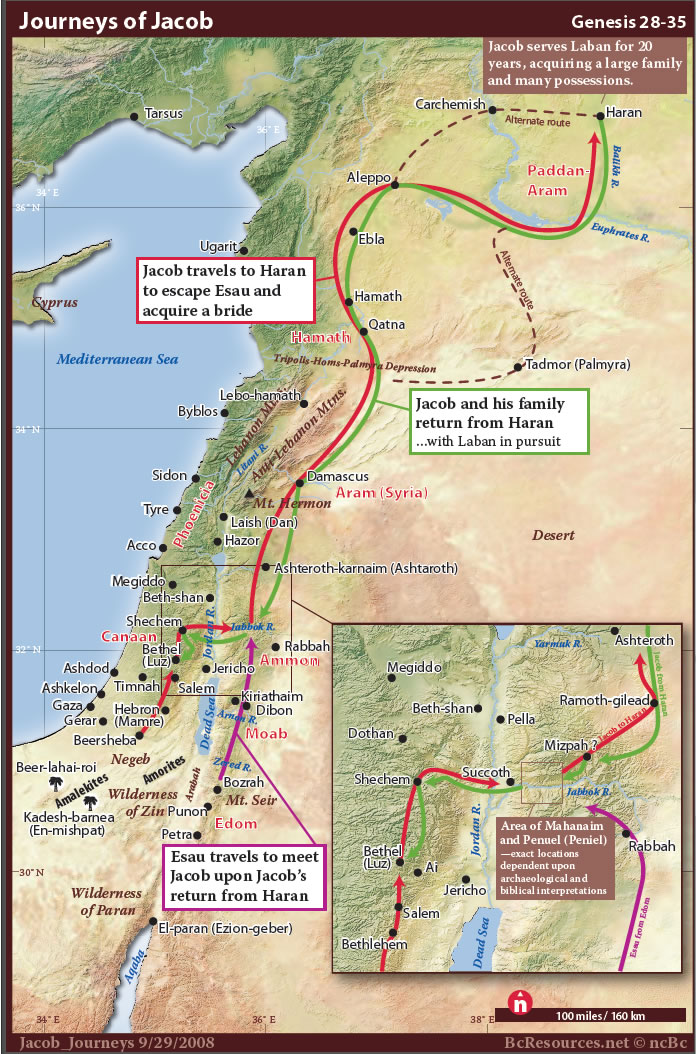
Some people have tried to argue that Jacob's encounter with God at Peniel totally transformed him, so that he became a completely new man, no longer fearful of his brother, no longer a deceiver, but a servant of God. However, the above passage suggests otherwise.
Jacob tells his brother that he will slowly make his way to him in Seir (i.e. Edom, in the South), but he instead goes the opposite way to Succoth, and then to Shechem. Now, even though this is where God wanted him to go, and ultimately to Bethel (cf. Genesis 35:1), this does not take away from the fact that he again deceived his brother. In Israel's ongoing history, Edom would be a perpetual thorn in its side. Perhaps one reason for this is the series of deceptions upon which the two brothers forged their strained relationship. And the reason for Israel's continual progress through biblical history is not because of the righteousness of the patriarchs, nor of the generations of people that would come by them, but simply and completely because of the sovereign choice, grace and power of God.
Unmi, in a previous comment on this reading, suggested that God had Jacob wrestle with him all night because He may have been trying to build into him perseverance and character. I would add to this that God would continue to build Jacob's character even beyond this encounter. One encounter with God, even a dramatic one, did not a new man make.
Perhaps this is a lesson for us as well. Certain people seem so eager for the next great experience. They think that by it they will grow closer to God. So they go to IHOP, they go to a Lakeland Revival, or they seek a Toronto-like blessing. It's almost like a drug addict seeking their next fix. But is this how we are called to mature in the Lord?
In fact, though by this time you ought to be teachers, you need someone to teach you the elementary truths of God’s word all over again. You need milk, not solid food! Anyone who lives on milk, being still an infant, is not acquainted with the teaching about righteousness. But solid food is for the mature, who by constant use have trained themselves to distinguish good from evil (Hebrews 5:12–14).
All Scripture is God-breathed and is useful for teaching, rebuking, correcting and training in righteousness, so that the man of God may be thoroughly equipped for every good work (2 Timothy 3:16–17).
We mature by learning and applying God's Word, not by seeking out "spiritual" experiences. If God supernaturally visits us, that is one thing, but we are never encouraged to seek out retreats, revivals, or similar type experiences. Even in Jacob's case, there is no indication that Jacob sought this "man" out. The visitation was spontaneous.
Instead, we are constantly encouraged to seek Him in His Word:
Let the word of Christ dwell in you richly as you teach and admonish one another with all wisdom, and as you sing psalms, hymns and spiritual songs with gratitude in your hearts to God (Colossians 3:16).
AI-Expanded Reflection
Jacob’s encounter at Peniel is decisive, but Genesis does not present it as the end of every ambiguity in his character. He receives a new name and a blessing, yet he also leaves with a limp. The scene combines divine favor with an enduring reminder of dependence. The original’s refusal to turn the event into an instant cure for every weakness is therefore valuable. A genuine encounter with God need not be measured by whether a person thereafter displays uninterrupted courage or perfect judgment.
The subsequent exchange with Esau raises a real question about Jacob’s intentions. He speaks of coming to Seir, but the narrative next places him at Succoth and then Shechem. This discrepancy makes the original’s reading of continued deception understandable. Still, the passage does not explicitly disclose all Jacob’s plans or state whether a later visit occurred. The strongest conclusion is that the narrative does not support a simple portrait of immediate, complete transformation. We should avoid making an uncertain reconstruction carry more weight than that.
The original also proposes that the brothers’ earlier deceptions may help explain later conflict between Israel and Edom. The family story certainly gives that conflict an ancestral dimension, but the later history should not be reduced to one cause. Biblical accounts also describe particular political decisions, refusals of help, and acts of violence. Recognizing a recurring pattern can illuminate the story without replacing attention to those later events.
Hebrews 5:12–14 provides a positive account of maturity: discernment is trained through practice. The difficulty addressed is not a shortage of extraordinary experiences but a failure to advance in understanding and use of God’s instruction. Second Timothy 3:16–17 likewise joins Scripture with teaching, correction, and equipment for good work. Maturity involves habits of reception and response that become embodied in judgment, conduct, and relationships.
This does not require condemning every retreat or gathering that offers concentrated time for prayer and teaching. Such occasions can serve the ordinary means of growth when their content and practices are sound. The problem is expecting intensity itself to accomplish what attentive obedience is meant to cultivate. A powerful weekend can encourage someone, but its fruit must be lived through patient conversations, restitution, resisting temptation, and serving people whose needs are less dramatic than the event.
Colossians 3:16 also keeps growth communal: the word dwells richly as believers teach, admonish, and sing together. Scripture-shaped maturity is not solitary information collection. It develops through a community willing to help one another practice what it confesses. Jacob’s unfinished story can therefore encourage both patience and responsibility. We need not deny the reality of God’s work when change is incomplete, and we must not use a remembered encounter as an excuse to resist the continuing work of correction.
On Friday, January 20, 2012 (Last Updated on 1/19/2022), Yujin wrote,
Did anyone else feel uncomfortable reading today's passage? In these chapters, the account of Jacob wrestling with God seems to completely eclipse the rape, deception, and mass murder that also occur. It's a little like how news is received today — the latest celebrity escapade can eclipse the suffering of tens of thousands in Haiti, or the hundreds being killed in Syria, not to mention serious crises within the United States.
Perhaps the comparison isn't quite fair. The contemporary example is genuinely frivolous, reflecting a popular addiction to gossip. In our reading, what eclipses the atrocity isn't a bizarre wrestling match but an encounter orchestrated by God to prepare Jacob to lead his family into the next phase of God's plan to bless the whole world. As horrible as the rape, the deception, and especially the mass murder were, we're reminded that Jacob is God's chosen, and that his twelve sons are God's elect as well. Jacob would become Israel, and the twelve sons the twelve tribes. Even at the very end, God's elect are not forgotten — their names will be recorded on the gates of the heavenly Jerusalem (Revelation 21:12).
We're only in Genesis, and I wonder whether anyone still doubts the profundity of God's election. In considering it we must remember that God's election doesn't speak to the goodness of the elect — quite the contrary. It speaks to the power of God's grace and the inviolability of His purposes.
AI-Expanded Reflection
The discomfort this comment names is worth honoring rather than resolving too quickly, and Genesis itself eventually supplies a verdict that the immediate narrative withholds. Jacob says nothing meaningful at the time — his recorded concern in chapter 34 is for his own standing among the neighboring peoples — but on his deathbed he returns to it and condemns Simeon and Levi explicitly, cursing their anger and its cruelty and declaring that he wants no part in it (Genesis 49:5–7). The judgment is delayed by fifteen chapters, but it is unambiguous when it arrives, and it falls on the two men the narrative had left unaddressed. That delay is characteristic of how Genesis handles moral evaluation: it reports, follows consequences, and renders its verdict where the story's own logic brings it, rather than pausing to editorialize. Readers who feel the silence of chapter 34 as a problem are reading it correctly — the silence is meant to be uncomfortable, and it does not turn out to be permanent.
The comment's understanding of election as unrelated to the merit of the elect is one this batch's own material supports strongly; Christians differ on the mechanism of election, but on this particular point the Reformed and non-Reformed traditions largely agree, and the chapter makes the case about as forcefully as any passage could.
On Wednesday, February 23, 2011, Unmi wrote,
It seems Jacob spends his whole life wrestling with someone. It begins in the womb, fighting with Esau, even grabbing his brother's heel during birth; continues through their conflict over birthright and blessing; and continues further still in his struggles with Laban over wives and unfair wages.
Now he wrestles with an unnamed man in the middle of the night — as dawn approaches, neither will give up the struggle, so the man touches Jacob's hip, crippling him. Experiencing this supernatural touch, Jacob realizes he isn't wrestling an ordinary man at all, but God Himself, declaring that he's seen God face to face, yet his life was spared (a paraphrase).
This is a remarkable claim — Jacob says it was God he wrestled with. Was this a spiritual fight in a dream, or a physical one? Jacob walks away limping, suggesting it was genuinely physical in some sense. Either way, Jacob's wrestling with God doesn't end that night — throughout the rest of Israel's national history, this same struggle with God continues.
What I find interesting is that the struggle could have ended at any moment during the night with a single touch, yet God allowed it to continue for hours. Why? We often find ourselves wrestling with God too, asking hard questions when He seems silent or unresponsive to our prayers. Is God allowing us to keep struggling as a way of building perseverance and character in us?
Whether our life is easy or a continuous struggle from beginning to end, we know that in all things God works for the good of those who love Him, who've been called according to His purpose (Romans 8:28).
Blessed be the name of the Lord, who knows what's good for us and helps us persevere through our struggles.
AI-Expanded Reflection
The timing of when God finally ends the struggle is worth noting alongside this comment's own question, since it isn't arbitrary — the text specifies it happens "as dawn was breaking" (Genesis 32:24, 26), right when Jacob would otherwise need to face Esau's approaching camp in the light of day. The all-night wrestling match isn't simply prolonged for its own sake; it runs for exactly as long as Jacob has left before he must face the very confrontation he's terrified of. Whatever character-building this comment suspects God was accomplishing through the extended struggle, it was compressed into precisely the window of time Jacob actually had available before needing it most.
On Thursday, January 20, 2011 (Last Updated on 1/20/2013), Yujin wrote,
One of our members asked: who is this man Jacob wrestles with? Jacob himself calls it "God," while Hosea 12:4 says he struggled with "the angel." Was this a spiritual or physical fight — and if physical, could this be the pre-incarnate Jesus?
My response: both the immediate context and Hosea 12:3–4 point to this being God incarnate, likely the pre-incarnate Lord Jesus Christ Himself. Remember, God had already appeared to Abraham in human form alongside two angels earlier in Genesis, and numerous Old Testament texts describe God as "the Angel of the LORD." Many persuasive arguments hold that every appearance of this Angel, every physical appearance of God on earth, refers specifically to the pre-incarnate Christ.
Hosea 12:3–4 presents two parallel statements — that in his strength, Jacob struggled with God, and that he struggled with "the Angel" and prevailed (a paraphrase). This is synonymous parallelism, where the second line restates the first in different words. Hosea 12:4–5 reinforces this further, describing Jacob weeping and seeking favor from this same figure, finding Him at Bethel, where He spoke — identifying Him directly as "the LORD God of Hosts," whose memorable name is simply "the LORD" (a paraphrase).
The Angel is God, the same "Man" Jacob wrestles with in Genesis 32:24. When God later tells Jacob he has wrestled with both God and man, the immediate reference is to this single figure, whom I understand to be the God-man, Jesus Christ. Jacob himself recognizes he's wrestled with God, and his resulting name change confirms it — "Israel" means "one who struggles with God." There's substantial evidence, then, that the One Jacob wrestled with was indeed God Himself.
Perhaps the more telling question is what this struggle actually meant — why was it significant in Jacob's life, and why did Moses include it in the history he wrote for the generation about to enter the Promised Land?
AI-Expanded Reflection
One answer to that closing question is worth adding, since it ties this episode directly to Jacob's entire life story: he's about to face Esau again for the first time in twenty years, terrified his brother is coming to kill him and his family (Genesis 32:6–11). The wrestling match happens the very night before that reunion. Read that way, Jacob's struggle with God isn't a random theological interlude dropped into the narrative — it's the immediate spiritual preparation for the hardest human confrontation of his life, leaving him limping, renamed, and humbled the morning he finally faces the brother he'd wronged decades earlier.