
On Friday, February 8, 2019, Yujin wrote,
Picture the tabernacle that Bezalel, Oholiab, and the other workers crafted for Israel's worship of the Lord. Its courtyard was roughly half the length of an American football field. Notice the movement of worship from east to west, from the most common (the outer courtyard) to the most holy (the Most Holy Place). Remember, only priests of Aaron's line could enter the Holy Place, and only the high priest could enter the Most Holy Place, once a year, on the Day of Atonement.
One of my former teachers, Elmer Towns, has written a helpful explanation of the tabernacle, which I summarize here. He begins with the meaning of "holy": at its most basic, it means "set apart" or "different." God is holy because He is utterly different from everything else — distinct from all so-called gods and completely separate from sin. He illustrates with the word "Bible," which simply means "book"; there are many books, but this one is called holy because it is set apart as the Word of God.
The Holy Place and the Most Holy Place, Towns explains, were set apart because God's presence was uniquely there. Since Israel was forbidden to make images of God, God gave them the tabernacle as a way to sense His presence among them, later replaced by the temple in Jerusalem.
The tabernacle had three areas: the outer court, where priests and Levites offered sacrifices; the Holy Place, entered only by priests; and the Most Holy Place. The Holy Place contained three pieces of furniture: the golden lampstand, kept burning continually; the table for the bread of the Presence, which only the priests could eat; and the altar of incense, burned morning and evening. Jesus identified Himself as the fulfillment of the first two, as the Light of the World (John 8:12) and the Bread of Life (John 6:35).
Behind the Holy Place was the Most Holy Place, containing the ark of the covenant with its mercy seat, regarded as the throne of God among His people. Only the high priest could enter, once a year, with blood, and with incense to veil his view, to atone for the sins of the people. Anyone else who entered would die.
The tabernacle and temple emphasized both God's presence among His people and His holiness, which made Him inaccessible because of their sin. When Jesus died, three Gospels report that the curtain separating the Holy Place from the Most Holy Place was torn in two (Matthew 27:51; Mark 15:38; Luke 23:45). The torn curtain signified that the way to God was now open to all through the death of Christ, as Hebrews explains: since we have confidence to enter the holy places by the blood of Jesus, by the new and living way He opened for us through the curtain, that is, His flesh, and since we have a great priest over the house of God, "let us draw near with a true heart in full assurance of faith" (a paraphrase of Hebrews 10:19–22).
AI-Expanded Reflection
Exodus 35–39 records the building of the tabernacle in great detail, repeating almost word for word the instructions of chapters 25–31. The repetition is deliberate: it shows that the people did exactly what God commanded. The section ends with the refrain, "According to all that the Lord had commanded Moses," so the people had done (39:42), and Moses blessed them (39:43). Then the glory of the Lord filled the tabernacle (40:34). The chapters also record something rare in Israel's history — generosity so abundant that the craftsmen had to ask Moses to stop the people from giving (36:5–7).
The comment's summary of the tabernacle's meaning lands where the New Testament does. John says the Word "became flesh and dwelt among us" — literally "tabernacled" among us — "and we have seen his glory" (John 1:14). Hebrews explains that the earthly tabernacle was "a copy and shadow of the heavenly things" (8:5), and that Christ entered "once for all into the holy places... by means of his own blood" (9:12). And Revelation ends with the tabernacle's fulfillment: "Behold, the dwelling place of God is with man. He will dwell with them" (21:3).
On Saturday, February 8, 2014, Yujin wrote,
"The people bring much more than enough" for the work the Lord commanded (Exodus 36:5).
I know this text is often the basis for sermons on generous giving, for that is what we see here in Israel's response to God's call to give, as each was willing, the materials to build the tabernacle.
What puzzles me is this: how could such a generous people also be labeled stiff-necked and rebellious? This very generous group would later grumble against the Lord about taking the land of Canaan, and God would punish them with forty years of wandering, during which everyone twenty years and older died. In the Psalms and in Hebrews God declares of them, "They shall not enter my rest" (cf. Psalm 95:11; Hebrews 3–4).
Friends, I think this reveals the unsteadiness and unreliability of our faith. I believe faith that springs from human free will may blossom for a moment and then shrivel at the first adversity. A great moment of generous giving can be overshadowed the next moment by widespread rebellion and unbelief.
So, friends, while we encourage one another to give generously to God's work, let us not be smug about our spiritual health because we gave. The important thing is not the giving but obeying God's command. It is not in giving, nor even in sacrifice, but in obedience.
What good is it to give to this or that cause without a command from God, while neglecting what God has clearly commanded? Do you think God will give you a break because you were charitable? He didn't give Israel a break at Kadesh-barnea. King Saul did not understand that God desires obedience over sacrifice, and he lost God's favor and the kingdom.
In the late Middle Ages, the sale of indulgences led many people to believe they could buy God's pardon by giving money to the church. It was one of the most corrupt practices of the time and helped prompt the Reformation.
Today, people are sometimes pressed to give to this project or that ministry with the promise of God's blessing in return. Yet these things are neither commanded by God, nor is there a biblical basis for the promised blessing. They are simply things churches and their leaders want to do — admittedly for God, but not by His direct command. There may be nothing wrong with them, but let us be careful when we say things like "God commands us to..." or "If you want to be a part of what God is doing, then..."
We must make a clear distinction between what God has commanded and what we desire for ourselves. The important thing is obeying God in His Word.
AI-Expanded Reflection
The comment raises a real puzzle: the same generation that gave so freely for the tabernacle rebelled so quickly afterward. Scripture seems to present this not as a contradiction but as a portrait of the human heart. The people who gave generously in Exodus 35–36 had, only chapters earlier, given their gold just as eagerly for the golden calf (32:2–4). Generosity and devotion can be directed toward God or away from Him with the same enthusiasm. Samuel's words to Saul capture the principle the comment draws: "to obey is better than sacrifice" (1 Samuel 15:22).
At the same time, the Exodus narrative clearly honors the giving itself. The text lingers on the "willing heart" and the skilled men and women who contributed (35:21–29), and Bezalel and Oholiab are described as "filled with the Spirit of God" for the work (35:31). Giving did not earn God's favor, but it was a genuine act of worship when offered from willing hearts. The comment's caution against manipulative fundraising — promising blessing in exchange for gifts — is shared by Christians across traditions, who agree with Paul that giving should be "not reluctantly or under compulsion" (2 Corinthians 9:7).
On Friday, February 8, 2013, Yujin wrote,
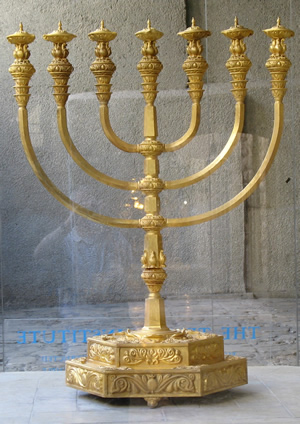
Sometimes visuals help in reading through the details in passages like this. The Jewish lampstand is called a menorah. Here is the text followed by a picture of a possible replica of the ancient menorah by the Temple Institute (www.templeinstitute.org), as well as a picture of an almond blossom, which was to be the mold for much of its design. You can judge whether they did a good job on the replica or not.
Then he made the lampstand of pure gold. He made the lampstand of hammered work, its base and its shaft; its cups, its bulbs and its flowers were of one piece with it. There were six branches going out of its sides; three branches of the lampstand from the one side of it and three branches of the lampstand from the other side of it; three cups shaped like almond blossoms, a bulb and a flower in one branch, and three cups shaped like almond blossoms, a bulb and a flower in the other branch—so for the six branches going out of the lampstand. In the lampstand there were four cups shaped like almond blossoms, its bulbs and its flowers; and a bulb was under the first pair of branches coming out of it, and a bulb under the second pair of branches coming out of it, and a bulb under the third pair of branches coming out of it, for the six branches coming out of the lampstand. Their bulbs and their branches were of one piece with it; the whole of it was a single hammered work of pure gold. He made its seven lamps with its snuffers and its trays of pure gold. He made it and all its utensils from a talent of pure gold (Exodus 37:17–24).
Almond Blossom
Menorah (Reconstruction from Temple Institute)

I tried to find a good replica of the Ark of the Covenant online, but I surprisingly could not find one (through Google search) that accurately followed the description given for the ark. Some forgot to make the poles overlaid with gold. Others forgot the rings or put them at the top or the middle rather than at the foot of the ark. Others simply had only the wings of the cherubim, even though the text clearly says that their faces were toward each other and the mercy seat. Some forgot the mercy seat altogether and others made it as a circle, even though the text clearly describes rectangular dimensions. It is amazing that people would spend hundreds and thousands of dollars, not to mention all kinds of time, to build a replica that would not exactly follow the biblical description. What is more, to the faithful, how could people be so careless when the Scriptures clearly show how God treated all these matters with exacting precision, sometimes on pain of rejection or death.
This causes me to reflect on the condition of our personal testimonies. What attention do we give to the priorities of God in our lives, for our families, in our work? Are we carefree about it? Are God's interests overshadowed by our own? Rather than spiritual and moral precision in keeping with God's Word, would our efforts at holiness and obedience be described as approximate, in the ballpark, or perhaps even on the sidelines?
AI-Expanded Reflection
The description of the lampstand invites visual attention. Its branching form, almond-blossom cups, and unified construction communicate careful design rather than a merely functional source of light. The original’s comparison with an almond blossom can help a reader notice details that a hurried reading would miss. A reconstruction can serve the same purpose by making questions of arrangement and proportion easier to consider.
It remains important to distinguish a modern reconstruction from direct evidence of the original object’s exact appearance. Exodus supplies significant details, but an artist must make decisions where the text does not specify every contour, angle, or decorative form. The images retained with the original should therefore be read as aids to imagination, not as photographs of the wilderness lampstand. A useful question is which features follow directly from the text and which reflect the maker’s interpretation.
The same distinction applies to the ark. Some features are explicit: the dimensions, gold overlay, rings, poles, cover, and cherubim. Omitting a stated feature can make a model less faithful to the description. Other details, however, require interpretive judgment, including how particular terms and spatial relationships are rendered visually. An online replica that differs from another model is not automatically evidence of contempt for Scripture. We should first determine whether the disagreement concerns an explicit instruction or an unresolved reconstruction choice.
The original’s moral application draws on the care God required in Israel’s sanctuary service. That care can indeed challenge casualness about obedience. Yet a modern educational model is not the consecrated ark, and the penalties attached to handling the holy object should not be transferred directly to an artist whose model is imperfect. Reverence includes accurate distinctions as well as earnestness. Otherwise, a useful visual exercise can become an occasion for judgments the passage does not authorize.
The sanctuary’s larger purpose also gives the details their theological setting. Exodus 25:8 connects its construction with God dwelling among his people. The craftsmanship serves that gracious presence. The beauty of the lampstand therefore belongs to a story of redeemed people receiving a place of ordered worship, not merely to a demand for technical perfection. Attention to detail can express love because the work is directed toward a relationship God has initiated.
For personal application, the question about priorities is best made concrete. Are there clear responsibilities we neglect while concentrating on less important religious appearances? Do we take care with our speech, promises, treatment of family, and use of entrusted resources? Such attention is more fruitful than attempting to achieve an anxious precision in every uncertain matter. Visual study can train patient observation, and patient observation can support obedience. The goal is a faithful response to what God has actually made known, with humility about what remains an inference.
On Friday, February 10, 2012 (Last Updated on 2/8/2013), Misty wrote,
Bezalel of the tribe of Judah made all that the Lord commanded Moses, and with him was Oholiab of the tribe of Dan, an engraver and designer, a weaver of blue, purple, and scarlet thread and of fine linen (a reference to Exodus 38:22–23).
So Oholiab and Bezalel are the artisans God chose and gifted for building the tabernacle, and together they made the Lord a beautiful dwelling place. The Lord planted wisdom and understanding in each for their respective work. I notice that the people had to have their hearts stirred to come and do the work. The tabernacle, then, is the gift of the Hebrew people to God. In fact they brought so much that those building had to tell them to stop. Can you imagine how this pleased God? He gave them the desire to build a place for Him, and then watched them enthusiastically bring more than was needed. He wanted their tabernacle to be a gift.
AI-Expanded Reflection
The detail about having to tell people to stop giving is worth keeping, because it is genuinely rare. Exodus 36:6–7 records Moses issuing a proclamation restraining the people from bringing more, since what they had was more than enough. Scripture contains a great many appeals for generosity and very few instances of anyone being asked to stop.
The tribal note adds something too. Bezalel is from Judah and Oholiab from Dan — the tribe that would become the royal line and one of the smaller tribes, working together, with the text naming Oholiab's skills in detail rather than treating him as an assistant. The construction account is careful about giving both men credit, which is a small thing but consistent with how the chapter handles the whole project: the work belongs to the community that brought it.
On Tuesday, February 22, 2011, Unmi wrote,
The people continue bringing freewill offerings morning after morning, until the craftsmen tell Moses the people are bringing more than enough to complete the LORD's commanded work. Moses then orders that no one bring any more offerings for the sanctuary — the people are actually restrained from giving further, since what they already had was already more than sufficient (a paraphrase of Exodus 36:3–7).
Exodus 38:24–25 records the total gold used for the sanctuary's work at 29 talents and 730 shekels (roughly a ton of gold, worth around $43 million at today's prices), and the silver at 100 talents and 1,775 shekels (roughly 3.4 tons plus 44 pounds, worth around $3.1 million at today's silver prices).
Wow — the golden calf they'd made earlier was only the tip of the iceberg. Where did all this gold and silver even come from? Exodus 12:35–36 tells us Israel, following Moses's instructions, asked the Egyptians for silver, gold, and clothing as they left — the LORD having made the Egyptians favorably disposed toward them, so they gave freely what was asked, effectively plundering Egypt on their way out (a paraphrase) — "plundered" honestly feels like an understatement given the sheer amount described here.
The sheer quantity Israel possessed is remarkable enough — but what's even more remarkable is their willingness to offer that much, and more, toward building God's sanctuary. Their offering wasn't only material either — it included their skills, with every person whose heart moved them, and who possessed skill the LORD had given, willingly coming to do the work (a paraphrase of Exodus 36:2). This willingness to offer both our abilities and our material resources is itself a test of where our heart actually is, since the LORD looks at the heart of those who serve and give (cf. 2 Corinthians 9:7, that each of us should give what we've decided in our heart, not reluctantly or under compulsion, since God loves a cheerful giver).
What a witness we'd be to the world if our own churches gave and served so abundantly that leadership actually had to restrain us! Is that really so impossible? It's nice to imagine and hope for — though dwelling on it too much can lead down a dangerous road of quietly accusing others of not doing enough, which can become its own stumbling block. Yes, we should encourage each other toward good — but each of us stands individually before God's throne on the day of judgment. Let's examine our own hearts instead of watching what others aren't doing.
AI-Expanded Reflection
One small correction: the "cheerful giver" verse is 2 Corinthians 9:7, not 1 Corinthians 9:7 (which addresses a different topic — an apostle's right to material support from those he serves). Beyond that correction, the specific dollar figures this comment calculates are a genuinely useful way to make an ancient text land with real weight for a modern reader — a wandering, formerly enslaved people voluntarily overshooting a multimillion-dollar building fund so significantly that leaders had to tell them to stop giving isn't an abstract ancient anecdote once it's translated into contemporary terms; it becomes a genuinely startling data point about what generosity, fully released from any sense of compulsion, can actually look like in practice.
On Tuesday, February 8, 2011 (Last Updated on 2/8/2014), Yujin wrote,
Friends, we're about a month into our daily Bible reading now. Some of you may have already let this reading go the way of other New Year's resolutions — if so, treat today, February 8, as a fresh January 1st, and resolve again to persevere. Some things are worth continuing no matter how often we fail at them.
I know several of you are part of an active email-sharing group. I've found nothing more helpful for growing in the discipline and understanding of God's Word than sharing regularly with others. If you don't yet have a community like that, I'd encourage you to form one — I pray all of you find your way into one or more such groups. The early church met daily to hear God's Word and encourage each other to live it out (cf. Acts 2:46) — quite different from our current tradition of a single weekly Sunday service, though we can recapture something of that early church heartbeat through daily reading and sharing today.
A small observation on the man named Bezalel from today's reading (Exodus 36:1). His name reappears in 2 Chronicles 1:5, referencing the altar he built for the Tabernacle — by that point, many centuries later, Solomon has just succeeded David as king, and worships God at that very altar Bezalel once built. There, God meets Solomon and grants him wisdom, along with wealth, riches, and honor. The historical progression of biblical history fascinates me precisely because it's never merely history — it's God's own sovereign hand connecting people and events together to fulfill His covenant promises and accomplish His glorious purposes. We too are part of that same connected history, still marching forward toward its culmination in our Lord Jesus Christ's return.
AI-Expanded Reflection
Bezalel's own introduction is worth adding, since it explains why his craftsmanship endured well enough to still be standing generations later — he's specifically described as filled with God's Spirit, given wisdom, understanding, and knowledge in every kind of craft (a paraphrase of Exodus 31:3–5), making him, remarkably, the first person in Scripture explicitly said to be filled with the Holy Spirit for a specific task. That detail adds real weight to this comment's own observation about connected history — the altar Solomon later worships at wasn't simply well-built furniture surviving by chance; it was, according to the text's own account, Spirit-empowered craftsmanship from the very beginning.