
On Monday, March 24, 2014, Yujin wrote,
When Israel grew strong, "they put the Canaanites to forced labor, but did not utterly drive them out" (Joshua 17:13).
The Lord commanded Israel to drive the Canaanites out of the land completely. Here and on many other occasions we are told that they did not obey the Lord in this. Instead of driving them out, they made the Canaanites their forced laborers. As Israel's history would show, this failure to obey the Lord led to the consequences God had predicted: Israel was corrupted by the immoral and idolatrous influence of the Canaanites.
Friends, I reflected on this today and asked what lessons there might be for us. While the Old Testament demanded the complete removal of the Canaanites because of their immoral and idolatrous influence, the New Testament commands believers to flee immorality and idolatry: "Flee from sexual immorality" (1 Corinthians 6:18), and "flee from idolatry" (1 Corinthians 10:14).
Israel got into trouble because they did not fully obey the Lord's command. They allowed the Canaanites to remain in the land, and the Canaanites became a strong influence turning Israel away from the Lord.
Do we fully obey the Lord? Do we flee immorality and idolatry, or do we allow these influences to remain? You may wonder, "How do we allow these influences to remain?"
Movies, television, the internet, social media, bars, clubs, office parties, immoral friends and associates, and so on. Have we drawn clear lines of obedience so that we are not influenced by these things into immorality, idolatry, and other sins?
Streaming services can become stumbling blocks to holiness and purity, for our eyes are a gateway to our hearts, and we are not immune to the influence of what we watch. I have unsubscribed from these services and deleted their apps, and I recommend that my friends consider doing likewise.
For me, this is part of what it means to flee from immorality and idolatry. There are many other things we can do to obey the Lord fully in this regard, but each of us must assess and act for ourselves.
AI-Expanded Reflection
Joshua 17:13 is part of a recurring refrain in Joshua and Judges. The book of Joshua records sweeping victories, but it also notes, tribe by tribe, the places where the inhabitants were not driven out (13:13; 15:63; 16:10; 17:12–13). Judges 1 continues the list, and Judges 2:1–3 records the consequence: the Canaanites would become "thorns in your sides," and their gods "a snare to you." The detail that Israel put them to forced labor "when they grew strong" is telling — the failure was not weakness but compromise. Israel chose economic advantage over obedience.
The comment's application to entertainment and influences is a personal conviction offered with humility — "each of us must assess and act for ourselves" — which fits Paul's approach to matters of conscience (Romans 14:5, 22). Many believers draw these lines differently, some abstaining as the comment does and others choosing carefully what they watch. The principle underneath is one all share, and Paul states it positively: whatever is true, honorable, just, and pure, "think about these things" (Philippians 4:8). Fleeing sin is always paired with pursuing something better (2 Timothy 2:22).
On Sunday, March 24, 2013, Yujin wrote,
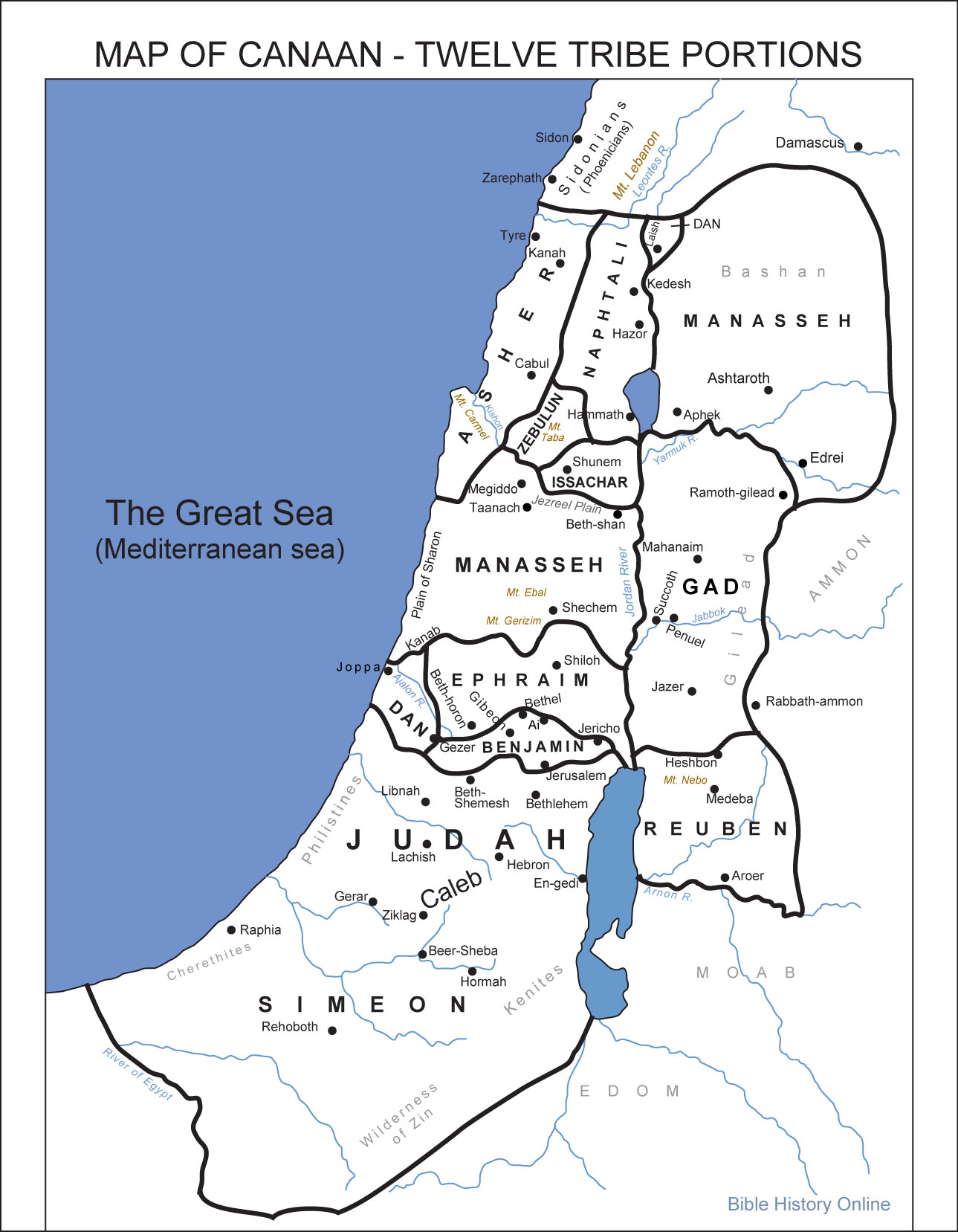
Some of the descriptions for the division of the land may be a little difficult to follow. I encourage you to use this map as a guide, so that you might have a better sense of how the land was divided.
AI-Expanded Reflection
A map can turn a difficult succession of place names into a more intelligible account. Joshua's allotment chapters describe boundaries, towns, and neighboring territories that ancient hearers could connect with actual locations. Modern readers often lack that familiarity. The supplied illustration offers a starting point for seeing the relative positions of the tribes, while the biblical text remains the authority for what each passage describes.
The central theological feature is that the land is received as an inheritance. The repeated attention to allotments makes God's promise concrete. Israel's life is not imagined only in general terms of blessing; families and tribes require places to live, cultivate, and pass on to the next generation. The details remind us that divine faithfulness can be expressed through ordinary arrangements whose importance becomes apparent when a community must inhabit them.
Joshua 16–18 also refuses a simple equation between an assigned territory and a completed possession. Ephraim does not drive out the Canaanites in Gezer, and Manasseh has difficulty with towns in its allotment. The descendants of Joseph ask for more space, while Joshua directs them to develop and possess what lies before them. In chapter 18, remaining tribes are challenged about delaying the occupation of their inheritance. Gift does not abolish responsibility, and the narrative distinguishes what has been allotted from what has actually been brought under Israel's control.
This distinction helps explain why different biblical maps may represent different things. One may show ideal tribal boundaries, another major settlements, and another a later political situation. Ancient place identifications and some boundary lines are also uncertain. A modern illustration should therefore be used as a guide rather than treated as a photograph of a single, precisely fixed moment. The original map is preserved here for its intended educational use, not as a claim that every line has been independently confirmed.
The chapters also locate the sanctuary at Shiloh and describe the casting of lots before the Lord. Distribution is presented within worship and communal order, not merely as the outcome of tribal bargaining. The whole community must make room for each part. This can encourage Christian readers to notice how practical organization serves shared life, while remembering that the church has not inherited Israel's territorial commission.
A fruitful reading practice is to trace one tribe at a time, identify the neighboring regions, and then ask what the narrative says about promise, incomplete obedience, or provision. Even a few clear relationships can make the names easier to retain. The goal is not mastery of every ancient location before the passage can be useful. It is to see that God's dealings with his people occurred within real communities, responsibilities, and places, and that their response to his gifts mattered in those concrete settings.
On Thursday, March 24, 2011, Stephen wrote,
Israel failed to dislodge the Canaanites from Gezer, so to this day the Canaanites live among Ephraim's people, subjected to forced labor (a paraphrase of Joshua 16:10). Similarly, the Manassites couldn't occupy certain towns because the Canaanites were determined to stay — even once Israel grew strong enough to subject them to forced labor, they never drove them out completely (a paraphrase of Joshua 17:12–13).
We all know Israel failed to fully dislodge the Canaanites from the Promised Land, and they became a perpetual problem until eventually removed from the land entirely, exactly as God warned. We discussed this last night in class — Israel disobeyed by mixing the Canaanites' evil practices with the Law they were meant to follow, rather than turning away from them completely. Obedience is all or nothing — there's no such thing as partial devotion. Let's examine ourselves today for any compromise in our own faith, and give everything we are to the Lord.
The people of Joseph also complain to Joshua that they've received only one allotment despite being a numerous, blessed people. Joshua tells them that if the hill country of Ephraim is too small, they should clear forest land among the Perizzites and Rephaites instead. They reply that even the hill country isn't enough, and that the Canaanites in the plain have iron chariots. Joshua answers that since they're numerous and powerful, they'll have both the hill country and the forest — clearing it themselves, driving out the Canaanites despite their iron chariots (a paraphrase of Joshua 17:14–18).
Even though the Promised Land had already been given to Israel as an inheritance, we see them struggling to actually obtain it — first scared by their enemies' size, now by their weapons. God still demanded they take a step of faith to claim what was already theirs. What about us, regarding the promise of salvation? Even though it's already given to us, and nothing, not even ourselves, can take it away, God still tells us to work out our salvation with fear and trembling, as though we might lose it. Hypothetically we could lose it, but it will never actually happen, since it's guaranteed not by our own performance but by the very Author of our salvation. This is our strength to walk in faith — not a reason for a sense of elitism, as some might wrongly claim. Who would say, "why did you rescue only me, not others," after being pulled from a raging torrent by their rescuer? Would he boast about being chosen to be saved, or feel overwhelmingly grateful instead? Let's praise Him again today for our salvation.
AI-Expanded Reflection
The pattern this comment identifies — Israel possessing a promise yet still needing to actively claim it through real effort — is worth naming as a recurring theological tension running through the whole conquest narrative, not a contradiction to resolve. The land was genuinely theirs by promise, and it genuinely required their own hard-fought effort to occupy; Scripture doesn't seem bothered by holding both truths together. That's precisely the parallel this comment draws to salvation itself: a secure, unearned gift that still calls for genuine, active engagement from the person who's received it, without either side of that tension canceling out the other.
On Thursday, March 24, 2011, Unmi wrote,
The significance of the city of Shechem
Joshua 17:7 places Shechem on the border between Ephraim and Manasseh, Joseph's two sons. Genesis had already promised that Joseph's descendants would inherit Shechem — Jacob, near death, tells Joseph he's giving him one extra ridge of land beyond his brothers, the one he took from the Amorites by his own sword and bow (a paraphrase of Genesis 48:21–22), referring to the very city Simeon and Levi had taken by killing all the Shechemites after tricking them into circumcision. Before his own death, Joseph similarly makes the Israelites swear to carry his bones up out of Egypt when God eventually brings them to the land promised to Abraham, Isaac, and Jacob (a paraphrase of Genesis 50:24–25). Both promises are fulfilled — Joshua 24:32 records Joseph's bones finally buried at Shechem, on the very plot Jacob had purchased there, becoming his descendants' own inheritance (a paraphrase).
Shechem wasn't significant only for Joseph, or for Dinah (Genesis 34) — it was the first Canaanite city Abraham reached after leaving his homeland, where the LORD first promised him the land, and where Abraham built his very first altar in Canaan (a paraphrase of Genesis 12:6–7). Jacob later arrived there too, after leaving Paddan Aram, purchasing land and building his own altar, calling it "God, the God of Israel" (a paraphrase of Genesis 33:18–20). This is believed to be the location of Jacob's famous well — the same well where Jesus later speaks with the Samaritan woman, near the town of Sychar (Shechem), close to the plot of land Jacob had given Joseph (a paraphrase of John 4:4–6). After discussing "living water" and her own life, she tells Jesus she can see He's a prophet, since her ancestors worshiped on "this mountain," while Jews claimed Jerusalem was the proper place (a paraphrase of John 4:19–20) — referring to Mount Gerizim, the mountain of blessing named in Deuteronomy 27, where Moses instructed six tribes to stand and pronounce blessing, and six others to stand on Mount Ebal and pronounce curses (a paraphrase of Deuteronomy 27:12–13). Shechem sits in the valley between these two mountains. After destroying Jericho and Ai, Joshua followed Moses's instructions, built an altar there, and renewed the covenant (Joshua 8:30–35); later, after completing Canaan's conquest, he brings all Israel back to Shechem once more, for one final covenant renewal before releasing the tribes to their allotted lands (Joshua 24).
After the land's allotment, Shechem is given to the Levites and becomes a city of refuge. Unfortunately, it's also at Shechem that Israel later divides into two kingdoms (1 Kings 12) — Shechem, in the Northern Kingdom, becomes that kingdom's religious center, with the Samaritans eventually believing Mount Gerizim to be the holiest place in the land and building their own temple there. It's against exactly this backdrop that Jesus tells the Samaritan woman that a time is coming, and has now arrived, when true worshipers will worship the Father neither on that mountain nor in Jerusalem, but in spirit and truth, since that's the kind of worshiper the Father actually seeks (a paraphrase of John 4:21–24).
No matter how much historical or religious significance Shechem or even Jerusalem carries, Jesus tells us the place of worship was never what mattered — it's the heart of worship, and not merely sincerity or zeal, but worship in truth specifically, that leads to salvation.
AI-Expanded Reflection
The layered history this comment traces — Abraham's first altar, Jacob's well, the blessing-and-curse ceremony, the kingdom's later division, and finally Jesus's own conversation there — makes Shechem one of the most consistently significant locations across the entire Bible's timeline, spanning roughly two thousand years of continuous theological weight attached to a single place. That density of meaning may be exactly why Jesus chooses this specific location, of all places, to make His most explicit statement about worship no longer being tied to any location at all — the announcement that place doesn't matter lands with particular force precisely because it's delivered at the one place that had mattered more, and longer, than almost anywhere else in Israel's story.